Walden AGACNP preceptor and placement: 640 acute-care hours
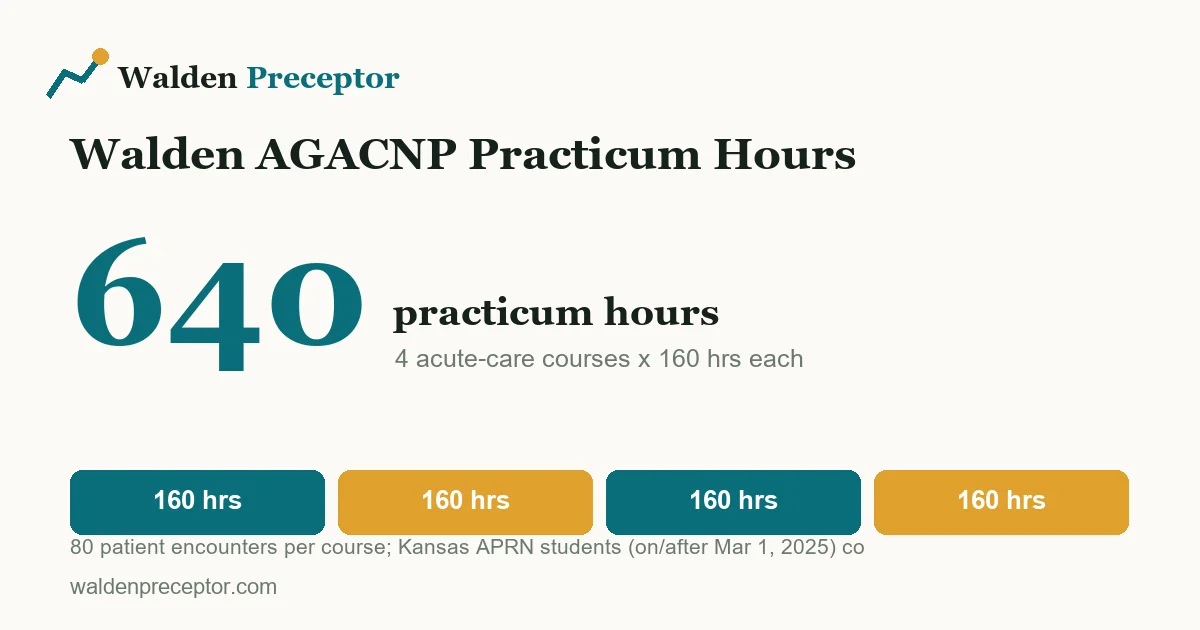
The Walden Adult-Gerontology Acute Care NP track runs on 640 practicum hours spread across four acute-care courses, 160 hours each, in high-acuity inpatient settings. You must secure your own acute-care preceptor and site, then nominate them in Meditrek for approval before the course begins. This page walks through the hours, the courses, who can precept, which sites count, and how we get you matched.
Last updated: June 22, 2026 · Reviewed by the Walden Preceptor placement team
Start your placement, free
Tell us your program. We map the whole practicum. No payment until you are matched.
The hour requirement at a glance
Every AGACNP specialization course pairs didactic content with a practicum block. Across the four practicum courses you log 640 hours total, with 160 hours in each course, plus 80 patient encounters per course. There is a state exception: students pursuing APRN licensure in Kansas who started on or after March 1, 2025 complete 750 hours, which works out to roughly 188 hours per course (Walden Nursing Practicum Manual).
Total practicum hours
Acute-care courses, 160 hrs each
Patient encounters per course
Catalog numbering shifts by entry year, so confirm the exact hour count and course list on your personal program-of-study page before you plan.
The four AGACNP practicum courses
The acute-care sequence builds from older-adult care into progressively higher acuity. Each course carries a didactic prefix (NRNP or DRNP) paired with a practicum prefix (PRAC or PRCM) at the same 6xxx number.
| Course number | Focus | Practicum |
|---|---|---|
| 6540 | Advanced Practice Care of Older Adults | 160 hrs / 80 patients |
| 6566 | Advanced Care of Adults in Acute Settings I | 160 hrs / 80 patients |
| 6550 | Advanced Care of Adults in Acute Settings II | 160 hrs / 80 patients |
| 6560 | Advanced Care of Adults in Acute Settings III | 160 hrs / 80 patients |
Numbers reflect the current AGACNP layout in Walden's field-experience guides; your actual codes appear in your course shell and Meditrek (Walden field experience, 6566 AGACNP).
Who can precept an acute-care student
The acute-care courses are stricter about preceptor specialty than primary-care tracks, because your encounters have to happen in genuinely high-acuity settings. Walden accepts a preceptor who holds a graduate degree, carries active licensure in the specialty, and has at least one year of post-graduate independent practice. Acceptable credentials for AGACNP include:
- ACNP or AGACNP (acute-care nurse practitioner)
- AGNP, ANP, or ENP working in an acute or emergency setting
- An intensivist or hospitalist
- An MD or DO practicing in the acute-care environment
- A physician assistant, where the state board permits it
A preceptor cannot supervise another student at the same time as you, and cannot have a conflict of interest (a relative, a direct supervisor outside the practicum, or anyone you report to). These details are verified during Meditrek approval (Walden, find a preceptor).
Which clinical sites count, and which do not
This is where AGACNP students get tripped up. The acute-care courses require high-acuity inpatient experience, so primary-care and outpatient placements do not satisfy them, even if the preceptor is excellent.
Sites that count
- Acute care hospital units
- Critical care and ICU
- Emergency departments
- Inpatient specialty rotations (cardiology, trauma, and similar)
Sites that do not
- Outpatient and primary care clinics
- Operating rooms
- Palliative care units
- Any setting without acute or critical inpatient volume
The exception is the older-adult course (6540), which is broader by design. The three acute-settings courses (6566, 6550, 6560) all need the high-acuity inpatient environment.
How approval works in Meditrek
Walden runs placement approvals through Meditrek. The flow looks like this:
Walden's Office of Field Experience supports the process with checklists, coaching calls, and the affiliation-agreement database. For most students Walden does not assign the preceptor; you find your own. Its Practicum Pledge can step in as a backstop, but only after you document a qualifying failed search. A handful of sites require Walden to finalize the placement directly, in which case you schedule a coaching call to begin (Walden, course success).
Compliance and timing
Before clinical contact you clear compliance through CastleBranch (myCB): background check, drug screen, immunizations, and required trainings. Requirements are state-specific, and Walden does not accept an outside background check, so start this early.
Pacing rules apply across the practicum. You can log a maximum of 12 hours in a day, your hours must spread over at least eight weeks, and you complete the course by the end of Week 10 (Week 11 for Tempo, though note the NP tracks are course-based, not Tempo). With 160 hours and 80 encounters per course, mapping a realistic weekly schedule against your shift availability matters from day one.
How many practicum hours does the Walden AGACNP program require?
640 hours across four courses, 160 each, plus 80 patient encounters per course. Kansas APRN students who started on or after March 1, 2025 complete 750 hours, about 188 per course. Confirm your own count on your program-of-study page.
Who is allowed to precept Walden AGACNP students?
An ACNP, AGACNP, AGNP, ANP, ENP, intensivist, hospitalist, MD, or DO in an acute-care setting. A physician assistant may qualify depending on the state board. The preceptor needs a graduate degree, active specialty licensure, and at least one year of independent post-graduate practice.
What clinical sites count for the AGACNP practicum?
Acute and high-acuity inpatient settings: hospital units, critical care or ICU, emergency departments, and inpatient specialty rotations. Outpatient clinics, primary care, operating rooms, and palliative care units do not count for the acute-care courses.
Does Walden find my AGACNP preceptor for me?
Usually no. You secure your own preceptor and site, then nominate them in Meditrek for approval before the course starts. Walden supports with checklists, coaching, and the affiliation-agreement database, and finalizes placements directly only for sites that require it.
How many patient encounters do I log per AGACNP course?
80 patient encounters per course, alongside the 160 hours. You record time and patient logs in Meditrek and your preceptor signs off.
Sources
- Walden Nursing Practicum Manual, NP program and practicum requirements (MSN)
- Walden Nursing Field Experience, 6566 AGACNP (acute settings)
- Walden Nursing Field Experience, find a preceptor
- Walden Nursing Field Experience, course success
- Walden Nursing Field Experience, CastleBranch onboarding
Acute-care placements are hard to find. We do the finding.
High-acuity inpatient sites with an ACNP or hospitalist preceptor are the scarcest placements in the program. We source the site, confirm it clears the course requirements, and help you through the Meditrek nomination and affiliation agreement. We match you within 5 days, and you pay nothing until you are matched. More than 3,200 nurses supported.
Get matched for your AGACNP practicum