What does an NP preceptor cost in 2026?
Most nurse practitioner students who pay for a clinical placement spend roughly $12 to $18 per clinical hour, which lands at about $1,500 to $2,000 for a single 120 to 160 hour rotation. Some national services price it as a flat package instead, around $1,995 for a rotation of up to 250 hours. This page is the honest market breakdown, not a sales pitch: where those numbers come from, what moves them up or down, and what a fair fee should actually include before you pay anyone.
Last updated: July 11, 2026 · Reviewed by Talia Brooks, DNP, PMHNP-BC, Senior Practicum Advisor
Start your placement, free
Tell us your program. We map the whole practicum. No payment until you are matched.
What does a Walden preceptor placement service cost?
A Walden preceptor placement service runs about $12 to $18 per clinical hour, or $1,500 to $2,000 for a full 120 to 160 hour rotation, in line with national preceptor matching services. There are three common ways a preceptor or placement service prices the same thing, and the confusion students run into is that two quotes can describe an identical rotation in totally different units. Here is the 2026 market, with the source for each figure, expressed in all three units so you can compare apples to apples.
| How it is priced | Typical 2026 range | What it usually covers |
|---|---|---|
| Per clinical hour | About $12 to $18 per hour | One rotation; some services bill purely by the hour |
| Per rotation | About $1,500 to $2,000 | A single 120 to 160 hour clinical, the most common quote |
| Flat package | Around $1,995 for up to 250 hours | A bundled all-in fee, extra hours sold in blocks |
Published rates back each row. One large national matching service lists rotations starting at $12.75 per clinical hour, with a stated minimum of $1,000 plus service fees, and notes that the per-hour figure is a starting point that climbs with specialty, location, and the preceptor's experience (NPHub pricing). Another service advertises a flat $1,995 for a full rotation of up to 250 hours, all-inclusive of the preceptor's honorarium, the matching service, school paperwork support, and a money-back guarantee, with additional hours sold at $1,000 per 100-hour block. Industry write-ups put the broad student experience at roughly $12.50 to $17.50 per hour of supervision for a 125 to 160 hour rotation, or about $1,500 to $2,000 total.
So the headline answer is stable across sources: a single NP rotation typically costs in the low four figures, and the per-hour math sits in the mid-teens. The spread inside those ranges is not random. It is driven by four specific things, covered next.
What drives the price up or down?
Two students at the same school can get quotes hundreds of dollars apart for the same number of hours. These are the four levers that explain almost all of that gap.
Specialty
This is the biggest single factor. Psychiatric-mental health (PMHNP) and women's health rotations are the most competitive, because qualified preceptors in those fields are the scarcest, so they sit at the top of every range and sometimes above it. Primary care rotations, such as those in many family and adult-gerontology courses, tend to sit lower because the preceptor pool is larger (NPHub specialty cost guide).
Location
Dense, competitive metro areas push rates up because more students are chasing the same clinics. A rotation in a saturated city market can cost more than the identical rotation in a rural or lower-competition area, where a provider may take a student for a smaller honorarium or none at all.
Hour count
Price scales with hours, which is why your course matters. A Walden NP practicum course is 160 hours, so a per-hour rate and a per-course quote are two views of the same rotation. A package priced for 250 hours is covering more than one Walden course, so always normalize to your real course hours before you compare two prices.
Urgency and add-on fees
Rush placements cost more. Services commonly add a deposit to hold a match, a percentage service fee on the transaction, and a surcharge for urgent or last-minute requests. One service publishes a 15 percent deposit, a 5 percent service fee, and a 20 percent rush fee on top of the hourly rate (NPHub pricing). Read for these before you assume the advertised hourly number is the final price.
What should a fair NP preceptor fee include?
Price means nothing without scope. A $1,500 fee that ends at an email introduction is expensive; a $1,995 fee that carries the entire placement through approval can be a bargain. A complete placement, the kind worth paying for, should include all of the following. If a quote is missing items from this list, it should cost less than one that is not.
- A license-matched preceptor for your exact specialty, not a generic referral
- A clinical site whose patient population fits your course requirements
- The affiliation agreement handled with your school, not left to you
- Support getting your nomination approved in the practicum portal (Meditrek for Walden)
- A clear, written refund policy if no match is ever confirmed
- A real, contactable preceptor you can verify before any money changes hands
That last point is the one experienced advisors flag hardest. Public warnings exist about students who paid for a "preceptor" who turned out not to be real or available, so confirm the preceptor is genuine and your school's approval requirements are met before you pay.
How does cost connect to Walden's practicum specifically?
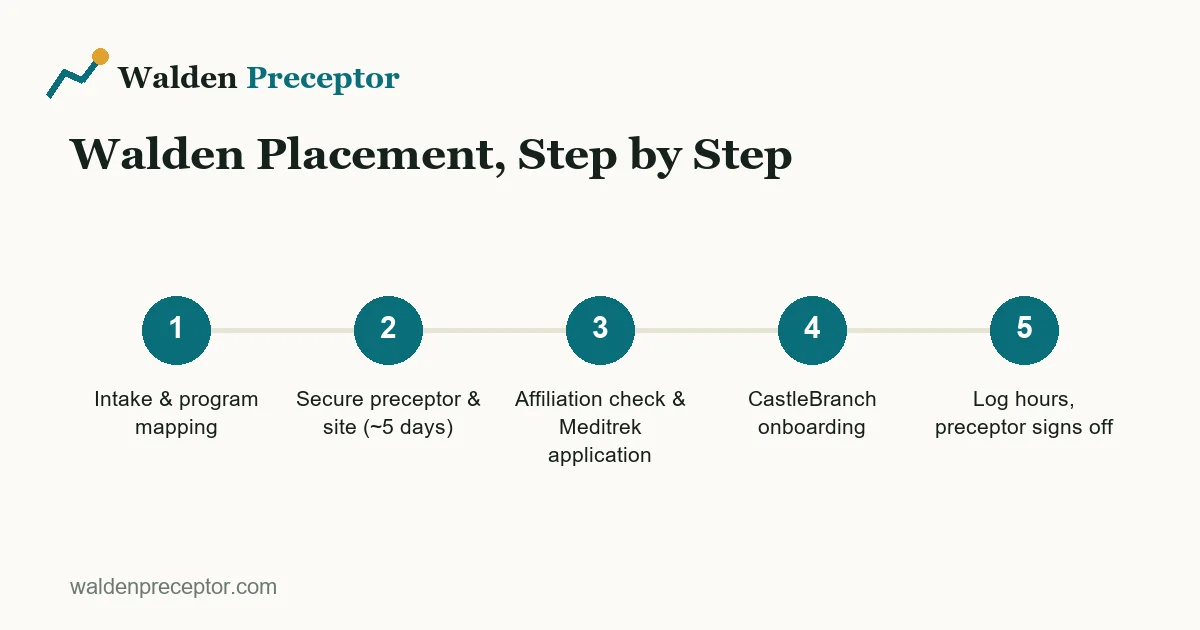
Walden does not sell or set a price for preceptors, and that is the first thing to be clear about. Walden's model is that you secure your own preceptor and site, at least one per course, and nominate them in Meditrek, Walden's nursing practicum management system, for the university's own approval. If your documented search is unsuccessful, Walden's Practicum Pledge can match you with a site and preceptor as a fallback (Walden Find a Preceptor and Site). Any fee for help with that search is paid to an independent service, never to Walden, and a paid preceptor is never a "Walden-approved" preceptor. The preceptor must still meet Walden's published requirements and be approved by Walden in Meditrek.
Because Walden prices nothing, the only number you control is the placement help you choose to pay for. To size that fairly, anchor it to your real course hours. Each Walden NP practicum course requires 160 direct-patient-care hours, and the standard FNP, PMHNP, and AGPCNP specializations total 640 practicum hours across four courses (Walden MSN practicum requirements). So when you see a flat package quoted for 250 hours, recognize that it is sized above a single Walden course. Walden also requires a 1:1 preceptor-to-student ratio for on-site direct supervision, which is part of why a qualified preceptor is a finite, paid-for resource in scarce specialties (Walden PMHNP field experience).
| Your course | Practicum hours | What a per-hour quote means at this size |
|---|---|---|
| One Walden NP practicum course | 160 hours | At $12 to $18 per hour, roughly $1,920 to $2,880 for that course |
| Full NP specialization (FNP, PMHNP, AGPCNP) | 640 hours across four courses | Priced and placed course by course, not as one lump sum |
| A flat 250-hour package | 250 hours | More than one Walden course; confirm exactly which course it covers |
Hour figures are Walden's published requirements; dollar figures are illustrative math on the market ranges above, not a Walden or Walden Preceptor price.
Is it cheaper to find a Walden preceptor yourself?
In direct dollars, yes. Calling clinics and emailing providers yourself can cost nothing but time, and plenty of Walden students place themselves successfully every term. The honest trade is what that time is worth and what it risks. A self-directed search can stretch across weeks or months, and the real cost of a search that fails is not the placement fee you saved, it is a delayed or lost term, which is far more in tuition and postponed nurse-practitioner income. A growing number of individual preceptors and clinics now ask for a training stipend of their own even when a student finds them directly, so "free" is not always free either. What a service fee actually buys is speed and someone to carry the affiliation agreement and the Meditrek nomination, not a different or better preceptor than Walden's requirements already define.
The right answer depends on your specialty, your state, and how much runway you have left before your term. If you are in a scarce specialty like PMHNP, in a competitive metro, or already short on time, paying for help usually pencils out. If you are in primary care, in a lower-competition area, and have months of lead time, self-placement is a reasonable and cheaper path. Either way, knowing the market ranges on this page means no one can overcharge you for it.
Frequently asked questions
What does a Walden preceptor placement service cost?
A Walden preceptor placement service runs about $12 to $18 per clinical hour, which works out to about $1,500 to $2,000 for a single 120 to 160 hour rotation. Flat packages exist too: one national service advertises $1,995 for a rotation of up to 250 hours, with extra hours sold at $1,000 per 100-hour block. Psychiatric and women's health rotations sit at the top of those ranges because preceptors in those specialties are scarcer.
Why does the price for a Walden preceptor vary so much?
Four things move the number: specialty (PMHNP and women's health cost more than primary care because preceptors are scarcer), location (dense, competitive metros run higher), the hour count for the course, and urgency (rush placements add a fee). A Walden NP course is 160 practicum hours, and the program totals 640 hours across four courses, so a per-hour quote and a per-course quote are describing the same rotation from two angles. Convert one into the other before you compare two services.
What should a fair NP preceptor fee include?
A fair fee should cover a license-matched preceptor and a clinical site that fits your course, the affiliation agreement handled with your school, support getting your nomination approved in your school's practicum portal, and a clear refund policy if no match is confirmed. If a quote covers only an introduction and leaves the paperwork, the site agreement, and the portal approval to you, it is not a complete placement and should cost less.
Does Walden charge me for a preceptor or set the price?
No. Walden does not sell or price preceptors. Walden's model is that you secure your own preceptor and site and nominate them in Meditrek for the university's approval, with the Practicum Pledge as a fallback if your own documented search is unsuccessful. Any fee you pay for help finding a preceptor is paid to an independent service, never to Walden, and a paid preceptor is never a Walden-approved or Walden-endorsed preceptor. The preceptor must still meet Walden's published requirements and be approved by Walden in Meditrek.
Is it cheaper to find a Walden preceptor myself?
In direct dollars, yes. Reaching out to clinics and providers yourself can cost nothing but your time, and many Walden students place themselves successfully. The trade is time and risk: a self-search can take months, the cost of a lost term in tuition and delayed income is far larger than a placement fee, and a few preceptors and clinics now charge their own training stipend even when you find them directly. A service fee buys speed and someone to carry the paperwork, not a different preceptor than the requirements already demand.
How does a placement fee compare with the cost of a lost Walden term?
The fee is usually the smaller number by a wide margin. A placement service runs about $1,500 to $2,000 for a single rotation, while Walden bills the MSN by the quarter credit hour: $785 for the BSN-entry NP specializations under the catalog effective February 23, 2026, $775 for students who started June 2023 or later, and $625 for earlier starts, plus an $80 per quarter credit hour clinical fee on NP practicum coursework. A search that fails late enough to make you repeat or stretch a practicum course bills those credits all over again, and every extra 11-week term also pushes back the date you start earning as a nurse practitioner. The full term-by-term arithmetic is in our guide to what a delayed graduation costs.
Can I avoid the cost by pushing my practicum to a later term?
Deferring is a cost with a different name. Walden's practicum application is due in Meditrek by the first day of the month about three months before the term, review can take up to three months once it begins, and an application not approved by the Friday before the term closes, so one missed window often cascades into two lost terms rather than one. Each 11-week term you push carries the tuition timing, the fee schedule, and the delayed income with it, and if you are mid-course and short on hours, the Week 10 deadline decides whether waiting is even an option; our behind-on-hours guide runs that math honestly. Deferring deliberately, with a plan, can still be right, but price it before you choose it.
Sources
- NPHub: NP rotation pricing (per-hour starting rate, deposit, service and rush fees)
- Walden Academic Guides: Find a Preceptor and Site (student-secured model, Meditrek)
- Walden Practicum Manual: MSN practicum requirements (160 hours per course, 640 total)
- Walden Academic Guides: PMHNP field experience (1:1 preceptor-to-student ratio)
Want a real number for your course, not a range?
Tell us your specialty, state, course, and term date and we will map your 160 practicum hours and quote a flat, all-in price to place you, with no payment until a confirmed preceptor and site agree to take you. See exactly how our pricing works, or start a free consult. We present preceptors who meet Walden's published requirements, submitted for Walden's own approval in Meditrek.
Get a flat, all-in quote for your placement
No payment until you are matched. We map your hours, your timeline, and one clear price. 3,200+ nurses supported.
Start your free consult