Walden AGPCNP preceptor and placement, made simple
The Walden Adult-Gerontology Primary Care Nurse Practitioner track asks you to complete 640 practicum hours across four courses, all in adult and older-adult primary care, and to find your own preceptor for each one. We match you with a qualified preceptor and a compliant site, then help you carry it through Meditrek approval and sign-off.
Last updated: June 22, 2026 · Reviewed by the Walden Preceptor placement team
Start your placement, free
Tell us your program. We map the whole practicum. No payment until you are matched.
What the AGPCNP practicum requires
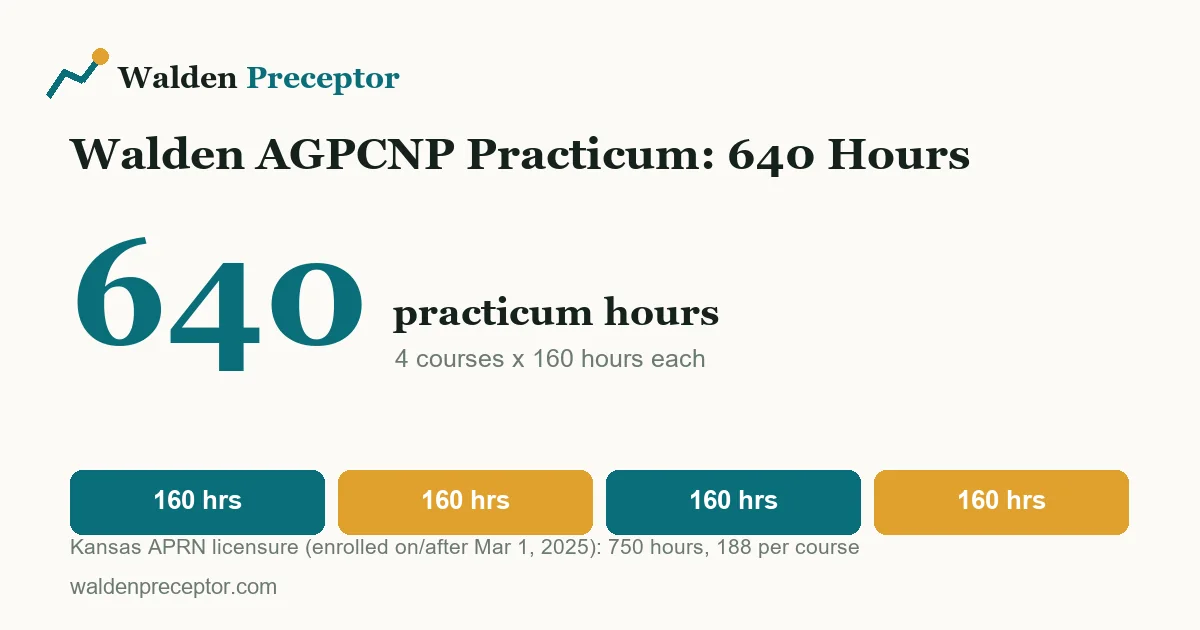
Walden's AGPCNP specialization is built around primary care for adults of every age, from young adults through the oldest patients. The clinical core is 640 supervised hours, divided evenly into four practicum courses of 160 hours each. Each practicum course (the PRAC or PRCM prefix, depending on your catalog year) runs alongside a matching NRNP or DRNP didactic course, so your hours are tied to what you are learning that term. Source: Walden Nursing Practicum Manual, MSN requirements.
| Practicum course | Focus | Hours |
|---|---|---|
| PRAC / PRCM 6531 | Primary care of adults across the lifespan | 160 |
| PRAC / PRCM 6540 | Advanced practice care of older adults | 160 |
| PRAC / PRCM 6552 | Advanced nurse practice in reproductive health | 160 |
| PRAC / PRCM 6565 | Synthesis in primary care settings | 160 |
| Total | Adult and older-adult primary care | 640 |
Course numbers and prefixes are catalog-year sensitive. Confirm your exact program map in your student portal before you plan placements.
The Kansas exception
If you intend to seek APRN licensure in Kansas and you are a new student who enrolled on or after March 1, 2025, your requirement rises to 750 hours, which works out to 188 hours per practicum course rather than 160. Everyone else stays at 640. Source: Walden Nursing Practicum Manual.
What an AGPCNP preceptor needs to cover
Because the AGPCNP scope is adult and older-adult primary care, your preceptors should practice in settings where you see that population day to day. Good fits include family medicine and internal medicine clinics, geriatric and long-term care practices, primary care offices, and womens health or reproductive health clinics for the 6552 course. Across the four courses you want a mix that covers:
- Adults across the lifespan in a primary care setting
- Older adults, including chronic disease and complex management
- Reproductive and womens health for the 6552 rotation
- A synthesis experience that pulls the whole scope together
Eligible preceptors are typically board-certified nurse practitioners, physicians, or other qualified providers whose practice matches the course objectives. Each preceptor and site must meet Walden's prescreen criteria and have, or be willing to enter, an affiliation agreement.
How placement actually works at Walden
For most students, Walden does not assign you a preceptor. The Practicum Pledge exists as a fallback, though it requires documented attempts and a per-term deadline before Walden will match you. You are responsible for finding your own preceptor and site, then nominating them in Meditrek for approval before the course starts. Walden supports that search with coaching from Field Placement Coordinators, prescreen checklists, training on professional outreach, and an affiliation-agreement database. A handful of facilities are different: some require Walden to secure or finalize the placement directly, in which case you contact a coordinator and submit a request well ahead of the deadline. Source: Walden, finding a preceptor.
Know which practicum course is next and when it opens, so the placement is approved in time.
Match the provider and setting to the course focus, then prescreen them against Walden's criteria.
Submit your preceptor and site application in Meditrek for approval. No practicum course registration happens without an approved application.
Finish CastleBranch onboarding for your state and site, log time and patient encounters in Meditrek, and your preceptor signs off your hours and evaluations.
Meditrek and CastleBranch, briefly
Meditrek (edu.meditrek.com/waldenu/student) is where you nominate a preceptor, then log your time and patient encounters once you begin. Your preceptor reviews and signs off your hours and evaluations there. You cannot register for a practicum course without an approved Meditrek application, so the nomination has to come first. Source: Walden, practicum course success.
Compliance runs through CastleBranch (myCB, at walden.castlebranch.com), which is where your background check, drug screen, immunizations, and required trainings live. Requirements are state-specific and sometimes site-specific, and Walden does not accept outside background checks, so plan for the CastleBranch timeline as part of getting cleared to start. Source: Walden, onboarding and compliance.
Pacing your 640 hours
Walden sets practical limits on how you bank hours so a rotation stays safe and well supervised. You can log a maximum of 12 practicum hours in a single day, your hours should be spread across at least 8 weeks, and you generally complete them by the end of Week 10 (or Week 11 for Tempo-format programs). The AGPCNP track itself is course-based, not Tempo, so plan around the standard term calendar. With four 160-hour courses, mapping a steady weekly rhythm with your preceptor early keeps you from scrambling at the end. Source: Walden Nursing Practicum Manual.
Common questions
How many practicum hours does the Walden AGPCNP program require?
The track requires 640 practicum hours, split into four practicum courses of 160 hours each. Students seeking APRN licensure in Kansas who enrolled on or after March 1, 2025 complete 750 hours, which is 188 hours per course.
Does Walden find an AGPCNP preceptor for me?
In most cases you secure your own preceptor and site, then nominate them in Meditrek for approval before the course begins. Walden supports you with coaching, checklists, and an affiliation-agreement database. A few sites require Walden to finalize the placement directly. This is exactly the part we take off your plate.
What kind of preceptor does an AGPCNP student need?
You need preceptors who practice in adult and older-adult primary care, such as a board-certified NP, a physician, or another qualified provider in family medicine, internal medicine, geriatrics, or a related outpatient setting. Across the four courses the mix should cover adults across the lifespan, older adults, and reproductive or womens health.
Can I do the AGPCNP track through Tempo Learning?
No. The AGPCNP specialization is course-based, not a Tempo Learning competency-based program. Walden offers Tempo only for Nursing Education, Nurse Executive, and Nursing Informatics.
Sources
An AGPCNP preceptor in five days, no payment until you are matched
Finding four preceptors who fit primary care for adults and older adults, then clearing affiliation agreements and CastleBranch, is the slow part of this degree. We do that for you. Tell us your specialization, your state, your next course, and your start date, and we match you with a qualified preceptor and a compliant site, then stay with you through Meditrek nomination and sign-off. We guarantee a match within five days, and you pay nothing until you are matched. More than 3,200 nurses have been supported through their practicum with help like this.
Map your AGPCNP placement
Free consult, no obligation. We will tell you honestly what your next rotation needs.