Placement service vs self-placement for Walden NP students, compared
Self-placement is free of any service fee and is what Walden expects for most placements, but it puts the entire search, the affiliation-agreement check, and the Meditrek nomination on you. A placement service charges a per-rotation fee, commonly around $1,500 to $2,000 in 2025, to run that search and shorten your time to a confirmed preceptor. Neither option changes who approves the placement: Walden's Office of Field Experience does, every time.
Last updated: June 28, 2026 · Reviewed by the Walden Preceptor placement team (MSN and DNP coordinators)
Start your placement, free
Tell us your program. We map the whole practicum. No payment until you are matched.
What are you actually choosing between?
At Walden, you are responsible for securing your own preceptor and clinical site, then nominating them in Meditrek for approval before your practicum course begins. Walden's guidance asks students to "search for and securing a practicum site and preceptor" and to "communicate with potential preceptors and sites," while noting that "some practicum sites may require Walden to directly secure a preceptorship at the site on behalf of the student" (Walden, Find a Preceptor and Site). That responsibility is the whole reason this decision exists.
Self-placement means you do that work yourself: build a target list, reach out to providers, confirm a license-matched preceptor, check the affiliation agreement, and submit the Meditrek application. A placement service is a paid third party that runs the search and prepares the paperwork on your behalf. A third path, Walden's own Practicum Pledge, sits between the two and is covered below. This page compares them honestly on the five things that actually differ.
The side-by-side at a glance
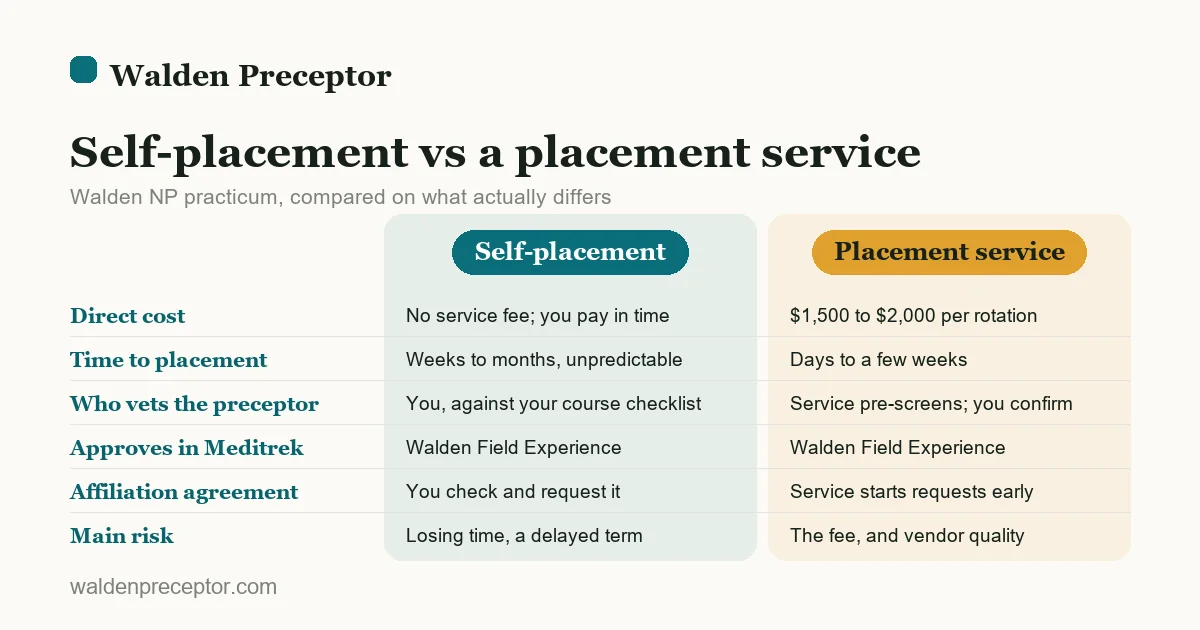
Here is the full comparison on the axes that genuinely differ. Every figure is sourced below; where a number is a market range, it is labeled as one.
| Factor | Self-placement (find your own) | Placement service (paid) |
|---|---|---|
| Direct cost | No service fee. You pay your time. | A per-rotation fee, commonly $1,500 to $2,000 in 2025 (higher for psychiatry). |
| Time to a confirmed preceptor | Weeks to months; unpredictable, and the leading cause of delayed terms. | Days to a few weeks; the search is the product, so it moves faster. |
| Who vets the preceptor | You, against your course prescreening checklist. | The service pre-screens for credentials and specialty fit; you still confirm. |
| Who approves the placement | Walden's Office of Field Experience, in Meditrek. | Walden's Office of Field Experience, in Meditrek. Unchanged. |
| Meditrek application | You prepare and submit it. | The service prepares it with you; you sign and submit. |
| Affiliation agreement | You check the database and request a new agreement where needed. | The service confirms status and starts requests early; you sign. |
| Effort on you | High. The full search and paperwork are yours. | Low to moderate. You review and decide; the service does the legwork. |
| Main risk | Running out of time and pushing your practicum to a later term. | Paying a fee, and the chance of a service that overpromises or is not legitimate. |
How do the two compare on cost?
Self-placement carries no service fee. Walden does not charge you to find your own preceptor, and you can absolutely complete a placement at zero out-of-pocket cost beyond your tuition and the standard Walden, Meditrek, and CastleBranch fees you would pay either way. The real cost of self-placement is time and uncertainty, which do not show up on an invoice.
A placement service charges a fee per clinical rotation. Across the named services in the nurse-practitioner market in 2025, most students pay roughly $1,500 to $2,000 per rotation, which works out to about $12.50 to $17.50 per clinical hour for a typical 125 to 160 hour rotation. Specialty matters: family-medicine rotations sit at the low end, while psychiatry rotations commonly run $1,800 to $2,000 because PMHNP preceptors are harder to find. Some services advertise a single flat rate per rotation that bundles the preceptor honorarium, the matching service, and school-paperwork support (NPHub pricing).
| Specialty | Typical 2025 per-rotation range |
|---|---|
| Family medicine | $1,500 to $1,600 |
| Pediatrics | $1,600 to $1,800 |
| Women's health / OBGYN | $1,600 to $1,800 |
| Psychiatry (PMHNP) | $1,800 to $2,000 |
Ranges are market figures across multiple services, not Walden figures, and they change. Always get a flat, written quote before you commit. Our own pricing is on the pricing page.
How do they compare on time to placement?
This is where the two options diverge most. Walden recommends starting your preceptor search months ahead, and the slow steps are outside the match itself: the Meditrek application must be approved before you can register, and a missing affiliation agreement can take weeks to put in place. Self-placement adds the unknown of how long providers take to say yes, which is why starting late is the single most common cause of a delayed practicum.
A placement service compresses the search because finding preceptors is what it does full time, with relationships already in place. The trade is money for speed. For an FNP student three to four months out, self-placement is usually workable. For a PMHNP student in a saturated city, or anyone whose term is weeks away, the time saved is the entire reason to pay. If your term has already started or your preceptor just fell through, read what to do when you cannot find a preceptor.
Who vets the preceptor, and who approves the placement?
These are two different questions, and people conflate them. Vetting is the screen for whether a preceptor holds the right credentials and practices in a setting that matches your course. With self-placement you run that screen yourself against your course prescreening checklist. With a service, the service pre-screens candidates for credential and specialty fit before presenting them, which is most of what you pay for, though you should still confirm the match against your own checklist.
Approval is separate and never moves. Walden's Office of Field Experience is the only party that approves a placement, regardless of who found the preceptor. You nominate the preceptor and site in Meditrek, and the application is reviewed against your course requirements before you can register for the practicum course (Walden, Course Success). A service can present preceptors who meet Walden's published requirements, submitted for Walden's own approval, but it cannot approve anyone on Walden's behalf. Any service that claims it can guarantee Walden approval is misrepresenting how the process works.
Who handles the Meditrek portal and the affiliation agreement?
Walden's nursing practicum runs on Meditrek. The practicum application is submitted in Meditrek, the Affiliation Agreement Database lives in Meditrek, and your preceptor signs your time logs and completes the midterm and final evaluations there (Walden, Find a Preceptor and Site). Background-check compliance is handled separately through CastleBranch.
With self-placement, you review the Affiliation Agreement Database for your site, request a new agreement where one is missing, prepare the Meditrek application, and respond to any review questions. With a placement service, the service typically confirms the agreement status, flags sites that require Walden to secure the placement directly, and prepares the Meditrek application with you. In both cases you are the one who signs and submits, and Walden is the one who approves. The portal work does not disappear with a service; it gets prepared for you so the submission is clean the first time. For a deeper walk-through, see our Meditrek guide and the how it works page.
How do they compare on risk?
Each option carries a different risk, and naming them honestly is the point of this page.
- Self-placement risk: time. The main downside is running out of it. If providers decline, if a market is saturated, or if you start late, the practicum slips to a later term. That delay can cost more than any service fee in lost tuition cycles and graduation timing.
- Placement-service risk: the fee and the vendor. You pay regardless of outcome unless the service offers a refund policy, and the market includes some that overpromise. Read the refund terms, confirm the preceptor is real and license-matched, and never pay for clinical hours you did not actually work. If you are vetting services, our guide to finding a Walden preceptor lays out what a qualified match looks like.
A clean way to think about it: self-placement risks your timeline, a service risks your money. Which risk you can absorb depends on how close your term is and how hard your specialty and market are.
Where does Walden's Practicum Pledge fit?
Walden offers its own placement-support program, the Practicum Pledge, which is neither pure self-placement nor a paid third party. Walden states that "if you have worked to identify your own site and preceptor but have been unsuccessful," the Practicum Pledge "will match you with a site and preceptor" (Walden, Practicum Pledge). It is not automatic and it is not fast. Walden's published conditions include completing two coaching calls with a Field Placement Coordinator, finishing the required preparation tasks, documenting formal denials from at least five sites or preceptors, and registering roughly nine months before your practicum course.
That nine-month, five-denial requirement is the catch. The Pledge is a genuine safety net if you plan far ahead and are willing to document a failed search, but it does not help the student whose term is two months out. The Pledge is a school program; a service is an outside option.
Which option is right for you?
There is no single answer; it depends on your timeline, specialty, and market.
| Your situation | The honest lean |
|---|---|
| FNP, primary-care market, 3 to 4 months out | Self-placement is realistic. Start now and follow the steps. |
| PMHNP or acute care, or a saturated city | A service often pays for itself in time saved and scarce-specialty access. |
| Term starts in weeks, or preceptor just dropped | A service or urgent help; self-placement rarely closes in time. |
| Planning nine-plus months ahead, fee-averse | Self-placement first; the Practicum Pledge as the documented fallback. |
| Tight on time but fee-sensitive | Self-place the easy courses, use a service only for the hard rotation. |
You do not have to choose one approach for your whole program. Many students self-place the rotations that are easy in their market and bring in help only for the specialty or the term where the search stalls.
Frequently asked questions
Is self-placement free at Walden?
Yes. Walden does not charge you to find your own preceptor and site, and Walden expects you to do exactly that for most placements. Self-placement costs no service fee. What it does cost is your time and the risk of a delayed term, because you run the entire search, the outreach, the affiliation-agreement check, and the Meditrek nomination yourself. A placement service charges a per-rotation fee, commonly around $1,500 to $2,000 in 2025, in exchange for running that search for you.
Does using a placement service change who approves my preceptor at Walden?
No. Whoever finds the preceptor, Walden's Office of Field Experience is still the only party that approves the placement. You nominate the preceptor and site in Meditrek and the application is reviewed against your course requirements before you can register. A service can source and pre-vet a preceptor who meets Walden's published requirements, but it cannot approve anyone on Walden's behalf, and no honest service should claim it can.
What is the Walden Practicum Pledge and how is it different from a paid service?
The Practicum Pledge is Walden's own placement-support program: if you have tried to find your own site and preceptor but have been unsuccessful, Walden will match you with one. It is not automatic. Walden's published conditions include completing two coaching calls, finishing the preparation tasks, documenting formal denials from at least five sites or preceptors, and registering roughly nine months before your practicum course.
Who handles the affiliation agreement and the Meditrek application in each option?
In both options, the affiliation agreement is housed in Walden's Affiliation Agreement Database in Meditrek and the final nomination is submitted there. With self-placement you check the database, request a new agreement where one is missing, and submit the application yourself. With a placement service, the service typically confirms the agreement status and prepares the Meditrek application with you, but you still sign and submit, and Walden still approves.
Is it allowed to pay someone to help find a Walden preceptor?
Paying an independent service to help you find and secure a qualified preceptor is a common practice in nurse-practitioner education and is different from paying for clinical hours you did not work. The preceptor must still meet Walden's published requirements, you must complete every supervised hour yourself, and Walden's Office of Field Experience still approves the placement. Confirm your program's own policies, because the rules are set by your school, not by any service.
Sources
- Walden University, Find a Preceptor and Site (student responsibility, Meditrek, Affiliation Agreement Database)
- Walden University, Course Success (Meditrek application and approval before registration)
- Walden University, Practicum Pledge (placement-support program and conditions)
Want the search run for you?
If your term is close, your specialty is hard, or your market is saturated, self-placement is the slow road. We run the search for you: we source a qualified preceptor and site that meet Walden's published requirements, submitted for Walden's own approval, confirm the affiliation-agreement status, and prepare your Meditrek application so it clears the first time. You are matched within five days, and you pay nothing until you are matched. More than 3,200 nurses have been supported through placements like this.
Decide with a free consult, owe nothing today
Tell us your program, specialty, and term. We will map your timeline, give you a flat price, and lay out whether self-placement or a service makes more sense for your situation.
Start your free consultOr see our pricing and how it works first.