Walden FNP Preceptor in Alaska
A Walden FNP practicum in Alaska runs on 640 direct-patient-care hours across four 160-hour courses, under an FNP-qualified preceptor. Alaska adds two rules most states do not: the preceptor must be an APRN authorized in Alaska or a board-approved physician, and you register the preceptorship with the Alaska Board of Nursing before you start. We find a preceptor who meets both Alaska's rule and Walden's published requirements, then help you submit the placement for Walden's review. Matched in about five days, with nothing to pay until you are matched.
Last updated 2026-06-28 · Reviewed by the Walden Preceptor placement team
Start your placement, free
Tell us your program. We map the whole practicum. No payment until you are matched.
What does a Walden FNP practicum require in Alaska?
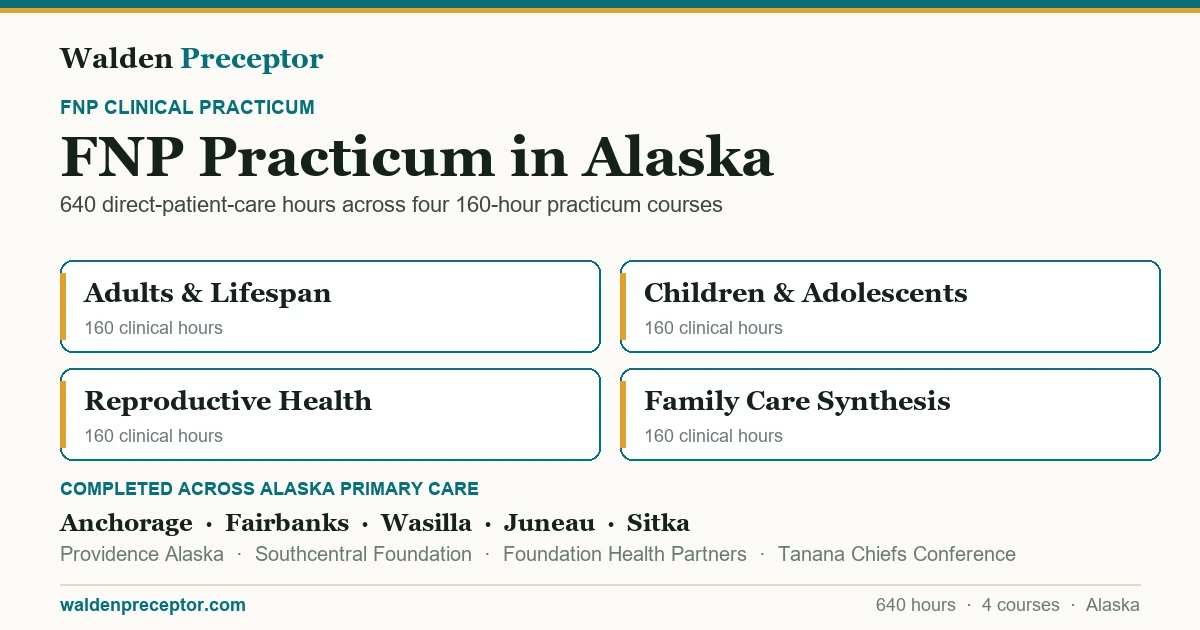
Your hour total comes from Walden, not from Alaska, and it follows you north unchanged. The Master of Science in Nursing Family Nurse Practitioner specialization is built on 640 total practicum hours, split evenly into four practicum courses of 160 hours each, all direct patient care. Across those four courses you cover primary care for every age band, from newborns through older adults, plus reproductive and women's health.
| Course | Focus | Hours |
|---|---|---|
| 6531 | Primary Care of Adults Across the Lifespan | 160 |
| 6541 | Primary Care of Adolescents and Children | 160 |
| 6552 | Advanced Nurse Practice in Reproductive Health | 160 |
| 6568 | Synthesis in Advanced Nursing Practice, family care settings | 160 |
Source: Walden MSN practicum requirements. Course numbering is catalog-year sensitive; confirm yours in your program map. The full course-by-course breakdown lives on our Walden FNP page.
Walden also paces those hours. You can log a maximum of 12 practicum hours in any one day, the hours have to be spread over no fewer than 8 weeks, and they generally need to be done by the end of Week 10 of the course. In Alaska that pacing rule matters more than usual, because a single willing primary-care clinic in a small market may only host you a day or two a week. At two clinical days a week you clear 160 hours comfortably inside the window; at one day a week you can run out of calendar before you run out of patients.
How does Alaska's full practice authority affect FNP precepting?
The American Association of Nurse Practitioners classifies Alaska as a full practice state, a status it has held since 1994. A licensed advanced practice registered nurse in Alaska evaluates patients, orders and interprets diagnostics, diagnoses, and prescribes under the Board of Nursing's authority, with no required physician collaborative or supervision agreement. For your FNP practicum, the practical effect is simple: an APRN preceptor in Alaska can model the entire FNP role, prescribing included, without a physician hovering over the chart.
That autonomy makes APRN preceptors easier to work with, but it does not loosen a single Walden requirement. Full practice authority is about what a licensed Alaska NP may do on their own. It says nothing about whether your placement is approved, your hours counted, or your paperwork in order. Those still run through Walden. We cover the broader state picture, including the advanced nurse practitioner title and prescriptive authority, on our Alaska placement page.
Does Alaska require a preceptorship registration for a Walden FNP student?
This is the part of an Alaska placement that surprises Walden students, and it has no equivalent in many Lower-48 states. The Alaska Board of Nursing expects a student in an APRN program to register the preceptorship before completing clinical hours in the state, including students enrolled in an out-of-state program such as Walden. The mechanism is the Advanced Practice Registered Nurse Preceptorship Registration, board form 08-4253.
- The registration carries a $50 fee payable to the Alaska Board of Nursing.
- An authorized preceptorship is good for 12 months and may be renewed once, so plan your course sequence against that window.
- You generally need a current, unencumbered RN license and enrollment in a nationally accredited program; the form can be initiated through the board's MY LICENSE self-service portal.
Treat the board, not a blog, as the authority on whether and exactly how this applies to you, and build the lead time in early. Nothing stalls an Alaska start date faster than discovering a state filing requirement two weeks before the term begins. We flag the registration up front and keep it moving alongside your Meditrek application so the two timelines do not collide.
Who can serve as a Walden FNP preceptor in Alaska?
Alaska is unusually specific about preceptor credentials. Under state regulation 12 AAC 44.990, a qualified preceptor is an advanced practice registered nurse currently authorized to practice as an APRN in Alaska, or a currently licensed, practicing physician approved by the board. Some states let a wider range of providers precept; Alaska does not. For an FNP placement that narrows the field to APRNs and physicians who actually hold an active Alaska credential.
On top of the state rule sits Walden's own course-specific criteria. Because the FNP role spans the whole family, your four courses together have to cover the lifespan, so your preceptor's scope and setting need to match the population for each course:
- Adult and lifespan primary care for the 6531 course
- Pediatric and adolescent care for the 6541 course
- Reproductive and women's health exposure for the 6552 course
- A family-care setting that lets you synthesize across populations for 6568
So a preceptor here has to clear two bars at once: Alaska's 12 AAC 44.990 definition and Walden's course requirements. We confirm both before we ever send a name forward. A preceptor we match is one who meets Walden's published requirements, and the placement is then submitted for Walden's review and approval. We never describe a preceptor as Walden-endorsed, and a match is never a guarantee of placement; Walden reviews and approves every proposed site and preceptor.
Where do Walden FNP students find primary-care sites in Alaska?
Alaska is large, thinly populated, and served by a small number of systems plus a long tail of independent and tribal clinics. Most FNP primary-care placements concentrate in two regions:
Southcentral and Interior
Anchorage, Eagle River, Wasilla, and Palmer in the Mat-Su, plus Fairbanks in the Interior. This corridor holds the bulk of Alaska's clinics, including systems such as Providence Alaska, Southcentral Foundation's Nuka primary-care clinics, and, around Fairbanks, Foundation Health Partners and the Tanana Chiefs Conference network.
Southeast and beyond
Juneau, Sitka, and Ketchikan host students too, and we can help you think through Kenai, Soldotna, or a smaller community. The preceptor pool is thinner here, so the earlier you start, the more room you have to maneuver.
Family medicine, internal medicine, pediatric, women's health, and community or tribal health clinics are the common FNP settings, and a single broad family practice can sometimes carry more than one of your four courses. Whichever site fits, it will need an affiliation agreement with Walden on file before you begin, which is another reason to confirm the placement well ahead of your start date.
Why is finding an FNP preceptor in Alaska hard, and how do we help?
Two pressures stack up here. The first is the one every Walden student faces: you are responsible for securing your own preceptor and site, then nominating that preceptor in Meditrek for review. Walden's Office of Field Experience coaches the process but does not generally hand you a preceptor. The second is geography. Alaska's clinical community is small, the qualified-preceptor pool is narrowed by the 12 AAC 44.990 rule, and the providers who can precept get asked often. Cold-emailing clinics from a different time zone, getting ghosted, and circling back near a deadline is a slow way to lose a term.
That is the gap we fill. We carry the outreach, vetting, and scheduling, we already know which Alaska practices are open to students, and we line up a preceptor who meets both Alaska's rule and Walden's criteria. Then we help you assemble a clean Meditrek application and keep the Alaska preceptorship registration, CastleBranch compliance, and the affiliation agreement moving in parallel so nothing waits on anything else. You still nominate the preceptor in Meditrek and your preceptor still signs your hours there; we just remove the months of searching.
Map your course and timeline
We confirm which FNP course is next, its population and preceptor requirements, and your start date, then size the search to your region of Alaska.
Source a qualified preceptor
We secure an APRN or board-approved physician who satisfies 12 AAC 44.990 and meets Walden's course criteria, and confirm they are willing and available.
Handle the Alaska and Walden paperwork
We keep the state preceptorship registration, the Meditrek nomination, the affiliation agreement, and CastleBranch compliance moving together so the timelines line up.
Submit for Walden's review
You nominate the preceptor in Meditrek and the placement goes to Walden for review and approval. There is no practicum registration without an approved Meditrek application.
Walden FNP in Alaska FAQ
How many practicum hours does a Walden FNP need in Alaska?
The Walden FNP track requires 640 direct-patient-care practicum hours across four 160-hour courses (6531, 6541, 6552, and 6568). Those totals are set by Walden and do not change in Alaska. The hours must be completed over no fewer than 8 weeks, finished by the end of Week 10 of the course, with a daily maximum of 12 practicum hours.
Does Alaska require a preceptorship registration for an out-of-state Walden FNP student?
Yes, in most cases. The Alaska Board of Nursing requires a student in an APRN program to register a preceptorship before completing clinical hours in Alaska, using the Advanced Practice Registered Nurse Preceptorship Registration (Form 08-4253). The registration carries a $50 fee, is authorized for 12 months, and may be renewed once. Confirm your exact obligation directly with the board before you begin.
Who can serve as a Walden FNP preceptor in Alaska?
Under Alaska regulation 12 AAC 44.990, a qualified preceptor is an advanced practice registered nurse currently authorized to practice as an APRN in Alaska, or a currently licensed, practicing physician approved by the board. The preceptor must also meet Walden's course-specific criteria and hold a scope that matches the FNP patient population. We match preceptors who meet both Alaska's rule and Walden's published requirements, then submit the placement for Walden's review.
Does Alaska's full practice authority change my Walden FNP practicum?
No. Alaska is a full practice authority state, so a licensed APRN preceptor can teach the full scope of the role without a physician collaborative agreement. That makes APRN preceptors easier to work with, but it does not change Walden's rules: you still need a qualified preceptor, an approved site, an affiliation agreement, and an approved Meditrek application before you can register for the practicum course.
Where do Walden FNP students complete clinical hours in Alaska?
Most FNP primary-care placements sit in Southcentral and Interior Alaska, where the clinics are concentrated, including Anchorage, the Mat-Su valley, and Fairbanks. Family medicine, internal medicine, pediatric, and community or tribal health clinics are the common settings. Southeast communities such as Juneau, Sitka, and Ketchikan also host students, though the pool of available preceptors is smaller.
Sources
- Walden University, MSN practicum requirements (640 hours, four 160-hour FNP courses)
- Walden University, Find a Preceptor (student-secured model, Meditrek)
- Alaska Board of Nursing, APRN Preceptorship Registration (Form 08-4253, $50, 12-month term)
- 12 AAC 44.990, definition of a qualified preceptor (APRN or board-approved physician)
- AANP State Practice Environment, Alaska (full practice authority)
Ready to lock in an FNP preceptor in Alaska?
Tell us which FNP course is next, your timeline, and where you are in Alaska. We will source a preceptor who meets 12 AAC 44.990 and Walden's criteria, keep the state preceptorship registration and Meditrek application on track, and submit the placement for Walden's review. Matched in about five days, with no payment until you are matched. See pricing or start a free consult.