Walden FNP Preceptor in Arkansas
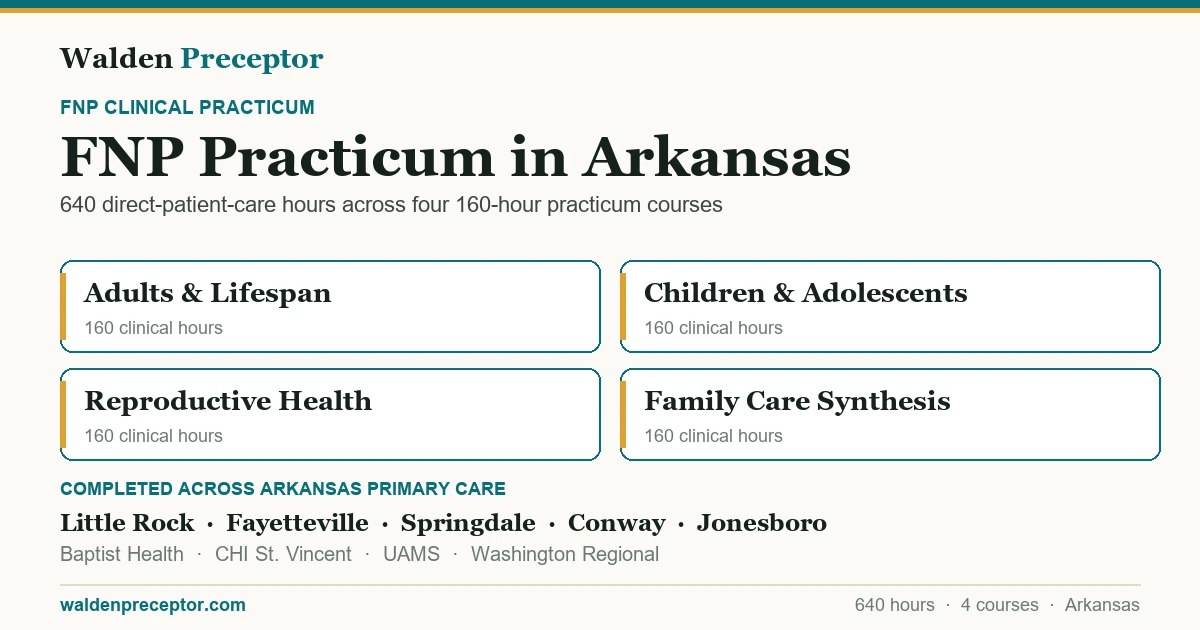
A Walden FNP practicum in Arkansas requires 640 direct-patient-care hours across four 160-hour practicum courses, completed under an FNP-qualified preceptor you secure and nominate in Meditrek for Walden's review. Arkansas is a reduced-practice state, so the certified nurse practitioner who precepts you works under a collaborative practice agreement with a physician for prescriptive authority. We find an Arkansas primary care preceptor who meets Walden's published requirements, with no payment until you are matched.
Last updated 2026-06-28 · Reviewed by the Walden Preceptor placement team
Start your placement, free
Tell us your program. We map the whole practicum. No payment until you are matched.
How many hours does a Walden FNP practicum need, and does Arkansas change that?
Your hour total is a Walden number, not an Arkansas one. The Master of Science in Nursing Family Nurse Practitioner specialization is built around 640 direct-patient-care practicum hours, split evenly into four practicum courses of 160 hours each. Arkansas law shapes who may precept you and how that clinician prescribes in their own practice, but it does not add or subtract a single practicum hour. A nurse logging FNP hours in Little Rock owes the same 640 as one in Jonesboro. Walden's FNP runs on four courses, not six, and each carries 160 hours. For all four courses and the Kansas hour exception, our Walden FNP preceptor and placement page covers them in full.
What are the four Walden FNP practicum courses?
Each FNP practicum pairs a didactic course with a clinical component under the same number, and across the four you move through primary care for the whole family. Numbering shifts by catalog year, so confirm yours in your program of study.
| Course | Patient population | Hours |
|---|---|---|
| 6531 | Primary Care of Adults Across the Lifespan | 160 |
| 6541 | Primary Care of Adolescents and Children | 160 |
| 6552 | Advanced Nurse Practice in Reproductive Health | 160 |
| 6568 | Synthesis in Advanced Nursing Practice, family care settings | 160 |
In Arkansas terms, a single family-medicine practice in Conway or Springdale can often cover several courses, while reproductive health for 6552 may send you to a women's health clinic for part of your hours. Each course's population still has to be met, and each site needs an affiliation agreement with Walden before you start.
What does Arkansas practice authority mean for an FNP preceptor relationship?
The American Association of Nurse Practitioners classifies Arkansas as a reduced-practice state. In plain terms, a certified nurse practitioner here cannot prescribe fully independently by default. To hold prescriptive authority, a CNP must keep a current, board-approved collaborative practice agreement with a physician on file with the Arkansas State Board of Nursing, and that agreement has to spell out consultation availability, emergency coverage, quality assurance, and the protocols for prescriptive authority. If no current agreement is on file, the board inactivates the nurse practitioner's prescriptive authority, and the APRN must notify the board in writing within seven days of an agreement ending.
Why does this matter when you are only a student? Because it describes the working world your preceptor lives in, and it explains why an experienced Arkansas FNP can precept you in primary care: they already run that collaborative structure every day. As a Walden student you complete supervised clinical hours, not prescribing under your own authority, so the reduced-practice category shapes the practice you train inside more than your daily rotation. Our Arkansas placement overview covers the same scope-of-practice picture for every Walden NP track.
Is there a path to full independent practice in Arkansas?
Yes. Under Act 412 of 2021, a certified nurse practitioner can apply for full independent practice after completing 6,240 hours under a collaborative practice agreement. Applications run through the Arkansas Nurse Portal with a notarized practice-hours affidavit signed by the collaborating physician, plus evidence of five advanced-pharmacology continuing-education hours within the last two years, and are reviewed by the state's Full Independent Practice Credentialing Committee, which meets at least quarterly. Until that approval comes through, the collaborative agreement stays required. For your FNP rotation, that means a long-practicing Arkansas FNP may already hold full independent practice while a newer one collaborates with a physician. Both can be qualified preceptors; the difference is the structure of their practice, not their ability to teach you.
Who can precept a Walden FNP student in Arkansas?
Two sets of rules stack here. Arkansas requires a preceptor to hold an active, unencumbered APRN or physician license and to be in current practice in the role and population you are training in. Walden then adds its own course-specific preceptor criteria. The clinician must clear both gates before they can precept you.
- An active, unencumbered Arkansas APRN (typically FNP) or physician license
- Current practice in the population your FNP course covers, from pediatrics to older adults
- A credential and scope that match Walden's criteria for that specific course
- A clinical site willing to host you under an affiliation agreement with Walden
One honest point of language: a preceptor or site is never endorsed by Walden on its own. You propose a preceptor who meets Walden's published requirements, and Walden reviews and approves the placement. We never promise that a placement is certain; we present qualified Arkansas clinicians and submit them for Walden's review. You can confirm any preceptor's Arkansas license through the state board before you commit, and we verify it before we present anyone to you.
Where do FNP students actually find primary care preceptors in Arkansas?
Arkansas concentrates its primary care in a handful of systems and metros, with large rural stretches in between. Knowing where the family-medicine capacity sits saves weeks of cold outreach.
Central Arkansas
Little Rock, North Little Rock, Conway, and Benton, anchored by Baptist Health, CHI St. Vincent, and the UAMS academic network, with dozens of family-medicine and community clinics.
Northwest Arkansas
Fayetteville, Springdale, Rogers, and Bentonville, served by Washington Regional and Mercy, a fast-growing corridor with strong primary care demand.
The rest of the state
Fort Smith, Jonesboro, Hot Springs, Pine Bluff, and rural Delta and Ozark towns, where federally qualified health centers carry much of the primary care load.
Baptist Health alone runs more than 175 access points across Arkansas, and CHI St. Vincent operates dozens of primary care and specialty clinics, so the family-medicine, internal-medicine, and women's-health settings your four FNP courses need genuinely exist here. The hard part is not whether a suitable practice is nearby; it is getting a busy clinician to say yes and finish the paperwork before your term starts.
How does Meditrek and pacing work for an Arkansas FNP placement?
Walden routes the entire placement through Meditrek, its nursing practicum portal. You nominate your preceptor and site there, and you cannot register for a practicum course without an approved Meditrek application, so a clean nomination protects your start date. Background and health compliance runs through CastleBranch, and the affiliation agreement between Walden and your Arkansas site has to be executed before you log a single hour.
Walden also caps your pace. You may log a maximum of 12 practicum hours per day, your hours must spread over no fewer than 8 weeks, and each 160-hour course is expected to finish by the end of Week 10. At roughly two clinical days a week you stay inside that window; a preceptor who can only host you once a week can leave you scrambling near the deadline. We factor an Arkansas preceptor's real availability into the match.
Why FNP students in Arkansas get stuck, and how we help
The coursework is rarely the bottleneck. The bottleneck is cold-emailing clinics across the state, getting ghosted, chasing affiliation agreements, and discovering two weeks before a term that you still have no signed preceptor. Stretch that across four courses and the timeline pressure compounds fast, especially outside the Little Rock or Fayetteville metros.
That is the work we take off your plate. We identify Arkansas primary care preceptors who meet Walden's published requirements, match you by your FNP course, county, and schedule, verify the preceptor's state license, and prepare your Meditrek nomination so it clears review the first time. You confirm hours in Meditrek and your preceptor signs off as usual. We do not promise a placement, and we never claim a preceptor is endorsed by Walden; we shorten the search and submit qualified candidates for Walden's review.
How many practicum hours does the Walden FNP program require in Arkansas?
The Walden FNP track requires 640 direct-patient-care practicum hours, divided into four practicum courses of 160 hours each. That total is set by Walden, not by Arkansas. The state shapes who may precept you and the prescriptive rules of the practice you train in, but it does not change your hour count.
Does Arkansas require my FNP preceptor to work under a collaborative practice agreement?
Arkansas is a reduced-practice state, so a certified nurse practitioner needs a board-approved collaborative practice agreement with a physician to hold prescriptive authority. That rule governs the clinician you train under in their own practice. As a Walden student you complete supervised hours under that preceptor, so the agreement is part of the working world you are training for rather than a document you sign.
Who can precept a Walden FNP student in Arkansas?
Your preceptor must hold an active, unencumbered Arkansas APRN or physician license, practice in the role and population that matches your FNP course, and meet Walden's published preceptor criteria for that course. You secure the preceptor and nominate them in Meditrek, and Walden reviews and approves the placement before you log hours.
Does Walden place me with an FNP preceptor in Arkansas?
Generally no. Walden expects you to secure your own preceptor and clinical site, then nominate them in Meditrek for Walden's review. That search is the gap we fill: we find a qualified Arkansas primary care preceptor who meets Walden's requirements and prepare your Meditrek nomination so it goes in clean.
How fast can my FNP hours go in Arkansas under Walden's pacing rules?
Walden caps practicum at 12 hours per day, requires hours to be spread over no fewer than 8 weeks, and expects each 160-hour course to finish by the end of Week 10. At roughly two clinical days a week you stay inside the window, so we match you to an Arkansas preceptor whose schedule supports that pace from the start.
Sources
- Walden University, MSN Practicum Requirements (640 hours, four 160-hour FNP courses, daily and weekly limits)
- Walden University, Find a Preceptor (student-secured model, Meditrek, Office of Field Experience)
- AANP State Practice Environment, Arkansas (reduced practice)
- Arkansas State Board of Nursing, Prescriptive Authority and Collaborative Practice Agreements
- Full Independent Practice Credentialing Committee (Act 412 of 2021, 6,240 hours)
Arkansas FNP placement, without the cold outreach
We have supported 3,200+ nurses and we match FNP students to a qualified Arkansas primary care preceptor and site, sized to your course, county, and schedule. No payment until you are matched, and a five-day match goal. See our pricing for how it works.
- All four FNP courses covered, from one Arkansas practice or several
- Every preceptor's Arkansas license verified before we present them
- We prepare your Meditrek nomination and chase the affiliation agreement
Ready to lock in your Arkansas FNP preceptor?
Tell us your city, which FNP course is next, and your start term. We will line up a qualified Arkansas preceptor, a primary care site, and your Meditrek nomination, with no payment until you have a confirmed match.
Book your free consult