Walden FNP Preceptor in Colorado
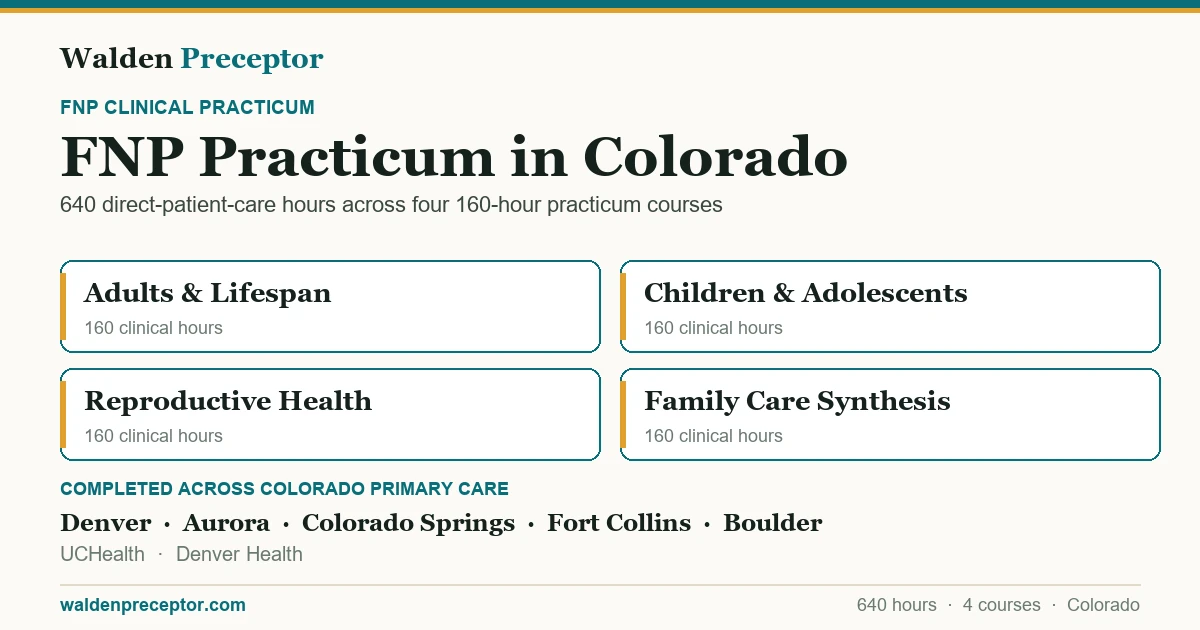
A Walden FNP practicum in Colorado requires 640 direct-patient-care hours across four 160-hour practicum courses, completed in person under a preceptor whose license and scope match each course. Colorado is a full practice authority state, which gives you a deep bench of independently practicing family nurse practitioners to learn from, but the hour count, the four-course structure, and the Meditrek nomination all come from Walden and travel with you into Colorado unchanged. This page maps how the two fit together and how we find your preceptor.
Last updated 2026-06-28 · Reviewed by the Walden Preceptor placement team
Get matched with a Colorado FNP preceptor See how it works
No payment until you are matched with a confirmed Colorado preceptor.
Start your placement, free
Tell us your program. We map the whole practicum. No payment until you are matched.
What does a Walden FNP practicum in Colorado actually involve?
It is two sets of rules sitting on top of each other. One set is Walden's and does not bend for geography: 640 practicum hours, four courses of 160 hours each, direct patient care only, nominated and logged in Meditrek, with compliance cleared through CastleBranch. The other set is Colorado's: who may hold a license, what a preceptor's credential must look like, and what the state's full practice authority does and does not mean while you are still a student. Get both right and your placement is approvable. Miss the Colorado-specific paperwork and an otherwise qualified preceptor can still stall your start date.
The short version: Colorado does not change how many hours you owe or how your courses are built. It changes the pool of clinicians available to precept you, the license you verify before hours begin, and the affiliation paperwork a given clinic expects. Our FNP placement page covers the program mechanics in depth, and our Colorado page covers the state across every Walden track. This page is the intersection of the two for family nurse practitioner students.
How many FNP hours do you complete, and over what timeline?
The Walden FNP specialization is built around 640 total practicum hours, divided into four practicum courses of 160 hours each. That figure is set by Walden and is the same whether you place in Denver or anywhere else (the one published exception is for students seeking APRN licensure in Kansas, which does not apply to a Colorado placement). It also differs from other schools, so do not carry a number you saw on a different program's page into your Colorado planning.
| FNP practicum course | Patient population | Hours |
|---|---|---|
| PRAC/PRCM 6531 | Primary Care of Adults Across the Lifespan | 160 |
| PRAC/PRCM 6541 | Primary Care of Adolescents and Children | 160 |
| PRAC/PRCM 6552 | Advanced practice in reproductive health | 160 |
| PRAC/PRCM 6568 | Synthesis, care of patients in family care settings | 160 |
Source: Walden MSN practicum requirements. Course numbering is catalog-year sensitive; confirm yours in your program map.
The pacing rules matter as much as the totals when you are scheduling around a Colorado clinic's calendar. Each course's hours must be direct patient care, spread over no fewer than 8 weeks, completed by the end of Week 10, with a daily maximum of 12 practicum hours. At roughly two clinical days a week you land comfortably inside that window. A preceptor who can only host you once a week, or a rural site with limited days, is the kind of constraint we screen for before you commit, because the Week 10 deadline does not move.
Does Colorado's full practice authority change anything for an FNP student?
The American Association of Nurse Practitioners lists Colorado as a full practice authority state. For a licensed NP that means evaluating, diagnosing, ordering and interpreting tests, and managing treatment under the licensure authority of the Colorado Board of Nursing, without a mandated physician collaboration agreement. It is a real advantage, but it is worth being precise about when it applies to you.
Full practice authority is a post-graduation licensure status, not a student practicum rule. As a Walden FNP student your hours and supervision are governed by Walden's course requirements, not by Colorado's prescriptive-authority statute. Where the state's environment helps you is upstream of all that: Colorado has a large, established population of FNPs who run their own panels in family medicine, and a preceptor who already practices to the full scope of the license is well positioned to teach the full scope you will be expected to practice after you graduate. In a restricted state, fewer independently practicing NPs are available to precept; in Colorado, the pool is wide.
One Colorado wrinkle worth knowing so it does not surprise you later: new APRNs here move through a two-step prescriptive-authority path after graduation, provisional authority (RXN-P) first, then full authority (RXN) after completing a 750-hour mentorship within three years under a physician or a full-authority APRN (3 CCR 716-1.15). That mentorship is a future-you concern, separate from your Walden 640. We flag it only so you understand the difference between your student practicum and the licensure steps that come after it.
Who must your Colorado FNP preceptor be, and how do you verify them?
Nursing in Colorado is regulated by the Colorado Board of Nursing, inside the Division of Professions and Occupations (DPO) under the Department of Regulatory Agencies (DORA). Colorado does not issue a separate APRN license; advanced practice status is added to an active RN credential through the state's Advanced Practice Registry. For your practicum, that means the clinician you place with must hold an active, unencumbered Colorado credential, and you can verify it yourself through the state's online license lookup before a single hour is logged.
What Walden requires of the preceptor
- License and scope matched to each FNP course's patient population
- A family or primary-care setting for adult, pediatric, and women's-health hours
- Willing to nominate and sign off in Meditrek
- Meets Walden's published, course-specific preceptor criteria
What Colorado adds on top
- Active, unencumbered Colorado RN or APRN credential
- Verifiable through the DPO online license lookup
- An affiliation agreement between the clinic and Walden
- Any site-specific screening a Colorado health system layers on
We confirm a Colorado preceptor's license status before you start, and you can independently re-verify any clinician we present. To be clear about what approval means: Walden reviews and approves the placement you propose. We match preceptors who meet Walden's published requirements and prepare a clean submission for Walden's review. We never describe a preceptor or site as Walden-endorsed, and no service can guarantee that a placement will be approved.
Where do Walden FNP students place across Colorado?
The FNP role spans the whole family, so across your four courses you need primary-care exposure to adults, children and adolescents, and women's health. Colorado supports that in real systems. UCHealth runs family-medicine and primary-care clinics from Denver and Aurora through Colorado Springs and Fort Collins, with NPs embedded on its primary-care teams. Denver Health operates primary-care clinics certified as Patient-Centered Medical Homes. Beyond the large systems, independent family practices, community health centers, and rural clinics on the Western Slope round out the options, especially for students who want a single site that can cover more than one course.
Front Range
Denver, Aurora, Boulder, Lakewood, Centennial, and the surrounding metro family-medicine clinics.
Northern and southern hubs
Fort Collins, Greeley, Loveland, Colorado Springs, and Pueblo primary care.
Western Slope and mountains
Grand Junction, Durango, and resort-area communities where rural FNP placements open up.
Some FNP students find one family practice that can cover several courses; others split across two or three sites to hit every population. Both approaches work, as long as each course's requirement is met and every site has an affiliation agreement on file. We weigh your location and which course is next when we match, so you are not driving two hours each way for hours you could log closer to home.
Why is finding an FNP preceptor in Colorado hard, and how do we help?
Here is the part Walden FNP students find frustrating. Walden expects you to secure your own preceptor and site, then nominate that preceptor in Meditrek for review. The Office of Field Experience supports the process and reviews submissions, but it does not generally hand you a placement. Multiply that by four FNP courses and the timeline pressure compounds.
That is the work we take off your plate. We keep working relationships with primary-care clinicians and clinics across Colorado, match you to a preceptor who fits your FNP course, population focus, and part of the state, and handle the outreach and affiliation paperwork. You confirm the preceptor we present, nominate them in Meditrek, and we help you assemble a clean application so Walden's review goes through without back-and-forth. Remember there is no practicum registration in Meditrek until an approved application is in place, so getting this right early is what protects your start date.
Tell us your course and your part of Colorado
Which FNP course is next, your term dates, and where in the state you can realistically drive to.
We match a qualified Colorado preceptor
A clinician whose Colorado credential and scope fit that course's patient population, verified before you commit.
You nominate in Meditrek for Walden's review
You submit the preceptor and site; we prepare the application so the Office of Field Experience can approve it cleanly.
Clear CastleBranch and the affiliation agreement
Background check, immunizations, and any Colorado site-specific screening, plus the clinic-to-Walden affiliation agreement.
Can any of the Colorado hours be virtual?
Your supervised, direct-patient-care hours, the ones that count toward your 640, are completed in person at your approved Colorado site. There is no shortcut around face-to-face clinical time for the FNP track. Telehealth is a genuine and growing part of Colorado primary care, especially across the rural Western Slope, so depending on your course and preceptor some patient contact may happen through a telehealth platform under direct supervision. The supervision has to be real and the hours have to be patient-facing either way. We match you to FNP preceptors whose practice model fits both your course requirement and how you want to work.
Walden FNP in Colorado: FAQ
How many hours is a Walden FNP practicum in Colorado?
640 direct-patient-care hours, completed in Colorado the same as in any other state. The total is split into four practicum courses of 160 hours each (6531, 6541, 6552, and 6568). The hour count comes from Walden and does not change based on Colorado's practice environment.
Does Colorado being a full practice authority state change my FNP practicum?
Not the hour requirement. Colorado's full practice authority is a licensure status that applies after you graduate and register as an APRN. As a student, full practice authority helps indirectly: Colorado has a large pool of independently practicing FNPs who can serve as preceptors, which widens who can teach you across the four courses.
Who can be my FNP preceptor in Colorado under Walden's rules?
A clinician who holds an active, unencumbered Colorado credential and whose scope matches each FNP course's patient population, typically a family or primary-care NP, physician, or other provider that meets Walden's published preceptor criteria. We match preceptors who meet those requirements, then you nominate them in Meditrek for Walden's review and approval.
Where in Colorado can a Walden FNP student place?
FNP primary-care settings exist across the Front Range (Denver, Aurora, Boulder, Lakewood), the northern and southern hubs (Fort Collins, Greeley, Colorado Springs, Pueblo), and the Western Slope (Grand Junction, Durango). Real systems with primary care across the state include UCHealth and Denver Health.
How fast can the hours be completed in Colorado?
Each 160-hour course must be spread over at least 8 weeks and finished by the end of Week 10, with a daily maximum of 12 practicum hours. At roughly two clinical days a week you finish comfortably inside the window, so we match you to a Colorado preceptor who can host you on a workable schedule.
Sources
- Walden University, MSN practicum requirements (640 hours, four 160-hour FNP courses, pacing limits)
- Walden University, Find a Preceptor (student-secured model, Meditrek)
- AANP, State Practice Environment (Colorado full practice authority)
- Colorado Board of Nursing, Division of Professions and Occupations (DORA)
- Colorado APRN prescriptive authority rules (3 CCR 716-1.15, RXN-P to RXN mentorship)
- UCHealth primary care across Colorado and Denver Health primary care clinics
Ready to lock in your Colorado FNP preceptor?
Tell us which FNP course is next, your term, and your part of Colorado. We will match you with a preceptor who meets Walden's requirements, help you nominate them in Meditrek for Walden's review, and get your CastleBranch and affiliation paperwork moving. No payment until you are matched. See pricing for how it works.