Walden FNP Preceptor in Delaware
A Walden FNP practicum in Delaware runs on 640 direct-patient-care hours across four 160-hour practicum courses, completed in person under a preceptor who meets Walden's published requirements. Delaware grants nurse practitioners full practice authority at licensure, which widens the pool of NPs who can precept you. The catch is the same one Walden sets everywhere: you find and nominate your own preceptor in Meditrek. That search is the part we handle, across Wilmington, Dover, Newark, and the Sussex coast.
Last updated 2026-06-28 · Reviewed by the Walden Preceptor placement team
Get matched with a Delaware FNP preceptor See how it works
No payment until you are matched with a confirmed Delaware preceptor.
Start your placement, free
Tell us your program. We map the whole practicum. No payment until you are matched.
How many hours is the Walden FNP practicum in Delaware?
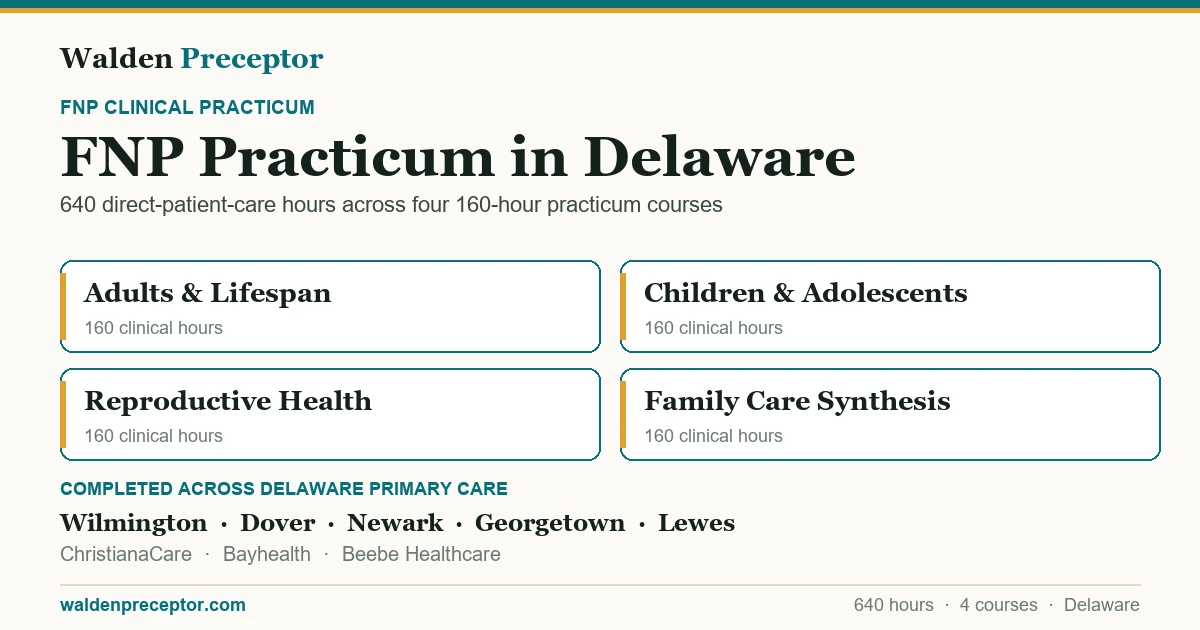
The Walden Master of Science in Nursing Family Nurse Practitioner specialization is built around 640 practicum hours, split evenly into four practicum courses of 160 hours each. Every hour is direct patient care, and the total is set by Walden and its accreditor, not by Delaware. A student in Wilmington logs the same 640 hours as one in Boise; the state changes who can precept you and how the placement is supervised, not the count.
Walden's FNP practicum is sequenced across four courses, each pairing a didactic NRNP or DRNP course with a PRAC or PRCM practicum under the same number. The numbering is catalog-year sensitive, so confirm yours in your program of study, but the current structure is:
| Course | Population focus | Hours |
|---|---|---|
| 6531 | Primary Care of Adults Across the Lifespan | 160 |
| 6541 | Primary Care of Adolescents and Children | 160 |
| 6552 | Advanced Nurse Practice in Reproductive Health | 160 |
| 6568 | Synthesis in Advanced Nursing Practice, family care settings | 160 |
This is the FNP-specific figure. Walden's other NP tracks also total 640 hours, but the course mix and patient populations differ, which is why a Delaware FNP placement is planned around primary care across the lifespan rather than a single setting. For the full program breakdown, see our Walden FNP page; for the state context, see our Delaware NP practicum guide. The official figures live in the Walden MSN Practicum Requirements.
What does Delaware's full practice authority mean for an FNP placement?
The American Association of Nurse Practitioners classifies Delaware as a Full Practice state, and the Delaware Board of Nursing answers the collaborative-agreement question plainly: full practice authority without a collaborative agreement is granted with licensure. In practice that means a licensed Delaware NP can evaluate patients, diagnose, order and interpret diagnostic tests, and start and manage treatment, including prescribing, under the sole authority of the Board of Nursing.
For a Walden FNP student, that scope is a tailwind. Because a Delaware NP precepts on their own license rather than through a tied physician, the pool of providers who can supervise and sign your 640 hours is wider than it is in a restricted state. A nurse-practitioner-led family practice can host you start to finish, and your preceptor can attest to the full breadth of primary-care decisions you need to see. Delaware's Board rules also draw a clean line on who may precept: a clinical preceptor must hold an active, unencumbered license as an APRN, physician assistant, pharmacist, or physician and practice in a comparable focus, which maps neatly onto Walden's own course-by-course preceptor criteria. That said, full practice authority is a licensing rule, not a site policy. An individual Delaware clinic or health system can still set its own expectations for hosting a student, so we confirm those with each preceptor before your first clinical day. You can read the AANP summary on its Delaware advocacy page.
What does the Delaware Board of Nursing require?
Nursing in Delaware is overseen by the Delaware Board of Nursing, inside the Division of Professional Regulation, with APRN licensure governed under Title 24 of the Delaware Code and the Board's rules and regulations. The Board does not dictate your Walden hour count, but it defines the scope your preceptor practices under and the standards a clinical preceptor must meet. Under the APRN regulations, a preceptor enhances faculty-directed clinical learning rather than replacing it, and as a Walden student you train under the direct supervision of your approved preceptor without holding a separate APRN license yourself.
The credential checks that matter for your preceptor and site sit with the Board:
- Your preceptor holds an active, unencumbered Delaware APRN, PA, pharmacist, or physician license in a comparable practice focus.
- The preceptor's population focus lines up with the FNP course you are taking, primary care across the lifespan.
- License status can be verified through Delaware's DELPROS system before a placement is finalized.
- The clinical site agrees to host you and to an affiliation agreement with Walden.
You can confirm a license or read the Board's standards at the Delaware Board of Nursing, the APRN license overview, and the DELPROS portal. The Board office sits in the Cannon Building in Dover.
Which Delaware settings fit a Walden FNP practicum?
Because the FNP role covers the whole family, your four courses need to span the lifespan, not one patient population. That points you toward primary-care settings: family medicine, internal medicine, pediatrics, and women's health. Delaware is compact, so a student can often reach two or three sites within a short drive, which makes covering all four courses realistic even on a full schedule. The state's care is concentrated across three counties:
New Castle County
Wilmington, Newark, and Bear along the I-95 corridor, where most of the state's family-medicine and pediatric practices sit, including the ChristianaCare ambulatory network.
Kent County
Dover and Milford, anchored by the Bayhealth system and its employed primary-care practices serving central Delaware.
Sussex County
Georgetown, Seaford, Lewes, and the Rehoboth coast, where Beebe Healthcare and growing primary-care offices serve year-round and seasonal patients.
Mapped to the FNP courses, that means an adult and lifespan primary-care practice for 6531, a pediatric or adolescent setting for 6541, reproductive and women's-health exposure for 6552, and a family-care setting broad enough to synthesize across populations for 6568. Some Delaware students find one family practice that covers several courses; others split across two or three sites. Both work, as long as each course's population requirement is met and every site has an affiliation agreement in place.
Does Walden assign my FNP preceptor in Delaware?
No. Walden expects you to secure your own qualified preceptor and clinical site for each course, then nominate that preceptor in Meditrek, Walden's nursing practicum portal, for the university's review and approval. Walden's Office of Field Experience supports the process with coaching and checklists and reviews what you submit, but the outreach falls to you. In a small, busy state like Delaware, where a handful of health systems employ most of the primary-care providers, that search can stall right when you are carrying didactic coursework.
That is the gap we fill. We source and confirm preceptors who meet Walden's published requirements for your FNP course and hand you a preceptor ready to nominate in Meditrek, then stay with you through Walden's review. To be precise about what that approval is: Walden reviews and approves the placement you submit. We do not, and cannot, call any preceptor "endorsed by Walden" before that review happens, and no service can guarantee a placement. What we provide is a vetted, qualified match and the legwork around it:
Tell us your course and county
Share which of the four FNP courses is next and where in Delaware you can travel, so we match population focus and geography at once.
We source a qualified preceptor
We find a Delaware preceptor whose license and practice focus meet Walden's course requirements, and confirm they will host you.
You nominate in Meditrek
You submit the preceptor and site in Meditrek for Walden's review. You cannot register for a practicum course without an approved Meditrek application.
Clear CastleBranch
Complete your background check, drug screen, and immunizations through CastleBranch. Delaware sites may add their own screening steps, which we flag early.
Log hours and get signed off
Track encounters in Meditrek through the placement; your preceptor signs your hours and evaluations there.
How fast can you finish a 160-hour FNP course in Delaware?
Walden caps how quickly you can burn through hours. Each 160-hour practicum course must run over no fewer than 8 weeks and be completed by the end of Week 10, with a daily maximum of 12 practicum hours. That math drives your Delaware scheduling more than anything else. At roughly two clinical days a week you land comfortably inside the window; a preceptor who can only host you for one short day a week can leave you scrambling near the deadline.
This is exactly why a Delaware match has to account for weekly availability, not just credentials. A willing preceptor who can give you steady days through an 8-to-10-week course is worth more than a prestigious site that can only fit you in once a fortnight. When we match you, we confirm the cadence up front so your 160 hours fit the term you are actually in. Compliance and any new affiliation agreement run in parallel through CastleBranch and Walden, and because a new Delaware site can take time to paper, we flag that early rather than two weeks before your start date.
Common questions from Walden FNP students in Delaware
How many hours is the Walden FNP practicum in Delaware?
The Walden FNP specialization requires 640 direct-patient-care practicum hours, divided into four practicum courses of 160 hours each. That total is set by Walden and is the same in Delaware as anywhere else; Delaware state law does not change the number. The hours must be completed in person at an approved Delaware clinical site under a qualified preceptor.
Does Delaware's full practice authority make it easier to find an FNP preceptor?
It helps. The Delaware Board of Nursing grants nurse practitioners full practice authority at licensure, so a Delaware NP can evaluate, diagnose, and prescribe without a tied physician and can precept a Walden FNP student on their own authority. That widens the pool of providers who can sign your hours. A specific clinic may still set its own rules for hosting students, which we confirm before you start.
Does Walden assign my FNP preceptor in Delaware?
No. Walden expects you to secure your own qualified preceptor and clinical site for each course, then nominate that preceptor in Meditrek for Walden's review and approval. Walden's Office of Field Experience supports the process but does not generally place you. We source and confirm a preceptor in Delaware who meets Walden's published requirements, ready for you to submit for Walden's review. We never describe a preceptor as endorsed by Walden before Walden reviews the placement.
How fast can the Walden FNP practicum be completed in Delaware?
Each 160-hour course must run over no fewer than 8 weeks and be completed by the end of Week 10, with a daily maximum of 12 practicum hours. At roughly two clinical days a week you finish comfortably inside that window. A Delaware preceptor who can only host you one short day a week can leave you short near the deadline, so we factor weekly availability into every match.
Which Delaware settings work for a Walden FNP placement?
FNP courses span the lifespan, so placements run through primary care: family medicine, internal medicine, pediatrics, and women's health across New Castle, Kent, and Sussex counties, including practices around Wilmington, Newark, Dover, and the Sussex coast. The 6552 course needs reproductive and women's-health exposure and 6541 needs pediatric and adolescent care, so a single family practice often covers several courses while specialty rotations fill the rest.
Where this comes from
- Walden University, MSN Practicum Requirements (640 hours, four 160-hour FNP courses, course codes)
- Walden University, Find a Preceptor (student-secured preceptor model, Meditrek)
- AANP, Delaware (State Practice Environment, Full Practice)
- Delaware Board of Nursing FAQ (full practice authority granted at licensure)
- 24 Del. Admin. Code 1900-8.0 (APRN rules, preceptor standards)
- Delaware Board of Nursing, Division of Professional Regulation
- DELPROS, Delaware license application and verification
Ready to lock in a Delaware FNP preceptor?
Tell us which of the four FNP courses is next and your county. We will source a preceptor who meets Walden's requirements, ready for you to nominate in Meditrek, usually within five days, and you pay nothing until you are matched. See pricing for what placement costs.