Walden FNP Preceptor in Georgia
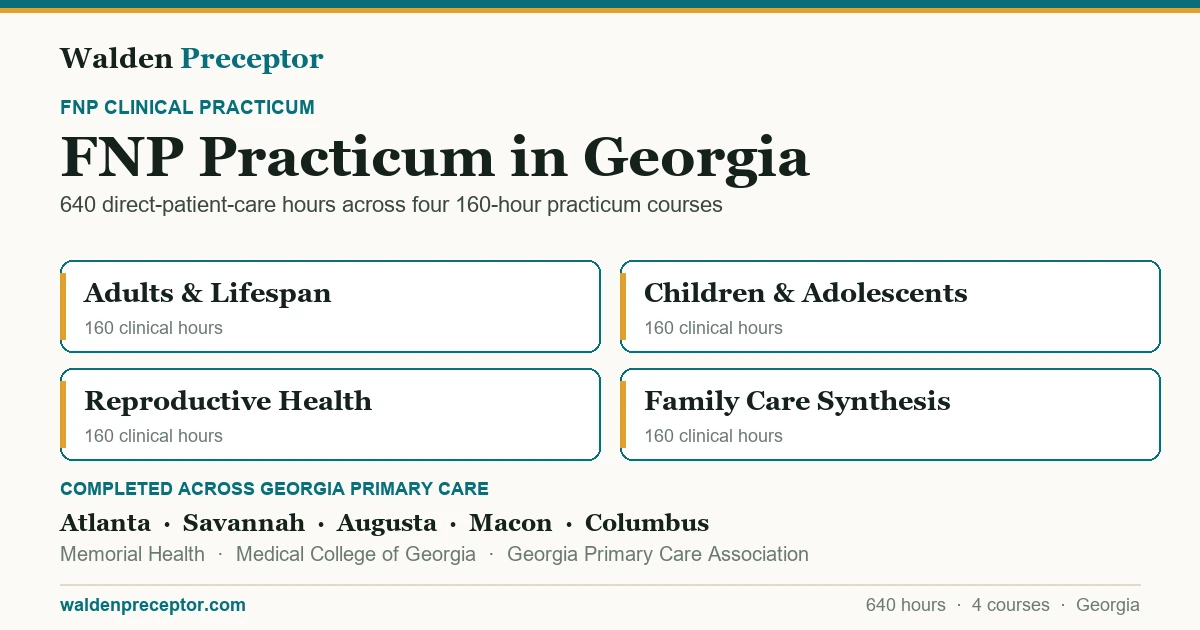
A Walden FNP practicum in Georgia requires 640 direct-patient-care hours across four 160-hour practicum courses under an FNP-qualified preceptor, and Georgia is an AANP restricted-practice state where a practicing NP prescribes under a written nurse protocol agreement with a delegating physician. That practice rule shapes who is precepting in Georgia clinics, but it does not change your path: secure a preceptor who meets Walden's published FNP requirements, nominate them in Meditrek, and submit the placement for Walden's review. We do the Georgia search for you, from Savannah to the suburbs north of Atlanta.
Last updated 2026-06-28 · Reviewed by the Walden Preceptor placement team
Start your placement, free
Tell us your program. We map the whole practicum. No payment until you are matched.
How many practicum hours does the Walden FNP track need in Georgia?
The Walden Master of Science in Nursing Family Nurse Practitioner specialization carries 640 practicum hours, divided evenly into four 160-hour practicum courses. That total is set by Walden's program and does not change because you are in Georgia. Where Georgia enters the picture is the clinical site itself: the preceptor you find, the setting they practice in, and the state compliance your site expects before you start. The four FNP practicum courses move you across the whole family lifespan, which means a single Georgia practice does not always cover every course.
| Practicum course | Patient focus | Hours |
|---|---|---|
| PRAC/PRCM 6531 | Primary Care of Adults Across the Lifespan | 160 |
| PRAC/PRCM 6541 | Primary Care of Adolescents and Children | 160 |
| PRAC/PRCM 6552 | Advanced Nurse Practice in Reproductive Health | 160 |
| PRAC/PRCM 6568 | Synthesis in Advanced Nursing Practice, family care settings | 160 |
Course numbering is catalog-year sensitive; confirm yours in your Walden program of study. For the full FNP requirement breakdown, see our Walden FNP preceptor page.
What does Georgia's restricted-practice status mean for an FNP precepting relationship?
The American Association of Nurse Practitioners classifies Georgia as a restricted-practice state. In plain terms, a Georgia NP who diagnoses, treats, and prescribes does so under a written nurse protocol agreement with a delegating physician, registered through the Georgia Composite Medical Board under O.C.G.A. Section 43-34-25, rather than practicing independently. This is the environment you step into after licensure, and it is worth understanding now because it shapes the clinics you will precept in.
The practical effect for a Walden FNP student is twofold. First, many of the strongest Georgia preceptors are NPs already working inside a physician-collaborative arrangement, alongside the physician who delegates to them, so a practice that hosts students is usually set up for supervision in a way that maps cleanly onto a preceptor role. Second, physicians themselves are common FNP preceptors here, precisely because the restricted model keeps physicians close to advanced-practice care. Neither the protocol agreement nor the restricted status gates your student practicum. Your preceptor only needs to meet Walden's published FNP preceptor requirements for the course you are taking, and we submit the proposed placement for Walden's review.
Restricted, not closed
Restricted authority limits independent prescribing, not your ability to learn. Georgia has thousands of NPs and physicians precepting students across primary care.
Protocol-based culture
Prescriptive authority flows from a nurse protocol agreement with a delegating physician. Clinics that already supervise this way understand precepting.
Plan for after you graduate
Choosing a Georgia site whose model mirrors how you will practice helps you read the right board rules once you hold a Georgia APRN authorization.
Which Georgia rules actually touch your FNP preceptor?
Two Georgia agencies divide the work, which surprises students arriving from full-practice states. Your underlying APRN authorization and license verification sit with the Georgia Board of Nursing under the Secretary of State, so you can confirm a potential preceptor's license through the state portal before you ever nominate them. The prescribing piece, the nurse protocol agreement, is reviewed and registered by the Georgia Composite Medical Board under rules Chapter 360-32. As a Walden student you are not filing a protocol, but the rules that govern Georgia preceptors are worth knowing because they describe the supervision your preceptor already lives under. Our Georgia practicum placement page covers how the two boards split duties across every NP track; this page stays on the FNP-specific picture.
A few specifics that genuinely differentiate Georgia from a full-practice state:
- A Georgia delegating physician may hold nurse protocol agreements with no more than the combined equivalent of eight APRNs or physician assistants at any one time, so a busy collaborating physician is a finite resource that strong students compete for.
- The protocol must provide for immediate consultation, meaning the delegating physician is reachable for direct communication by phone or other telecommunications, and it requires direct on-site observation of the NP at least once a year. That habit of close oversight is why many Georgia practices are comfortable hosting a student.
- Under House Bill 557 (2024), a Georgia APRN with at least one year of post-licensure experience may prescribe certain Schedule II medications in emergencies, limited to an initial 5-day supply for patients 18 and older. A preceptor with this authority widens what you can observe.
- Public license verification is available online, so we can confirm a preceptor's credentials before you submit anything to Walden.
These are the rules a Georgia preceptor practices under; they are background for your student practicum, not requirements Walden places on you.
What FNP settings host Walden students in Georgia?
Because the FNP role covers the whole family, your four practicum courses need primary-care exposure across the lifespan, not a single population. In Georgia that usually means family medicine and internal medicine practices, pediatric and women's-health clinics, and the state's large network of community health centers. Georgia has one of the more developed federally qualified health center systems in the Southeast, organized through the Georgia Primary Care Association since 1977, and those centers are frequently open to precepting because teaching is part of their mission. We work across the state, not just the metro core:
Metro Atlanta and the north
Atlanta, Marietta, Alpharetta, Roswell, Sandy Springs, and the Gwinnett corridor: the deepest pool of family-medicine, pediatric, and women's-health sites for covering all four FNP courses.
Coast, midstate, and the CSRA
Savannah and the Memorial Health area, Augusta near the Medical College of Georgia, plus Macon and Columbus: strong primary-care and community-health options for students outside metro Atlanta.
Some Walden students find one Georgia practice that spans several courses; others split across two or three sites to hit the pediatric, reproductive, and adult-lifespan requirements. Both work, as long as each course's population requirement is met and each site has an affiliation agreement on file with Walden.
How do you actually find an FNP preceptor in Georgia?
This is where most Walden FNP students stall, and it is the part we own. Walden expects you to secure your own preceptor and clinical site, then nominate them in Meditrek so the Office of Field Experience can review and approve the placement; Walden's Practicum Pledge can match students whose own search comes up empty. Cold-calling Georgia clinics and waiting on callbacks while a term clock runs is exactly the situation we exist to remove. The reality on the ground is that a strong collaborating physician can only carry so many advanced-practice providers at once, so the best primary-care preceptors fill quickly, especially around a new term.
We match Walden FNP students with vetted Georgia preceptors whose credentials and patient population line up with the specific course you are taking, confirm they meet Walden's published FNP preceptor requirements before you submit anything, and help you get them into Meditrek cleanly so you are not redoing the work after a rejection. We never tell you a preceptor is "endorsed by Walden." Walden reviews and approves the placement you propose; our job is to hand you a qualified Georgia preceptor and a clean nomination, then let Walden's review run its course.
Tell us your course and your part of Georgia
Which FNP course is next (6531, 6541, 6552, or 6568), your city, and your schedule. That sets the population and drive radius we match against.
We source a qualified Georgia preceptor
We confirm the preceptor's Georgia license and that they meet Walden's published FNP criteria for your course before you ever submit a nomination.
You nominate in Meditrek for Walden's review
You submit the preceptor and site in Meditrek. You cannot register for the practicum course without an approved Meditrek application, so we build in lead time.
Clear Georgia site compliance
Background check, drug screen, immunizations, and trainings run through CastleBranch, with state and site-specific items. We help you read exactly what your Georgia site requires.
Log hours and get signed off
You track encounters in Meditrek inside the 12-hours-per-day cap, over at least 8 weeks and by Week 10, and your preceptor signs your hours in the portal.
How do Walden's scheduling caps play out at a Georgia site?
Walden limits how fast you can complete each 160-hour course. You can log a maximum of 12 practicum hours per day, your hours must be spread over no fewer than 8 weeks, and they must be finished by the end of Week 10 of the course. That math matters when you pick a Georgia preceptor. At two clinical days a week you sit comfortably inside the window for a 160-hour course; a preceptor who can only host you one day a week leaves you scrambling near the deadline. Because the FNP practicum hours are direct patient care, they happen in person at your approved Georgia site with your preceptor present, not online and not fully by telehealth. The coursework and faculty seminars that brought you to Walden stay online; the clinical hours are hands-on, which for most Georgia students means finishing close to home, whether that is a family practice in Savannah or a community clinic in Macon. We factor a preceptor's real availability into the match so your schedule is workable from day one.
Common questions from Walden FNP students in Georgia
How many hours does a Walden FNP practicum in Georgia require?
The Walden FNP specialization requires 640 direct-patient-care hours, split into four 160-hour practicum courses (6531, 6541, 6552, and 6568). The hour total is set by Walden and is the same in Georgia as in any other state. Each course's hours are completed over no fewer than 8 weeks, by the end of Week 10, with a maximum of 12 practicum hours per day, and are logged for your preceptor to sign in Meditrek.
Does Georgia's restricted-practice status stop me from precepting under an NP?
No. Georgia is an AANP restricted-practice state, which means a practicing NP prescribes under a written nurse protocol agreement with a delegating physician. That is the post-licensure practice environment, not a practicum rule. A qualified Georgia NP can still precept a Walden FNP student. Your preceptor only needs to meet Walden's published FNP preceptor requirements, and we submit the proposed placement for Walden's review.
Can a physician in Georgia precept my Walden FNP practicum?
Yes. A Georgia-licensed physician can serve as an FNP preceptor when the patient population fits your course, and physicians are common preceptors in this restricted-practice state because they already delegate to NPs under nurse protocol agreements. The preceptor must meet Walden's course-specific criteria, and we confirm that before nominating them in Meditrek.
Will Walden place me with a Georgia preceptor?
Generally you secure your own Georgia preceptor and site, then nominate them in Meditrek for Walden's review and approval. Walden's Practicum Pledge can match students whose own search is unsuccessful. We do the Georgia search for you, confirm the preceptor meets Walden's published FNP requirements, and submit the placement for Walden's review. We never promise that Walden will approve a placement.
Where in Georgia can I complete Walden FNP clinical hours?
FNP hours are completed in person at an approved Georgia primary-care site with your preceptor present. Common settings include family medicine and internal medicine practices, federally qualified health centers, and community clinics across metro Atlanta, Savannah, Augusta, Macon, and Columbus. We match you to a site within a reasonable drive when the course's population mix allows.
Sources
- Walden University, MSN Practicum Requirements (FNP 640 hours, four 160-hour courses, daily and weekly caps)
- Walden University, Find a Preceptor (student-secured model, Meditrek, Practicum Pledge)
- AANP State Practice Environment (Georgia restricted classification)
- Georgia rules Chapter 360-32, nurse protocol agreements under O.C.G.A. 43-34-25 (immediate consultation, on-site observation, eight-provider limit)
- Georgia Composite Medical Board, APRN protocol registration
- Georgia Board of Nursing (Secretary of State), APRN authorization and license verification
- Georgia Primary Care Association, federally qualified health centers
Ready to lock in your Georgia FNP preceptor?
Tell us which FNP course is next and your part of Georgia. We will source a vetted preceptor, confirm they meet Walden's published FNP requirements, and get you cleanly nominated in Meditrek for Walden's review. No payment until you are matched.