Walden FNP Preceptor in Louisiana
A Walden FNP practicum in Louisiana requires 640 direct-patient-care hours across four 160-hour practicum courses, completed under a Louisiana-licensed preceptor and logged in Meditrek. Louisiana is a reduced-practice state, so the nurse practitioner who precepts you works under a collaborative practice agreement with a physician. That rule shapes which preceptor and site fit your four courses, and it is the part we sort out for you, with no payment until you are matched.
Last updated 2026-06-28 · Reviewed by the Walden Preceptor placement team
Start your placement, free
Tell us your program. We map the whole practicum. No payment until you are matched.
What does the Walden FNP practicum look like in Louisiana?
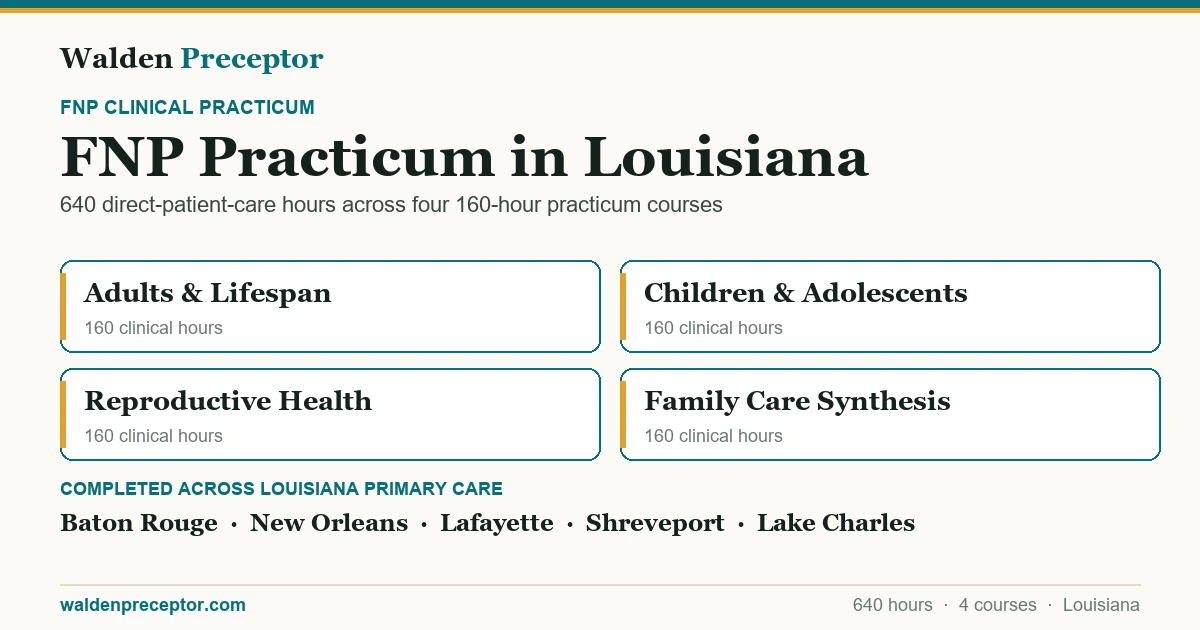
The clinical requirement does not move at the Louisiana state line. The Walden MSN Family Nurse Practitioner specialization is built on 640 practicum hours, divided evenly into four practicum courses of 160 hours each: 6531 (Primary Care of Adults Across the Lifespan), 6541 (Primary Care of Adolescents and Children), 6552 (reproductive health), and 6568 (Synthesis, family care settings). Those four courses, their populations, and the full hour breakdown live on the Walden FNP page, and the general state rules sit on the Louisiana placement page. This page is the narrow overlap of the two: a Walden FNP student placing in Louisiana.
What Louisiana changes is not the number, but who can sign off on your hours and under what structure. Because the state classifies nurse practitioners as reduced practice, a Louisiana NP who precepts you almost always works under a collaborative practice agreement with a physician. That is not a barrier to your practicum. It simply defines the preceptor and site you are looking for: a currently authorized Louisiana NP, or a physician, whose own scope matches the family and primary care population your four FNP courses cover.
How does Louisiana reduced practice affect an FNP preceptor?
The American Association of Nurse Practitioners classifies Louisiana as a reduced-practice state (AANP, State Practice Environment). Reduced practice means state law limits at least one element of independent NP practice. In Louisiana, the central limit is that an APRN must hold an approved collaborative practice agreement, a written document mutually agreed between the APRN and one or more Louisiana-licensed physicians or dentists, to medically diagnose, manage, and prescribe (LSBN, Collaborative Practice Agreement template).
A few details of how Louisiana regulates that agreement quietly shape who is actually free to precept you, and most FNP students do not learn them until they are mid-search:
- Recent clinical currency. To hold prescriptive authority, a Louisiana APRN must have current clinical practice of at least 500 hours as an APRN within the last two years in the role and population for which they are authorized. A preceptor who is genuinely active in primary care, not stepped back from clinical work, is the one who can model the full workflow your FNP courses expect (LSBN, Advanced Practice Registered Nurse).
- No more than two collaborating physicians per site. The board approves a limited number of collaborating physicians for each practice site, which can quietly cap how many APRN preceptors a busy Louisiana clinic can support at once (La. Admin. Code tit. 46, XLVII-4513).
- Same or comparable specialty. The collaborating physician must practice in a scope, specialty, or expertise comparable to the APRN's, and the collaborating license is verified through the Louisiana State Board of Medical Examiners. For a family and primary care preceptor, that physician is usually in family or internal medicine, which is why a primary care clinic is the natural home for your FNP hours.
- Physician availability, not constant presence. The rule requires the collaborating physician to be available "face-to-face, by telephone, or by direct telecommunications" for consultation, emergencies, or referral. The physician does not have to stand over the visit, so a Louisiana NP can run the primary care day you are learning from (La. Admin. Code tit. 46, XLVII-4513).
When we vet a Louisiana FNP preceptor, confirming that the agreement, the specialty match, and the authorization are current is part of the check. That is how you avoid the worst version of this: learning mid-rotation that the clinician signing your Meditrek hours was not authorized for the scope you logged.
Why is precepting law a career issue, not a practicum blocker?
The collaborative practice agreement binds the licensed APRN, not you as a Walden student. During your practicum you observe and treat under your preceptor's license and supervision, so Louisiana's reduced-practice rule does not stop you from completing your 640 hours. It matters later: the day you pass certification and apply for Louisiana APRN licensure, you will need your own agreement and, for prescribing, the 500-hour currency and a board-approved physician. Walden also places Louisiana outside the small set of state exceptions to the 640-hour total, so there is no Kansas-style adjustment; a Louisiana FNP follows the standard 640-hour, four-course path (Walden, MSN Practicum Requirements).
| FNP practicum element | What it means for a Louisiana placement |
|---|---|
| Total hours | 640, across four 160-hour courses, unchanged in Louisiana |
| Preceptor type | Louisiana-licensed NP (under a collaborative agreement) or a physician |
| Specialty match | Family or primary care, to satisfy the comparable-specialty rule |
| Prescribing currency | Best modeled by a preceptor with 500+ recent APRN hours and active authority |
| What we verify | Current Louisiana license, agreement, and population fit before you nominate |
Which patient populations must your 640 Louisiana hours cover?
The FNP is a lifespan role, so your four courses cannot sit in one age group. Across 6531, 6541, 6552, and 6568 you move through adult and older-adult primary care, pediatric and adolescent care, reproductive and women's health, and finally a family-care synthesis setting that ties the populations together. In Louisiana the practical wrinkle is access rather than rule: a single primary care clinic that sees the whole family lets you satisfy the spread under one collaborative agreement, instead of stitching together several sites and several agreements, each of which is its own approval. Some students cover all four courses at one practice; others split across two. Both work, as long as each course's population is met and every site has an affiliation agreement in place.
How do Walden's pacing caps change a Louisiana plan?
This is the Walden-specific constraint that turns site choice into a scheduling problem. Each 160-hour course must be completed over no fewer than eight weeks and finished by the end of Week 10, with a daily maximum of 12 practicum hours, all of which must be direct patient care (Walden, MSN Practicum Requirements). Do the arithmetic against a Louisiana reality. At roughly two clinical days a week you clear 160 hours comfortably inside the window. A preceptor who can only host you one day a week, which is common when the only nearby family-medicine clinic is short-staffed, leaves almost no margin before the Week 10 deadline. So in Louisiana the question is not only whether a preceptor exists, but whether the days they can offer fit the eight-to-ten-week course they are signing. We screen for that cadence when we match you, so your schedule is realistic from the first clinical day rather than a scramble in Week 9.
Where do Walden FNP students actually find a preceptor in Louisiana?
Geography decides most of this. FNP-appropriate primary care is most reachable in and around Louisiana's larger care hubs, where family medicine, internal medicine, pediatric, and women's health clinics cluster. Demand is real: Louisiana licenses several thousand nurse practitioners across the state, but they are unevenly spread, and many of the busiest family-medicine NPs, the ideal preceptors, are exactly the clinicians with the least spare time to take a student (NP Schools, Louisiana NP practice). We place across these regions and the parishes around them:
Baton Rouge
Capital-region family medicine, internal medicine, and pediatric clinics across East Baton Rouge and Ascension.
New Orleans
Greater New Orleans and Jefferson Parish primary care, women's health, and family-medicine panels.
Lafayette
Acadiana family medicine and community health, where NPs carry much of the primary care load.
Shreveport
Northwest Louisiana family and adult-gerontology primary care across Caddo and Bossier.
Lake Charles
Southwest Louisiana outpatient and family-medicine placements through Calcasieu.
Monroe and Alexandria
Northeast and central Louisiana, plus the surrounding rural parishes when you need hours closer to home.
You can confirm a potential preceptor's Louisiana license and APRN authorization yourself through Nursys, the national verification service Louisiana uses, before you ever nominate them. We run that check as part of vetting, but it is worth knowing where to look, because a credential problem caught early is the difference between a clean Meditrek nomination and a lost week.
What clears before your Louisiana FNP practicum starts?
Once you identify a preceptor and site, the same clearance gates apply, and any one of them left open stalls your start. Walden manages practicum application, site and preceptor approval, hour logging, and evaluations through Meditrek; it is not assigned to you, so the timing is on you.
Nominate in Meditrek
Submit your Louisiana site and preceptor for approval in Meditrek, with the preceptor's license and population coverage documented. No approved application means no practicum registration.
Affiliation agreement
Walden needs a signed affiliation agreement with your Louisiana site before you start. Some clinics already have one on file; others need it set up, which takes time, so we flag it early.
CastleBranch (myCB)
Background check, drug screen, immunizations, and trainings run through CastleBranch, with site-specific and Louisiana-specific requirements. Walden does not accept outside checks.
Log and sign off
You record direct-patient-care hours in Meditrek per course, and your Louisiana preceptor approves what you log and completes your evaluation before the course closes.
In-person or virtual FNP practicum in Louisiana?
Your direct patient-care hours are in person, at your approved Louisiana site, with your preceptor present; that is what Meditrek tracks and what your course objectives require. Telehealth can be part of the clinical day when your preceptor practices that way and the site allows it, but you are physically there under supervision, not logging hours from your kitchen table. What can be remote is the wraparound: some preceptor check-ins, faculty contact, and all of your coursework. If you live in a smaller parish, the goal is a strong in-person site within a workable commute for a full term of clinical days, paired with the online structure Walden already provides. We factor your location into the match so the drive is sustainable across the whole eight-to-ten-week course.
Louisiana FNP FAQ
How many practicum hours does the Walden FNP need in Louisiana?
The Walden MSN-FNP requires 640 practicum hours across four practicum courses of 160 hours each (6531, 6541, 6552, and 6568). That total is the same in Louisiana as anywhere else. What changes in Louisiana is that the licensed NP who precepts you works under a collaborative practice agreement with a physician, because Louisiana is a reduced-practice state.
Can a Louisiana nurse practitioner precept my Walden FNP practicum?
Yes. A Louisiana-licensed NP can precept your Walden FNP hours, and so can a physician. Because Louisiana is reduced practice, an NP preceptor maintains an approved collaborative practice agreement with a physician. To hold prescriptive authority, that NP must also have at least 500 hours of recent APRN clinical practice within the last two years, so we confirm the preceptor and site are currently authorized before you nominate them in Meditrek.
Does Louisiana reduced practice stop me from logging my Walden FNP hours?
No. The collaborative practice agreement is a rule for the licensed APRN, not for you as a student. During your practicum you observe and treat under your preceptor's supervision and license. The reduced-practice rule matters mostly for your own career after you graduate and apply for APRN licensure in Louisiana, not for completing your 640 supervised hours.
How fast does a Walden FNP need a preceptor approved before each course?
Before the practicum course begins. You cannot register for a Walden practicum course without an approved Meditrek application, and 160 hours must be spread over at least eight weeks and finished by the end of Week 10, with a daily cap of 12 practicum hours. That pacing means a Louisiana site that can host you only one day a week leaves little margin, so the nomination and affiliation agreement should clear early.
Where do Walden FNP students find a preceptor in Louisiana?
FNP-appropriate primary care is most reachable in family medicine, internal medicine, pediatric, and women's health clinics around Baton Rouge, New Orleans, Lafayette, Shreveport, Lake Charles, Monroe, and Alexandria. We match Walden FNP students to a vetted Louisiana preceptor and an approved site across these regions, with no payment until you are matched.
Sources
- Walden University, MSN Practicum Requirements (640 hours, four 160-hour courses, pacing caps)
- AANP, State Practice Environment (Louisiana, reduced practice)
- Louisiana Administrative Code, tit. 46, XLVII-4513 (authorized practice, collaborating physicians, availability)
- Louisiana State Board of Nursing, Collaborative Practice Agreement template
- Louisiana State Board of Nursing, Advanced Practice Registered Nurse (500-hour currency, prescriptive authority)
A Louisiana FNP placement, without the cold outreach
You now know the two things that make a Louisiana FNP placement harder than the average state: a reduced-practice rule that puts your preceptor under a collaborative agreement, and Walden's eight-to-ten-week pacing that punishes a one-day-a-week site, layered on top of the search being yours to run. We close all of that. We secure a vetted, Louisiana-authorized FNP preceptor whose panel fits your four courses, confirm their license and authorization, help you assemble a Meditrek nomination that clears, and chase the affiliation agreement so your hours stay on schedule.
- All four FNP courses covered, from one Louisiana site or several
- Preceptor cadence matched to the eight-to-ten-week, 12-hour-a-day caps
- No payment until matched, and a clear quote at your free consult
Get a Walden FNP preceptor in Louisiana
Tell us which of the four courses is next and where in Louisiana you are. We will find a vetted, authorized preceptor and an approved site, help you build the Meditrek nomination, and map all 640 hours. No payment until you are matched.