Walden FNP Preceptor in Mississippi
A Walden FNP practicum in Mississippi requires 640 direct-patient-care hours across four 160-hour practicum courses under a qualified preceptor. Mississippi is a reduced-practice state, so that preceptor works under a collaborative agreement with a physician and generally treats patients within 75 miles of the physician's primary office. You step into that already-approved practice as a student, complete your supervised hours, and log them in Meditrek. We find the preceptor and site for you across the state, and you pay nothing until you are matched.
Last updated: June 28, 2026 · Reviewed by the Walden Preceptor placement team
Start your placement, free
Tell us your program. We map the whole practicum. No payment until you are matched.
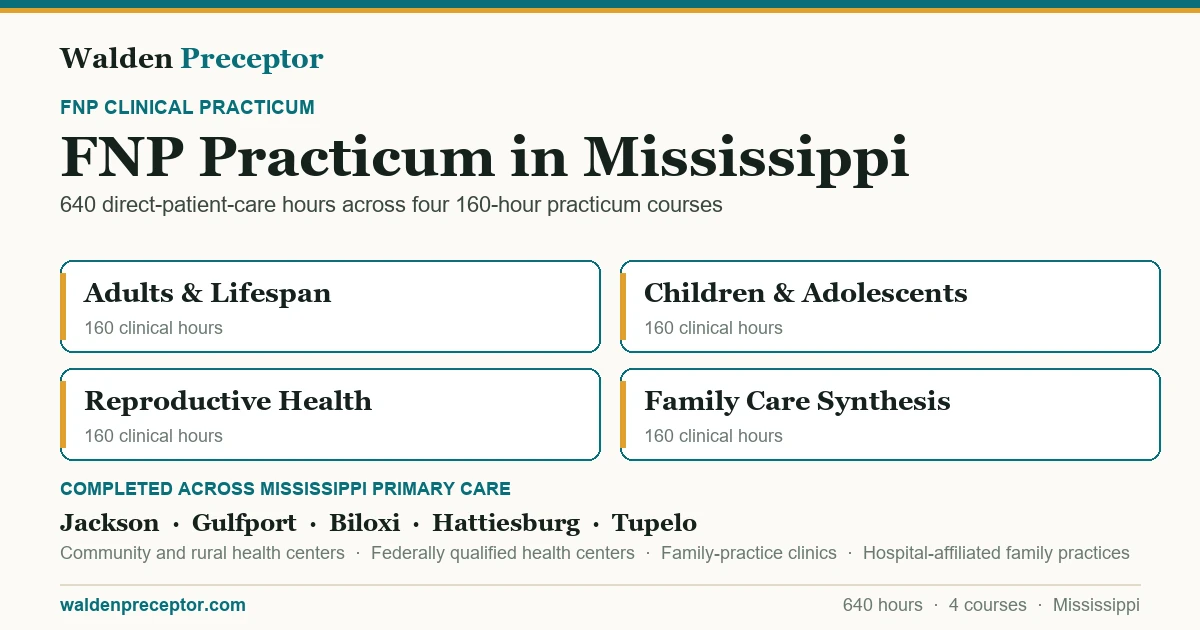
How many hours does a Walden FNP need in Mississippi?
The number does not change at the state line. Walden's MSN Family Nurse Practitioner specialization is built around 640 practicum hours, divided evenly into four practicum courses of 160 hours each. Every hour must be direct patient care, and the four courses walk you across the full lifespan in primary care. The Mississippi piece sits underneath those hours: it shapes how your preceptor's practice is structured, not how many hours you owe.
| FNP practicum course | Patient focus | Hours |
|---|---|---|
| 6531 | Primary care of adults across the lifespan | 160 |
| 6541 | Primary care of adolescents and children | 160 |
| 6552 | Advanced practice in reproductive health | 160 |
| 6568 | Synthesis, care of patients in family care settings | 160 |
Course numbering is catalog-year sensitive; confirm your own program map. Source: Walden University, MSN practicum requirements. The full breakdown lives on our Walden FNP page.
What does Mississippi's reduced-practice law mean for an FNP preceptor?
The American Association of Nurse Practitioners classifies Mississippi as a reduced practice state. In plain terms, a nurse practitioner here cannot practice fully on their own. Every NP must keep a collaborative relationship with a Mississippi-licensed physician whose practice is compatible with the NP's, and that requirement runs for the length of the NP's career under current law.
The mechanics are specific, and they explain a lot about how Mississippi clinics are set up. Under Title 30, Part 2630 of the state's collaboration rules, a nurse practitioner is authorized to treat patients within 75 miles of the collaborating physician's primary office. A practice that stays inside that radius does not have to file its protocol with the board for approval. A practice that wants to operate farther than 75 miles from the physician's office has to apply to the Mississippi State Board of Medical Licensure and appear before the board for approval. On top of that, the collaborating physician reviews the lesser of 10 percent or 20 randomly selected charts each month and meets with the nurse practitioner face to face at least once a quarter, and each collaboration runs a documented quality-assurance program kept on site.
For your FNP rotation, none of that paperwork is yours to file. Your preceptor already operates inside this structure, fully recognized by the state. You join an approved practice, work under supervision, and the collaboration governs your preceptor's license, not your enrollment. A 2025 bill (HB 849) would have let APRNs drop the collaborative agreement after 8,000 hours, but it died in the Senate, so the agreement remains required statewide. We confirm that your match is set up correctly before you ever start logging hours.
Who can precept a Walden FNP student in Mississippi?
Because the FNP role covers the whole family, your preceptor and site have to match the patient population of the course you are taking, not just hold any clinical license. Walden requires a 1:1 preceptor-to-student ratio for direct supervision, so your preceptor takes one student at a time. Across the four courses you need exposure that spans the lifespan, which in Mississippi usually means a mix of family-medicine and primary care providers.
- A licensed FNP, NP, physician, or PA whose scope fits the specific FNP course
- Adult and lifespan primary care for the 6531 course
- Pediatric and adolescent care for the 6541 course
- Reproductive and women's health exposure for the 6552 course
- A family-care setting that lets you synthesize across populations for 6568
An experienced FNP can precept you. In Mississippi that NP preceptor still practices under their own physician collaboration, but for your practicum the test is simpler: does their credential, scope, and patient mix meet Walden's criteria for the course? We confirm licensure through the Mississippi Board of Nursing and national certification before we propose anyone, because a clean, verifiable license is one of the first things Walden's Office of Field Experience checks when it reviews your nomination.
How does placement and Meditrek work in Mississippi?
Walden expects you to secure your own preceptor and site, then nominate that preceptor in Meditrek for approval before the practicum course begins. The university coaches and reviews, but it does not generally assign preceptors. We close that gap: we do the outreach, the vetting, and the paperwork legwork across Mississippi, then hand you a clean nomination so it clears review the first time rather than bouncing back.
Match a qualified preceptor and site
We confirm an FNP-appropriate preceptor and a Mississippi site whose population fits your course and whose location is workable from where you live.
Nominate in Meditrek
You submit the preceptor and site for approval in Meditrek. You cannot register for a practicum course without an approved application, so we build in lead time.
Sign the affiliation agreement
Walden and your Mississippi site must have a signed affiliation agreement on file before hours begin. We flag whether one already exists or needs to be set up.
Clear CastleBranch compliance
Complete your background check, screenings, immunizations, and site-specific requirements through CastleBranch at walden.castlebranch.com. Mississippi clinics often add their own steps, which we surface early.
Log hours and get signed off
Track patient encounters and time in Meditrek across your 160-hour course. Your preceptor signs off your hours and completes evaluations in the portal.
Your hours and nomination are submitted for Walden's own review and approval. We match preceptors who meet Walden's published requirements; the university makes the final call, and we never present a placement as guaranteed or Walden-endorsed. For the deeper Meditrek and compliance walkthrough, see our FNP placement guide and the Mississippi state overview.
How fast can I finish 160 hours per course in Mississippi?
Walden sets the pace, not the state. You can log a maximum of 12 practicum hours per day, your hours must be spread over no fewer than 8 weeks, and you generally finish by the end of Week 10. With 160 hours in each FNP course, that math matters. At roughly two clinical days a week you sit comfortably inside the window. A Mississippi preceptor who can only host you one day a week leaves you sprinting near the deadline, and a preceptor 80 miles away that you can only reach once a week is a scheduling problem before it is a driving problem. When we match you, we account for the 75-mile reality of where collaborating practices sit, your commute, and your weekly availability, so the in-person requirement is realistic from day one rather than a crisis in Week 9.
Where do Walden FNP students complete hours in Mississippi?
Roughly 1.6 million Mississippians live in a designated primary-care shortage area, so family-medicine demand is spread across the state rather than stacked in one city. That works in your favor: primary care offices, community and rural health centers, and hospital-affiliated family practices that precept exist in every region. We place students in settings across:
Jackson metro
The capital region plus Madison, Ridgeland, and Clinton, with the widest range of family-practice and women's-health sites for the FNP courses.
Gulf Coast
Gulfport, Biloxi, and Pascagoula, strong for lifespan family medicine and the adult-focused 6531 course.
Pine Belt
Hattiesburg and Laurel, with teaching-friendly clinics that are used to precepting FNP students across pediatrics and adults.
The Delta
Greenville, Cleveland, and Greenwood, where federally qualified and rural health center placements are common and primary care need is highest.
North Mississippi
Tupelo, Oxford, and Southaven, including DeSoto County practices serving the Memphis border for family and pediatric hours.
Golden Triangle
Columbus, Starkville, and West Point for family-practice and synthesis 6568 rotations.
Rural and community health center placements are a real strength in Mississippi for FNP students, because those sites see the full age range a family course requires under one roof. We match to the region you can realistically reach, then confirm the site and preceptor before you nominate.
Mississippi FNP practicum FAQ
How many practicum hours does a Walden FNP need in Mississippi?
The Walden FNP track requires 640 direct-patient-care hours, split into four practicum courses of 160 hours each (6531, 6541, 6552, and 6568). That total is set by Walden and does not change because you practice in Mississippi. What Mississippi adds is the collaboration structure your preceptor works inside, not extra hours.
Does Mississippi's collaborative agreement rule affect my Walden FNP practicum?
Indirectly. Mississippi is a reduced-practice state, so your FNP preceptor must hold a collaborative relationship with a Mississippi-licensed physician, and patients are generally treated within 75 miles of that physician's primary office. You are a student inside that already-approved setup. You do not file your own collaborative agreement; you complete supervised hours and log them in Meditrek.
Can my Mississippi FNP preceptor be a nurse practitioner, or must it be a physician?
An experienced FNP or other qualified NP can precept you, provided they meet Walden's course-specific preceptor criteria and the patient population matches the course. In Mississippi that NP preceptor still practices under their own collaborative agreement with a physician, but for your practicum what matters is that their credential and scope fit the FNP course you are taking.
How fast can I complete 160 hours per FNP course in Mississippi?
Walden caps you at 12 practicum hours per day, requires the hours to be spread over no fewer than 8 weeks, and expects them completed by the end of Week 10. At 160 hours per course, roughly two clinical days a week keeps you inside the window. A Mississippi preceptor who can only host you one day a week makes the deadline tight, which is why we match for schedule, not just location.
Where in Mississippi do Walden FNP students complete clinical hours?
Family-practice clinics, community and rural health centers, and primary care offices across the Jackson metro, the Gulf Coast, the Pine Belt, the Delta, and north Mississippi. Roughly 1.6 million Mississippians live in a primary-care shortage area, so family-medicine sites that precept are spread statewide rather than concentrated in one city.
Sources
- Walden University, MSN practicum requirements (640 hours, four 160-hour FNP courses, scheduling caps)
- Walden University, Find a Preceptor (student-secured model, Meditrek nomination)
- AANP State Practice Environment (Mississippi reduced-practice classification)
- Mississippi State Board of Medical Licensure, APRN Collaboration (75-mile rule, chart review, quarterly meeting, Title 30 Part 2630)
- Mississippi Board of Nursing, Advanced Practice Registered Nurse (APRN licensure)
- Magnolia Tribune (HB 849 8,000-hour exemption failed in the 2025 Senate)
Lock in your Mississippi FNP preceptor
Tell us your next FNP course, your city, and your weekly availability. We map your 640 hours, match a preceptor who meets Walden's requirements within 75 miles of where you live, and submit a clean Meditrek nomination for Walden's review. No payment until you are matched, with a typical match in five days.