Walden FNP Preceptor in North Carolina
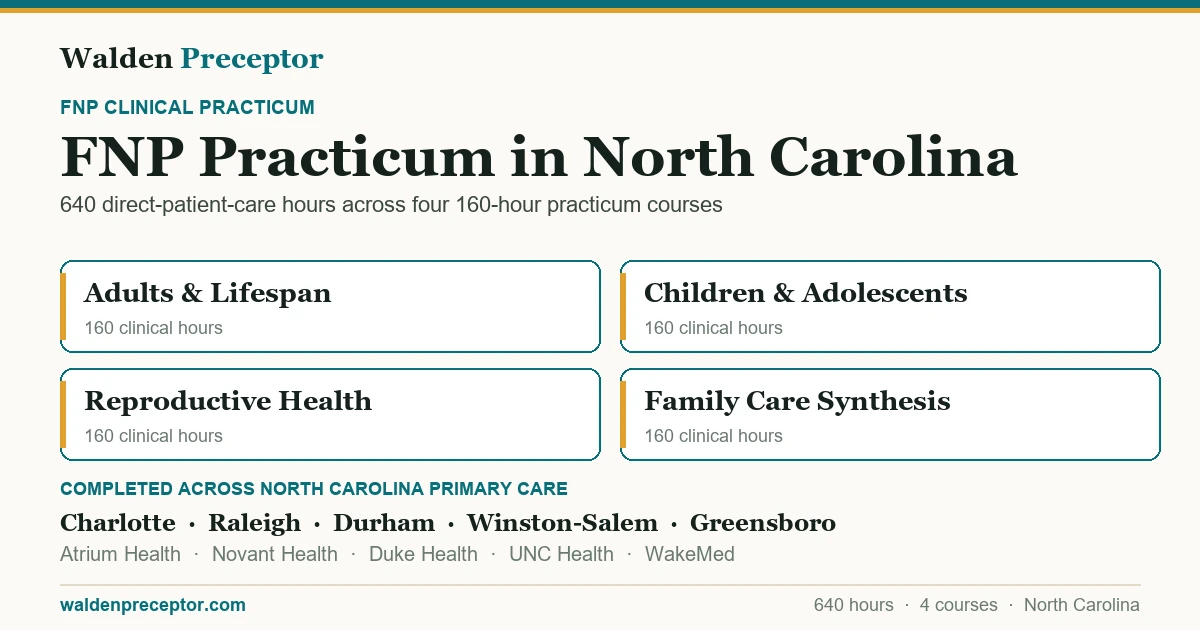
A Walden FNP practicum in North Carolina requires 640 direct-patient-care hours across four 160-hour practicum courses, completed in person under an FNP-qualified preceptor and nominated through Meditrek. North Carolina is a restricted-practice state, so the nurse practitioner who precepts you works under a collaborative agreement with a supervising physician. That status does not change your Walden hour count; it shapes the kind of site and preceptor you train in. We source a North Carolina preceptor who meets Walden's published requirements and prepare the nomination for Walden's review. You stay the student of record.
Last updated 2026-06-28 · Reviewed by the Walden Preceptor placement team
Start your placement, free
Tell us your program. We map the whole practicum. No payment until you are matched.
What does a Walden FNP practicum in North Carolina require?
Your requirements come from Walden, and North Carolina sits on top of them rather than replacing them. The Walden FNP specialization is built around 640 practicum hours, divided evenly into four practicum courses of 160 hours each. Every hour must be direct patient care, you can log no more than 12 practicum hours in a single day, and your hours must be spread over no fewer than 8 weeks and finished by the end of Week 10 of the course. Those caps matter in North Carolina because they decide how often you need to be on site: at roughly two clinical days a week you finish 160 hours comfortably, but a preceptor who can only host you one morning a week leaves you racing the Week 10 deadline.
The four courses walk you across the full family lifespan, which is why a single North Carolina clinic does not always cover everything you need. We map your placements to the population each course demands.
| Course | Patient population | Hours |
|---|---|---|
| 6531 | Primary care of adults across the lifespan | 160 |
| 6541 | Primary care of adolescents and children | 160 |
| 6552 | Advanced nurse practice in reproductive health | 160 |
| 6568 | Synthesis in advanced nursing practice, family care settings | 160 |
Course numbering is catalog-year sensitive; confirm yours in your Walden program of study. Source: Walden University, MSN Practicum Requirements. For the full FNP breakdown, see our Walden FNP requirements page.
How does North Carolina's restricted-practice status affect an FNP preceptor?
The American Association of Nurse Practitioners classifies North Carolina as a restricted-practice state. In plain terms, a nurse practitioner in North Carolina cannot evaluate, diagnose, and prescribe on their own authority. State rules require a collaborative practice agreement with a primary supervising physician, and an NP may not see patients until an Approval to Practice has been issued. North Carolina is also unusual in that this approval is granted jointly by the North Carolina Board of Nursing and the North Carolina Medical Board, and each approved NP carries a unique approval number.
None of that changes your Walden 640-hour requirement or your Meditrek steps. What it changes is the texture of your training. The FNP who precepts you is already working inside a collaboration agreement, already conferring with a supervising physician, and already documenting quality-improvement reviews. So when you join their practice, supervision and physician availability are part of the daily routine rather than something improvised for a student. That is usually a benefit: you see how a real North Carolina collaborative practice runs while you complete your primary-care hours.
Sources: AANP State Practice Environment (North Carolina restricted classification); 21 NCAC 36 .0801 (collaborative practice agreement and approval).
Can a nurse practitioner precept me in North Carolina?
Yes. Walden allows a qualified preceptor whose license and scope match the patients in your course, which can be an experienced FNP, a physician, a physician assistant in some courses, or another qualified provider that meets the course-specific criteria. North Carolina's collaborative-practice rules govern how that NP practices on their own patients; they do not bar an NP from teaching a student. The practical question is whether the preceptor's day-to-day patient mix matches the course population you are in, and whether their license and standing check out with the board.
Before you nominate anyone in Meditrek, we confirm the candidate against three things at once.
NCBON standing
We verify the preceptor's North Carolina license and, for an NP, their Approval to Practice through the Board of Nursing verification portal, so a credentialing flag does not surface after you have started.
Walden course match
The preceptor's population has to fit the specific course, adult and lifespan care for 6531, pediatrics and adolescents for 6541, reproductive health for 6552, and a synthesis family-care setting for 6568.
Meditrek readiness
We assemble the nomination packet so your Meditrek application is clean the first time, then you submit it for Walden's own review and approval.
Verify any North Carolina license at the NCBON license verification portal.
What North Carolina rules sit behind your preceptor's practice?
You do not have to memorize North Carolina's nurse-practitioner code, but it helps to recognize the rules your preceptor lives by, because they explain why a North Carolina placement can take a little longer to line up than one in a full-practice state. Three rules do most of the work.
- A signed collaborative practice agreement. Under 21 NCAC 36 .0801, the agreement is signed and dated by both the nurse practitioner and the primary supervising physician, kept at each practice site, and reviewed at least once a year. A practice that has this in order is a practice that can host a student cleanly.
- Quality-assurance meetings on a set cadence. Under 21 NCAC 36 .0810, a new collaboration requires monthly meetings between the NP and the supervising physician for the first six months, then meetings at least every six months after that, each documented and signed. It is one reason an established North Carolina practice is often the smoothest place to precept.
- Joint board approval, not self-authorization. An NP must hold an active Approval to Practice from both the Board of Nursing and the Medical Board before seeing patients. We confirm a candidate already holds that approval, rather than assuming it.
A note on the future, since students ask: North Carolina has repeatedly considered the SAVE Act (most recently filed in the 2025 session as the APRN-definitions bill), which would grant nurse practitioners full practice authority and remove the mandatory supervision requirement. As of mid-2026 it has not passed, so the collaborative-practice model above is still the law you plan around. We track the bill, but we never build a placement on a rule that is not yet in force.
Sources: NCBON, Nurse Practitioner; 21 NCAC 36 .0810 (quality-assurance standards); North Carolina Nurses Association, SAVE Act.
Where can you complete FNP primary care hours in North Carolina?
FNP hours are hands-on, so you complete them in person at a North Carolina primary care site. Because the four courses span the whole family, the settings we look for are family medicine, internal medicine, pediatrics, women's health, and community or federally qualified health clinics. Some students complete all four courses at one practice that sees a broad enough patient mix; others split across two or three sites to hit each population. Both are fine, as long as each course's requirement is met and every site has a Walden affiliation agreement in place.
North Carolina has real depth of primary care to place into. The largest systems include Atrium Health in Charlotte and the western Piedmont, Novant Health headquartered in Winston-Salem, Duke Health around Durham and Chapel Hill, UNC Health across the Triangle and beyond, and WakeMed in Raleigh, alongside hundreds of independent family-practice and community clinics. We place students across Charlotte, Raleigh, Durham, Greensboro, Winston-Salem, Asheville, Fayetteville, and Wilmington, and into rural eastern and western counties where primary care demand is high and a willing preceptor is often easier to secure than in a saturated metro.
For board rules and supervision details by state, see our North Carolina placement overview.
What makes finding an FNP preceptor in North Carolina hard?
Here is the part most Walden students learn the hard way. Walden does not assign your preceptor. Walden's Practicum Pledge can match qualified students later, after documented attempts, which is exactly the delay most students want to avoid. You are responsible for securing your own preceptor and clinical site, then nominating them in Meditrek for the university's review before the practicum course begins. The Office of Field Experience offers coaching, prescreen checklists, and the affiliation-agreement database, but the outreach is on you, four times over for the four courses.
In a restricted state, that search has extra friction. A North Carolina practice that takes a student is also a practice already managing a collaboration agreement and a supervising-physician relationship, so adding a learner is a real decision, not a favor. Clinics are busy, affiliation agreements take time, and a preceptor who agrees in March can fall through by August. That is the gap we close: we maintain relationships with North Carolina primary care preceptors, match you to ones that fit your FNP course, city, and schedule, verify their board standing, and carry the affiliation-agreement and nomination paperwork. You log your hours and patient encounters in Meditrek and your preceptor signs off, exactly as Walden requires. We simply remove the months of cold outreach.
An FNP placement in North Carolina, without the cold outreach
We have supported 3,200+ nurses. We source a North Carolina preceptor and site sized to your FNP course, city, and schedule, verify NCBON standing, and prepare your Meditrek nomination for Walden's review. You pay nothing until you are matched, and we aim to do it within five days.
- All four FNP courses covered, from one North Carolina site or several
- Preceptors who meet Walden's published requirements, submitted for Walden's approval, never a guarantee of placement
- No payment until matched, five-day match goal
Common questions from North Carolina FNP students
How many hours does a Walden FNP practicum in North Carolina require?
The Walden FNP track requires 640 practicum hours, split into four practicum courses of 160 hours each (6531, 6541, 6552, and 6568). All are direct patient care, completed over no fewer than 8 weeks and by the end of Week 10, with a daily cap of 12 practicum hours. North Carolina does not change those Walden numbers; it only shapes the kind of preceptor and site you complete them in.
Does North Carolina's restricted-practice status affect my FNP preceptor?
Yes, indirectly. North Carolina is a restricted-practice state, so a nurse practitioner there works under a collaborative practice agreement with a supervising physician and holds an Approval to Practice issued jointly by the Board of Nursing and the Medical Board. Your preceptor can be an experienced FNP or another qualified provider; we confirm they meet Walden's published course requirements before you nominate them in Meditrek for Walden's review.
Can a nurse practitioner precept me in North Carolina, or does it have to be a physician?
Walden allows a qualified preceptor whose license and scope match your course population, which can include an experienced FNP, a physician, or another qualified provider. North Carolina's collaborative-practice rules govern how that NP practices, not whether they may teach a student. We verify each candidate's NCBON standing and Walden eligibility before you submit them.
Does Walden assign me an FNP preceptor in North Carolina?
No. Walden expects you to secure your own preceptor and clinical site, then nominate them in Meditrek for the university's review and approval. The Office of Field Experience supports the process but does not place most students. We do that sourcing for you across North Carolina and prepare the nomination, while you stay the student of record.
Where in North Carolina can I complete FNP primary care hours?
Direct patient care happens in person at a North Carolina primary care site: family medicine, internal medicine, pediatrics, women's health, or a community clinic. We place students across Charlotte, Raleigh, Durham, Greensboro, Winston-Salem, Asheville, Fayetteville, and Wilmington, including practices tied to systems such as Atrium Health, Novant Health, Duke Health, UNC Health, and WakeMed.
Sources
- Walden University, MSN Practicum Requirements (640 FNP hours, four 160-hour courses, course numbers)
- Walden University, Find a Preceptor (student-secured preceptor, Meditrek nomination, Office of Field Experience)
- AANP, State Practice Environment (North Carolina restricted-practice classification)
- North Carolina Board of Nursing, Nurse Practitioner (Approval to Practice, joint review with the NC Medical Board)
- 21 NCAC 36 .0801 and 21 NCAC 36 .0810 (collaborative practice agreement and quality-assurance standards)
- North Carolina Nurses Association, SAVE Act (full-practice-authority legislation, 2025 session, not yet enacted)
Ready to lock in a North Carolina FNP preceptor?
Tell us your next FNP course and your city. We will source a verified North Carolina preceptor who meets Walden's published requirements, prepare your Meditrek nomination for Walden's review, and stay with you until it is approved. You are matched in five days, with no payment until you are matched. See pricing for what placement costs.