Walden FNP Preceptor in Pennsylvania
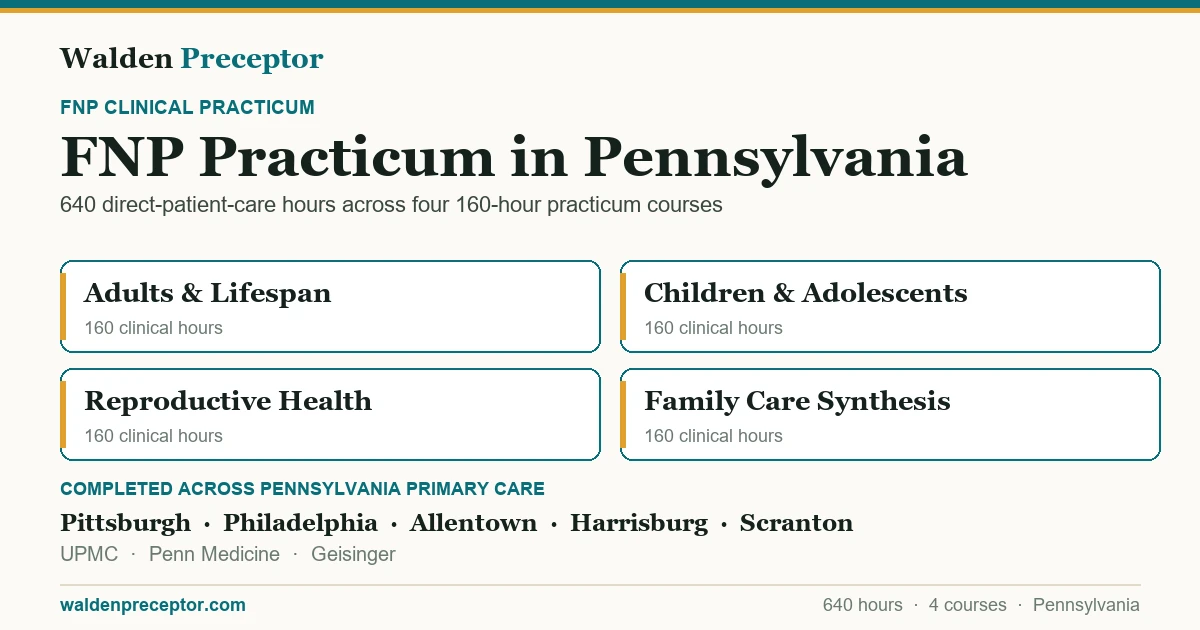
A Walden FNP practicum in Pennsylvania requires 640 direct-patient-care hours across four 160-hour practicum courses, completed under a preceptor who meets Walden's requirements and nominated in Meditrek for Walden's review. Pennsylvania is a reduced-practice state, so your preceptor is usually a CRNP who collaborates with a licensed physician, a physician, or another qualified provider. We find that Pennsylvania preceptor and site for you and prepare the Meditrek nomination, with no payment until you are matched.
Last updated: June 28, 2026 · Reviewed by the Walden Preceptor placement team
Start your placement, free
Tell us your program. We map the whole practicum. No payment until you are matched.
What does a Walden FNP practicum require in Pennsylvania?
The hour requirement is the same as everywhere else: the Walden Master of Science in Nursing Family Nurse Practitioner specialization is built on 640 total practicum hours, divided evenly into four practicum courses of 160 hours each. Those courses are PRAC/PRCM 6531 (Primary Care of Adults Across the Lifespan), 6541 (Primary Care of Adolescents and Children), 6552 (Advanced Nurse Practice in Reproductive Health), and 6568 (Synthesis in Advanced Nursing Practice, care of patients in family care settings). All hours must be direct patient care. Pennsylvania does not raise or lower that number. For the full breakdown of each course and what each one needs, see our Walden FNP page.
What Pennsylvania does change is the kind of preceptor and setting you work in, and the compliance paperwork your site expects. The rest of this page is about merging your Walden FNP requirements with Pennsylvania's nursing rules so your placement clears Walden's review the first time. For the broader picture of practicum across every Walden track in the state, see our Pennsylvania placement page.
What does reduced practice mean for an FNP preceptor in Pennsylvania?
The American Association of Nurse Practitioners classifies Pennsylvania as a reduced practice state. Pennsylvania regulation defines a Certified Registered Nurse Practitioner (CRNP) as a registered nurse certified in a specialty who "performs acts of medical diagnosis or prescription of medical therapeutic or corrective measures in collaboration with a licensed physician." In plain terms, a Pennsylvania CRNP diagnoses and prescribes, but does so under a collaborative relationship with a physician rather than fully independently.
For your FNP placement, that collaborative rule shapes who is precepting you and where, not whether you can be precepted. A CRNP can absolutely serve as your Walden FNP preceptor; so can a physician or another qualified provider who meets Walden's course-specific criteria. Because Pennsylvania CRNPs already practice inside physician-collaborative groups, a large share of the state's primary care happens in exactly the kind of family medicine offices, group practices, and hospital-affiliated clinics that make strong FNP teaching sites.
How does the Pennsylvania collaborative agreement and prescriptive authority work?
Pennsylvania nursing is regulated by the Pennsylvania State Board of Nursing within the Bureau of Professional and Occupational Affairs. To prescribe, a Pennsylvania CRNP files a written prescriptive authority collaborative agreement through the Pennsylvania Licensing System (PALS). Under the state code, that agreement must identify the collaborating physician and at least one substitute physician who steps in when the collaborator is unavailable, name the CRNP's certified specialty, and carry both signatures and effective dates. The collaborating physician must hold an active Pennsylvania medical license. The Board amended these prescriptive-authority rules with changes that took effect November 1, 2025.
You do not file any of this as a student. It matters to your placement only because it tells you what your preceptor's working world looks like: a CRNP preceptor in Pennsylvania is operating under that physician collaboration, which is why so many qualified preceptors sit inside physician-led practices. When we build your Pennsylvania match list, we target practices where a qualified preceptor has the time and the patient mix your FNP course needs.
Where do Walden FNP students do clinicals in Pennsylvania?
Because the FNP role spans the whole family, your four courses need to cover the lifespan: adult primary care for 6531, pediatric and adolescent care for 6541, reproductive and women's health for 6552, and a family-care setting that lets you synthesize across populations for 6568. Pennsylvania has deep primary care capacity to support that range.
- Pittsburgh and southwestern Pennsylvania, where UPMC runs a large network of primary care and outpatient offices
- Philadelphia and the southeastern suburbs, anchored by Penn Medicine and other academic and community systems
- Northeastern and central Pennsylvania, where Geisinger operates well over a hundred primary care and specialty clinics
- Mid-size markets such as Allentown, Bethlehem, Reading, Lancaster, Harrisburg, York, Scranton, and Erie, plus the counties between them
Naming a health system is not an endorsement claim, and we never imply one of those systems backs us. The point is simply that Pennsylvania's family medicine, internal medicine, pediatric, and women's health practices give an FNP student a realistic shot at covering all four courses within a sensible drive. Tell us where you can actually get to on clinical days, and we build the list around that radius.
How do I get a Pennsylvania preceptor approved through Walden?
This is the step that stalls most students, and it is the part Walden leaves to you. Walden's Office of Field Experience supports the process, but you are responsible for securing your own preceptor and clinical site and then nominating that preceptor in Meditrek. Walden reviews and approves the proposed placement; it does not hand you one. We do the sourcing and the prep so the nomination is clean before it reaches Walden's review.
Confirm the course and your radius
Tell us which FNP course is next, its patient population, your start date, and how far you can drive in Pennsylvania for clinical days.
We source a qualified Pennsylvania preceptor
We match you to a CRNP, physician, or qualified provider whose credentials and setting meet Walden's published requirements for that course.
Nominate in Meditrek for Walden's review
We prepare your Meditrek nomination so it is complete and submit it for the Office of Field Experience to review. You cannot register for the practicum until that nomination is approved.
Clear CastleBranch and Pennsylvania checks
Complete your background check, drug screen, immunizations, and trainings in CastleBranch, plus any Pennsylvania-specific clearances your site requires.
Log hours and get signed off
Track encounters in Meditrek across at least 8 weeks, finishing by the end of Week 10, with no more than 12 practicum hours in a day. Your preceptor signs your hours and evaluation in the portal.
We never describe a preceptor or site as "endorsed by Walden" before Walden has reviewed it. We match preceptors who meet Walden's published requirements and submit the placement for Walden's review. We do not guarantee a placement, and no service can.
What Pennsylvania-specific compliance should I expect?
Walden tracks compliance through CastleBranch (myCB), and the exact list is state and site specific. Pennsylvania sites commonly add state checks on top of the standard requirements. Pennsylvania also requires CRNP applicants to complete child abuse recognition and reporting training for licensure, which is a useful signal of how seriously the state and its clinical sites treat child-protection clearances, especially for the pediatric portion of your FNP rotations.
| Item | What it means for your Pennsylvania FNP placement |
|---|---|
| Hours | 640 direct-patient-care hours, four courses of 160. Spread over at least 8 weeks, done by the end of Week 10, 12 hours per day maximum. |
| Meditrek | You nominate your Pennsylvania preceptor and site in Meditrek; Walden reviews and approves before you register. |
| Preceptor type | A CRNP in physician collaboration, a physician, or another qualified provider who meets Walden's course criteria. |
| CastleBranch (myCB) | Standard background check, drug screen, and immunizations, plus Pennsylvania additions such as child abuse clearances at many sites. |
| Affiliation agreement | Walden needs a signed affiliation agreement with the Pennsylvania site before you begin. We start this early so it does not delay your term. |
CastleBranch requirements differ by site, so confirm your exact list with your placement before deadlines. We help you read the tracker.
Is Pennsylvania moving to full practice authority?
Pennsylvania lawmakers have repeatedly proposed full practice authority for nurse practitioners. The most recent attempts, Senate Bill 25 and House Bill 739, would let a qualified nurse practitioner practice independently after a three-year, 3,600-hour physician collaboration period. As of June 2026, neither bill had advanced beyond committee, so Pennsylvania remains a reduced-practice state. Even if that changes later, it would govern how a licensed CRNP practices after graduation, not your Walden FNP practicum, which stays at 640 hours across four courses regardless of state authority level.
Pennsylvania FNP placement questions
How many practicum hours does a Walden FNP need in Pennsylvania?
A Walden FNP student in Pennsylvania completes 640 direct-patient-care practicum hours across four 160-hour courses (PRAC/PRCM 6531, 6541, 6552, and 6568). Pennsylvania does not change that count. The hours are direct patient care, spread over no fewer than 8 weeks, finished by the end of Week 10, with a daily maximum of 12 practicum hours.
Does Walden approve my Pennsylvania preceptor, or do I find my own?
You secure your own preceptor and clinical site, then nominate them in Meditrek for Walden's Office of Field Experience to review. Walden reviews and approves the proposed placement; it does not generally assign one. We match you with a Pennsylvania preceptor who meets Walden's published requirements and prepare the Meditrek nomination so it is ready for Walden's review.
Can a CRNP precept me in Pennsylvania, given the collaborative practice rules?
Yes. Pennsylvania is a reduced-practice state, so a Certified Registered Nurse Practitioner (CRNP) diagnoses and prescribes in collaboration with a licensed physician. That collaborative relationship governs how a CRNP practices, not whether they can precept a student. A CRNP, physician, or other qualified provider who meets Walden's course-specific preceptor criteria can serve as your FNP preceptor.
Do I need extra Pennsylvania clearances for my FNP placement?
Often, yes. Walden tracks compliance through CastleBranch, and Pennsylvania sites commonly add state checks such as child abuse clearances on top of the standard background check, drug screen, and immunizations. Pennsylvania also requires child abuse recognition and reporting training for CRNP licensure, which signals how seriously sites treat these clearances. We map your CastleBranch tracker to what your specific Pennsylvania site asks for.
Will full practice authority in Pennsylvania change my Walden FNP practicum?
Not currently. Bills to grant Pennsylvania nurse practitioners full practice authority (Senate Bill 25 and House Bill 739) had not advanced beyond committee as of June 2026, so Pennsylvania remains a reduced-practice state. Even if the law changed, it would govern post-graduation practice, not your Walden practicum requirements, which stay at 640 hours across four courses.
Sources
- Walden University, MSN Practicum Requirements (640 hours, four 160-hour courses, FNP course numbers)
- Walden University, Find a Preceptor (student-secured preceptor, Meditrek, Office of Field Experience)
- AANP, State Practice Environment (Pennsylvania reduced practice)
- Pennsylvania State Board of Nursing, CRNP Licensure Snapshot (CRNP definition, child abuse training)
- 49 Pa. Code § 21.285, Prescriptive authority collaborative agreements
- Pennsylvania Senate Bill 25 (2025-2026), nurse practitioner practice authority
Pennsylvania FNP placement, without the cold outreach
We have supported 3,200+ nurses and we match Walden FNP students to a Pennsylvania preceptor and site that fit your course, location, and schedule. You pay nothing until you are matched, and we aim to do it within five days.
- All four FNP courses covered, from one Pennsylvania site or several
- Preceptors who meet Walden's published requirements, submitted for Walden's review
- We handle outreach, Meditrek prep, and affiliation agreements so you stay focused on clinicals
Ready to lock in your Pennsylvania FNP preceptor?
Tell us which course is next and where in Pennsylvania you can do clinicals. We map your 640 hours, source a qualified preceptor, and prepare the Meditrek nomination for Walden's review. No payment until you are matched.
Book your free consult