Walden FNP Preceptor in South Carolina
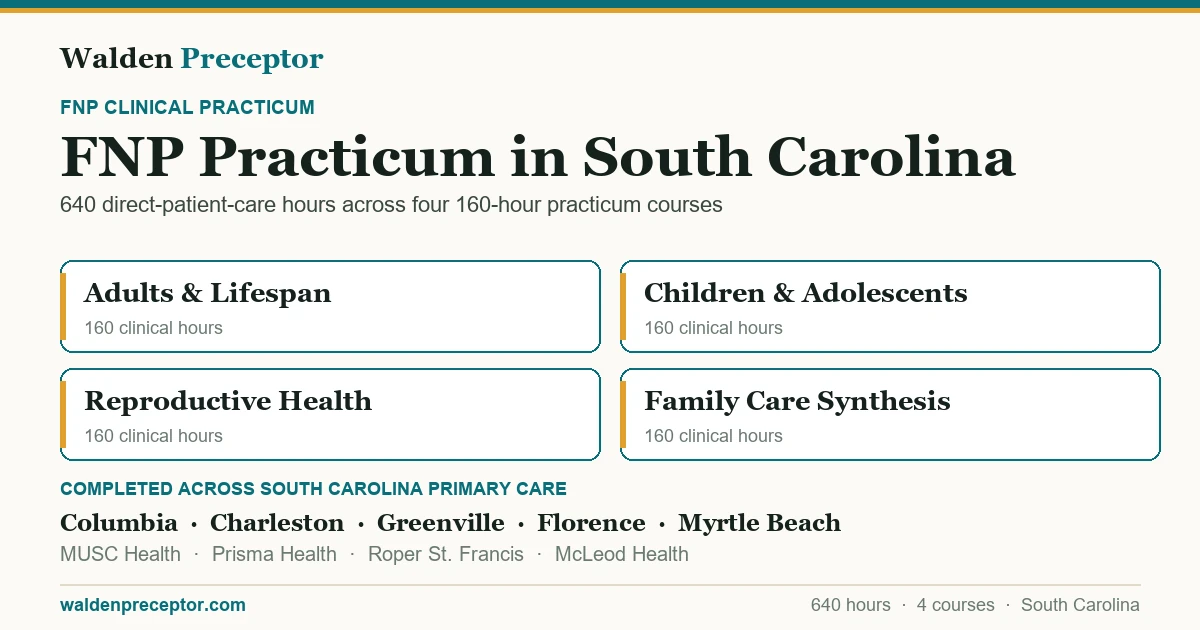
A Walden FNP practicum in South Carolina requires 640 direct-patient-care hours across four 160-hour practicum courses, supervised one-to-one by an FNP-qualified preceptor. South Carolina is a restricted-practice state, so a working NP here practices under a written agreement with a physician, but that rule shapes who can supervise you and the license check before approval, not the hours you owe. This page separates what Walden fixes from what South Carolina overlays, then how we secure a verified South Carolina preceptor for your Meditrek nomination.
Last updated 2026-06-28 · Reviewed by the Walden Preceptor placement team
Start your placement, free
Tell us your program. We map the whole practicum. No payment until you are matched.
How many FNP hours does Walden require, and does South Carolina change the count?
The Walden MSN Family Nurse Practitioner specialization runs on 640 total practicum hours, split evenly into four practicum courses worth 160 hours apiece (Walden University, MSN practicum requirements). That total holds steady in South Carolina; hour counts come from your program, not a state board. The four courses carry you across primary care for the whole family, from newborns through older adults plus reproductive and women's health, and the full course-by-course breakdown sits on the Walden FNP program page.
What the state does add is a layer around those 640 hours: which clinicians are licensed to supervise them, and the license verification you complete before Meditrek approves a placement. That layer traces to the South Carolina Board of Nursing and the state Nurse Practice Act rather than to Walden. Counting the hours is straightforward; clearing the South Carolina overlay is where FNP students tend to get stuck, so the rest of this page works through it.
| FNP practicum element | Set by Walden | Shaped by South Carolina |
|---|---|---|
| 640 hours across four 160-hour courses | Yes, fixed program requirement | No, the state does not change the count |
| Lifespan population mix | Yes: adults, children, women's health | Indirectly, through which local sites exist |
| Who may precept | Walden preceptor criteria, 1:1 ratio | Must hold an active South Carolina license |
| Physician practice agreement | Not required of a student | Required of a working NP, not of you |
| Site and preceptor approval | Nominated in Meditrek for Walden review | License verified through LLR |
What does South Carolina restricted practice mean for an FNP preceptorship?
Under the American Association of Nurse Practitioners' three-tier system, South Carolina sits in the restricted practice tier, the most limited of the three (AANP, State Practice Environment). A nurse practitioner here cannot practice on their own. State law requires the NP to carry out medical acts under a written practice agreement with a physician who stays readily available for consultation, whether in person, by phone, or electronically (SC Code 40-33-34).
Here is the distinction that matters to you. Restricted practice is about how a fully licensed NP operates after graduation; it says nothing about who must precept a student's FNP hours. A seasoned South Carolina FNP or other qualified NP can take you on, and any physician agreement that clinician holds belongs to their own independent practice, not to your training. As a student you sign no practice agreement, because you are not yet a licensed NP. Your preceptor may be an NP, a physician, or another qualified provider whose patients fit the FNP population, provided they hold an active South Carolina license and clear Walden's published requirements. We vet those credentials before anything reaches Meditrek, where the placement then goes to Walden for its own approval.
One South Carolina detail shapes where clinical sites cluster: an NP without full practice authority is expected to spend part of their time serving a rural or underserved area or population, which is part of why so much NP practice in the state sits in community and family-medicine settings (SC Code 40-33-34). That works in your favor, since those settings are exactly where FNP lifespan hours are easiest to gather.
Which South Carolina board rules touch how you vet an FNP preceptor?
Nurse licensure and APRN recognition run through the South Carolina Board of Nursing, under the Department of Labor, Licensing and Regulation (LLR), where you confirm a prospective preceptor holds an active license. A handful of details in the state's nursing statute are worth carrying with you when you size up a preceptor, since they reveal whether that clinician's supervising arrangement is current.
Annual review, 72-hour access
The agreement, and any later amendments, has to be reviewed at least once a year, signed and dated by both the NP and the physician, and produced for the board within seventy-two hours if it asks. A current signature line is a quick sign the arrangement is live.
15 business days on changes
An NP who switches practice setting or collaborating physician has fifteen business days to tell the board and show a verified agreement. A preceptor who recently changed clinics should already have that filed.
Prescribing caps in the agreement
For controlled substances, a Schedule II narcotic script tops out at a five-day supply and a Schedule II non-narcotic at a thirty-day supply. That cap shapes what a preceptor can walk you through during prescribing-heavy hours.
There is also a supervision ceiling on the working side: a single physician may collaborate with no more than six nurse practitioners, nurse-midwives, clinical nurse specialists, or physician assistants at once without prior approval from the Board of Medical Examiners. You complete none of this paperwork as a student, but it signals whether a prospective preceptor's own setup is current and in good standing. Our team verifies license status straight from the board instead of relying on a clinic's say-so, and you can run the same lookup yourself through LLR license verification or read the rules on the APRN pages of the South Carolina Board of Nursing.
A note on rules in motion
Legislators in Columbia have floated measures that would open an optional route to full practice authority for seasoned APRNs, House Bill 3580 among them in the 2025 to 2026 session (SC Legislature, H.3580). That bill is still sitting in committee as of mid-2026 and has not passed, so the restricted-practice rules above are what apply today. We watch the docket so the guidance here stays current.
Which South Carolina settings cover the FNP lifespan populations?
Because the FNP credential covers the entire lifespan, your four courses reach across adults, children and adolescents, and reproductive or women's health rather than one age group. In South Carolina that breadth dictates which clinics are worth approaching. One busy family-medicine practice can occasionally carry most of the mix, but it is common to split across two or three sites to capture pediatrics and women's health, and whichever preceptor you use has to match the course in front of you.
Family and adult primary care
The backbone of the 6531 adult-lifespan and 6568 family-care synthesis courses. Large systems such as Prisma Health across the Upstate and Midlands run family-medicine practices in many communities.
Pediatric and adolescent care
Well-child and sick visits for the 6541 course, frequently a different site from your adult preceptor. Pediatric groups and community health centers cover this age range.
Women's and reproductive health
Prenatal checks, contraception counseling, and routine gynecologic care for the 6552 course. Coverage is strongest around Charleston and Greenville and noticeably thinner in rural counties.
Community and rural health
Federally qualified health centers and rural clinics in the Lowcountry and Pee Dee run wide primary care panels, a practical option in counties where private practices are thin on the ground.
The state's major health systems give you anchor points: MUSC Health in Charleston, Prisma Health spanning the Upstate and Midlands, Roper St. Francis and Bon Secours in the Lowcountry, and McLeod Health around Florence in the Pee Dee. Most FNP hours, though, accrue in the outpatient primary care practices attached to those systems and in independent family-medicine clinics, not on inpatient or specialty-only rotations.
Why is finding an FNP preceptor in South Carolina hard, and who is responsible?
Here is what catches FNP students off guard. Walden does not generally assign your preceptor. You secure your own preceptor and site, then nominate that person in Meditrek for review before the practicum course starts (Walden University, Find a Preceptor). The Office of Field Experience offers coaching and the affiliation-agreement database, and Walden's Practicum Pledge can step in if your own search comes up empty, but the first outreach is yours. In a restricted-practice state that is a heavier lift, for two reasons.
One, plenty of qualified South Carolina NPs are already locked into a practice agreement and a packed patient panel, so they have little bandwidth for a student across a four-course run. Two, the lifespan requirement usually calls for more than one preceptor, because the provider giving you adult primary care may not see children or women's health patients. So the pattern repeats itself: a student secures a family-medicine preceptor for the early courses, learns weeks later that the same site has no pediatric or women's health volume, and then races to line up a second preceptor with a course deadline already running.
Closing that gap is our job. We keep a live South Carolina preceptor roster and place Walden FNP students region by region, pairing each preceptor's patient panel to whichever course is next on your plan.
Midlands
Columbia, Lexington, and Sumter family-medicine and primary care practices.
Lowcountry
Charleston, Mount Pleasant, North Charleston, Summerville, and Beaufort clinics.
Upstate
Greenville, Spartanburg, Anderson, and Rock Hill near the Charlotte line.
Pee Dee
Florence, Hartsville, and the inland northeast communities.
Grand Strand
Myrtle Beach, Conway, and the coastal Horry county practices.
Rural counties
Orangeburg, Greenwood, and the Pee Dee corridor, where we plan around your drive distance.
What pacing caps affect your 160 hours per course?
Walden's pacing limits matter when you plan a South Carolina placement. You can log a maximum of 12 practicum hours per day, your hours must spread over no fewer than 8 weeks, and you are expected to finish a course's 160 hours by the end of Week 10. At roughly two clinical days a week you sit comfortably inside that window. A preceptor who can host you only one day a week, common when a busy South Carolina clinic squeezes in a student, can leave you scrambling near the deadline.
What we confirm before Meditrek
- An active South Carolina license verified through LLR
- A scope that matches your current FNP course and population
- A site that can host you across the full course block at a workable pace
- A preceptor ready to complete the Meditrek nomination and sign time logs
What you do
- Tell us your specialization, the course coming up, your term, and your county
- Share your hour targets and any days you cannot be in clinic
- Submit the Meditrek nomination once we hand you the match
- Keep your CastleBranch file current so a lapse does not pause your hours
No practicum course opens until your Meditrek nomination is approved, and approval depends on the affiliation agreement and your compliance status, so the placement step gates everything else. We factor the 12-hour cap and the 8-to-10-week window into the match. You can read the full process on the Walden practicum in South Carolina page, and the program structure on the FNP program page.
South Carolina FNP FAQ
How many FNP practicum hours does Walden require in South Carolina?
The Walden MSN-FNP requires 640 direct-patient-care hours, split evenly into four practicum courses of 160 hours each. That count is set by Walden, not by South Carolina, so it does not change when you train in the state. What South Carolina changes is who is licensed to supervise those hours and the verification you clear before a Meditrek nomination is approved.
Does restricted practice mean a physician must precept my FNP hours?
No. Restricted practice governs how a fully licensed NP works in South Carolina, not who precepts a student. A seasoned South Carolina FNP or other qualified NP can precept your Walden hours one-to-one; any physician agreement that clinician holds is tied to their own practice, not to you. Your preceptor may be an NP, physician, or other qualified provider whose patients fit the FNP population and who clears Walden's published requirements, then goes to Walden for its own approval.
How fast can I complete 160 hours per FNP course in South Carolina?
Walden caps you at 12 practicum hours per day, requires the hours to span no fewer than 8 weeks, and expects each course's 160 hours by the end of Week 10. At roughly two clinical days a week you finish comfortably inside that window. A South Carolina preceptor who can host you only one day a week leaves you tight near the deadline, which is why we match for schedule fit, not just license.
Where do I verify a South Carolina FNP preceptor's license?
Use the South Carolina LLR public license lookup at verify.llronline.com, run by the South Carolina Board of Nursing. We confirm every preceptor's active South Carolina license and FNP-relevant scope before your Meditrek nomination so the Office of Field Experience can approve the placement without a delay.
Can I do my Walden FNP practicum virtually in South Carolina?
The bulk of FNP hours happen in person, since hands-on lifespan care is the heart of the role. Students near Columbia, Charleston, or Greenville generally find enough local sites for a fully in-person placement, while someone in a rural county might lean on a supervised hybrid to cover a sparse population like pediatrics or women's health. In every case the preceptor holds a South Carolina license and the hours are logged in Meditrek.
Sources
- Walden University, MSN practicum requirements (640 hours, four 160-hour courses, pacing limits)
- Walden University, Find a Preceptor (student responsibility, Meditrek, Practicum Pledge)
- AANP, State Practice Environment (South Carolina classified as restricted)
- SC Code of Laws, Title 40 Chapter 33, Section 40-33-34 (practice agreements, annual review, 15-day notice, prescribing, underserved requirement)
- South Carolina Board of Nursing (LLR), APRN information and license verification
- SC Legislature, H.3580 (2025-2026 APRN practice-authority bill, in committee)
Get a Walden FNP preceptor in South Carolina
You have the full picture now: 640 FNP hours the state cannot touch, a restricted-practice rule that governs supervision rather than your hour count, a board that confirms the license, and a university that hands you the placement to solve. That solving is what we take off your plate. We find a verified South Carolina FNP preceptor whose patient panel fits your remaining courses, run the board license check, and get the affiliation agreement ready so your Meditrek nomination clears. We aim to match you within five days, with nothing owed until the match lands.
Get matched in South Carolina See how it works
Related: Walden FNP preceptor and clinical placement · Walden practicum placement in South Carolina