Walden FNP Preceptor in Tennessee
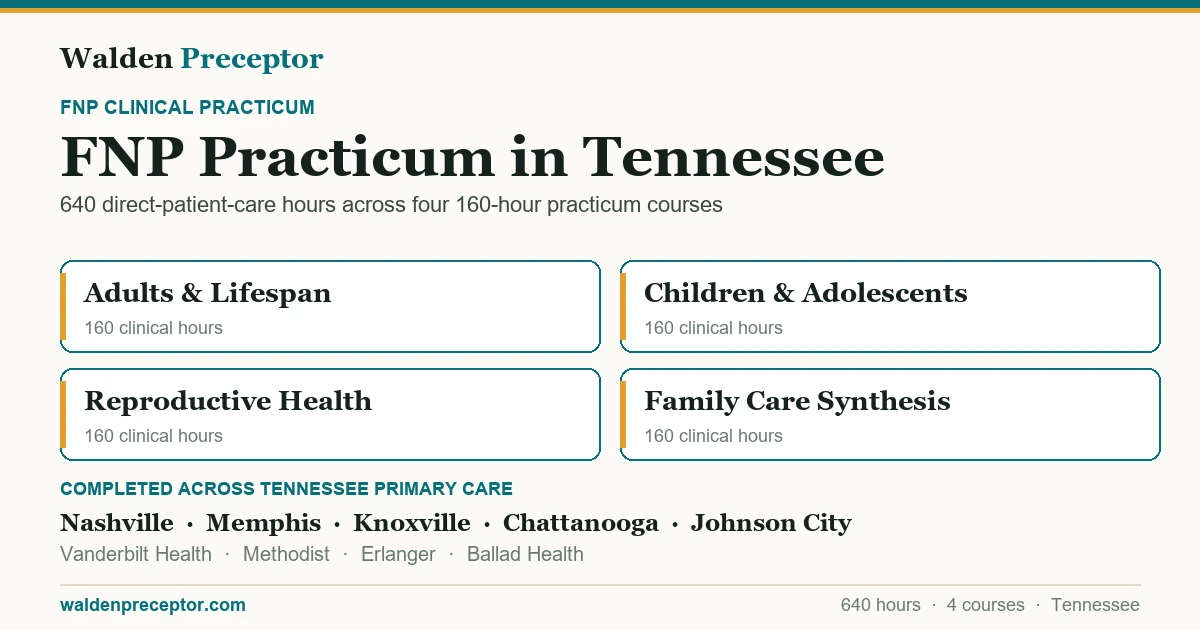
A Walden FNP practicum in Tennessee requires 640 direct-patient-care hours across four 160-hour practicum courses, supervised by a preceptor who meets Walden's course criteria and holds a Tennessee license at or above the level you are seeking. Tennessee is a restricted-practice state, so the clinics where you train mostly run on physician collaboration. None of that changes your 640 hours, but it shapes who can precept you and where. This page maps the FNP hour structure, the Tennessee board rules that govern your preceptor, the settings that take Walden students, and how we close the search.
Last updated 2026-06-28 · Reviewed by the Walden Preceptor placement team
Start your placement, free
Tell us your program. We map the whole practicum. No payment until you are matched.
How many FNP hours do you need in Tennessee?
The number is set by Walden and your national certifier, not by Tennessee, so it travels with you wherever you complete clinicals: 640 practicum hours, all direct patient care, divided into four practicum courses of 160 hours each. That figure differs from some other programs, so confirm it against your own program of study rather than against a friend at a different school. The four FNP practicum courses pair an NRNP or DRNP didactic course with a PRAC or PRCM practicum under the same number:
| Course | Patient population | Hours |
|---|---|---|
| 6531 | Primary Care of Adults Across the Lifespan | 160 |
| 6541 | Primary Care of Adolescents and Children | 160 |
| 6552 | Advanced practice in reproductive health | 160 |
| 6568 | Synthesis, family care settings | 160 |
Source: Walden University MSN Practicum Requirements. Numbering is catalog-year sensitive; verify yours in the student portal. For the full FNP breakdown see our Walden FNP preceptor page.
What does Tennessee's Board of Nursing require of an FNP preceptor?
Tennessee writes a specific rule that matters when you nominate a preceptor. Under the Board of Nursing definitions in rule 1000-01-.01, a preceptor is "an individual who may serve as a teacher, mentor, role model, or supervisor in a clinical setting," and the rule adds that a preceptor "must possess licensure at or above the level of licensure sought by the student." For a Walden FNP student that means your preceptor needs a current, unencumbered Tennessee license at NP level or higher, an NP, a physician (MD or DO), and their scope has to fit the FNP course you are taking.
Match the license to the patient population, course by course. The lifespan and adult courses (6531, 6568) want a family-medicine or internal-medicine setting; 6541 needs pediatric and adolescent exposure; 6552 needs reproductive and women's health. A preceptor whose practice does not see that population cannot carry that course no matter how willing they are. We verify each preceptor's Tennessee license on the Department of Health verification portal before you ever submit a nomination.
- Active, unencumbered Tennessee license at NP level or above (rule 1000-01-.01)
- Specialty and patient population that matches the specific FNP course
- A site willing to host a student and complete an affiliation agreement with Walden
- Availability that fits the 8-to-10-week course window, not a once-a-week slot
Does Tennessee's restricted practice change your FNP practicum?
Tennessee is a restricted-practice state, the most supervised of the three categories the American Association of Nurse Practitioners tracks. A licensed Tennessee NP who prescribes holds a certificate of fitness and works with a collaborating physician under Board of Nursing rule 1000-04 and Board of Medical Examiners rule 0880-06. In practice that physician reviews at least twenty percent of the NP's charts every thirty days, visits any remote site at least once every thirty days, and stays available for consultation or arranges a substitute.
Here is the part that matters for you: that framework governs an NP's own license, not a student's practicum. As a Walden FNP student you train under your preceptor's supervision and authority, so the certificate-of-fitness rules do not limit your learning hours. What they do explain is the shape of the field you are walking into. Because almost every Tennessee primary-care, urgent-care, and women's-health practice already runs on physician collaboration, the supply of FNP-appropriate preceptors and supervised sites is broad, which works in your favor when you are matching for four different courses.
Where do Walden FNP students complete practicum in Tennessee?
Tennessee has deep primary-care capacity, which is what an FNP needs across four lifespan courses. The settings that take Walden students cluster in the metros but reach well into the regional markets:
Metro health systems
Vanderbilt Health in Nashville, Methodist and the academic clinics in Memphis, Erlanger in Chattanooga, and the University of Tennessee practices in Knoxville run dense family-medicine, pediatric, and women's-health clinics that host students.
Tri-Cities and East Tennessee
Ballad Health anchors upper East Tennessee around Johnson City, Kingsport, and Bristol with twenty hospitals and a wide outpatient footprint, useful when the big metros are full.
Community and FQHC clinics
Federally qualified health centers and community clinics across the state see the full lifespan in one building, which can let one site cover more than one FNP course.
Independent primary care
Family-medicine and internal-medicine practices in Murfreesboro, Clarksville, Jackson, and Cleveland widen options if you want a placement closer to home.
Tennessee also carries federal primary-care shortage designations across many rural counties, which is a double-edged thing for an FNP student. Underserved areas need providers and often welcome a competent student, but a thin clinician roster can mean fewer preceptors with room to take one on. Our Tennessee work is concentrated where the FNP-appropriate supply actually sits, so you are not cold-emailing a one-provider clinic three counties over.
The pacing caps that decide your Tennessee schedule
Walden sets the clock on how fast a 160-hour course can be finished, and those caps drive how you should set up a Tennessee placement. You can log a maximum of 12 practicum hours in a single day, your hours must be spread over no fewer than 8 weeks, and the course generally has to be complete by the end of Week 10. At 160 hours, that is roughly two clinical days a week to land comfortably inside the window. A Tennessee preceptor who can only host you one day a week leaves you racing the Week 10 deadline, so we screen for availability that fits the math before we ever put a name in front of you.
Confirm your course and dates
Tell us which of the four FNP courses is next and your term start, so the population requirement and the 8-to-10-week window are set from day one.
We match a Tennessee preceptor
We confirm the license at or above NP level, the specialty fit for that course, and availability that clears the 12-hour-day and Week-10 caps.
You nominate in Meditrek
You submit the preceptor and site in Meditrek for Walden's review. No practicum registration happens until that nomination is approved.
Clear compliance and start hours
Finish CastleBranch background and health requirements, then log hours in Meditrek where your preceptor signs off on each block.
How placement actually works for FNP students in Tennessee
Walden expects you to secure your own preceptor and site, then nominate them in Meditrek for the Office of Field Experience to review. Walden coaches the process and runs the affiliation-agreement database, but it does not generally assign a preceptor to you. That gap, the cold outreach to busy Tennessee clinics across four separate courses, is what we close. We keep relationships with primary-care, pediatric, and women's-health preceptors around the state, match you to ones that fit your FNP course, location, and schedule, and prepare the paperwork so the nomination is clean when it reaches Walden.
One honest line on what we can and cannot promise. Walden reviews and approves every placement itself. What we do is match you with a preceptor who meets Walden's published FNP requirements and Tennessee's license rule, then submit that match for Walden's review. You confirm hours in Meditrek and your preceptor signs off as usual; we remove the months of searching. For the statewide picture across every Walden program, see our Walden practicum in Tennessee page.
How many practicum hours does a Walden FNP need in Tennessee?
640 direct-patient-care hours, the same in Tennessee as everywhere else, because the hour count comes from Walden and your national certifier, not the state. The 640 hours split into four 160-hour FNP practicum courses (6531, 6541, 6552, 6568). Each course's hours must be spread over no fewer than 8 weeks, finished by the end of Week 10, with a daily cap of 12 practicum hours.
Does my FNP preceptor need a Tennessee license?
Yes. Under Tennessee Board of Nursing rule 1000-01-.01, a preceptor must hold licensure at or above the level the student is seeking, which for an FNP student means a current, unencumbered Tennessee NP, physician, or comparable license. The preceptor's patient population must also match the FNP course, such as family or primary care for the lifespan courses.
Is Tennessee a restricted-practice state, and does that affect my FNP practicum?
Tennessee is a restricted-practice state, so a licensed NP who prescribes works under a certificate of fitness with a collaborating physician. That governs your future license, not your student hours. As a Walden FNP student you train under your preceptor's authority, but the collaboration model is why most Tennessee primary-care sites run with physician oversight.
Where do Walden FNP students complete practicum in Tennessee?
Family medicine, internal medicine, pediatrics, women's health, retail and community clinics, and federally qualified health centers across Nashville, Memphis, Knoxville, Chattanooga, and the Tri-Cities. Large systems such as Vanderbilt Health, Methodist in Memphis, Erlanger in Chattanooga, and Ballad Health in upper East Tennessee anchor the supply, alongside independent primary-care practices.
Can Walden Preceptor guarantee a Tennessee FNP placement?
No service can guarantee a placement, because Walden, not us, reviews and approves every preceptor and site you nominate in Meditrek. We match you with a preceptor who meets Walden's published FNP requirements and Tennessee's license rules, then prepare the nomination for Walden's review. You pay nothing until you are matched.
Sources
- Walden University, MSN Practicum Requirements (640 hours, four 160-hour FNP courses, course numbers)
- Walden University, Find a Preceptor (student-secured model, Meditrek, Field Experience support)
- Tennessee Board of Nursing rule 1000-01-.01, preceptor definition and licensure level
- Tennessee Board of Nursing rule 1000-04-.04, certificate of fitness and collaborating physician
- Tennessee clinical supervision rule 0880-06-.02 (20% chart review, 30-day site visit)
- AANP State Practice Environment, restricted-practice classification
- Tennessee Department of Health, Board of Nursing license verification
Your Tennessee FNP preceptor, without the cold outreach
We have supported 3,200+ nurses. For Tennessee FNP students we match a license-verified preceptor and site for each of your four courses, sized to your population requirement, location, and the 8-to-10-week window. You pay nothing until you are matched, and we aim to do it within five days.
- License checked against Tennessee's at-or-above rule before you nominate
- Specialty fit for each FNP course, from pediatrics to women's health
- We handle outreach and affiliation agreements; you focus on clinicals
Let us find your Tennessee FNP preceptor
Tell us which FNP course is next and where in Tennessee you are. We map your 640 hours, verify the license against the state rule, and start matching. No payment until you are matched.