Walden FNP Preceptor in Texas
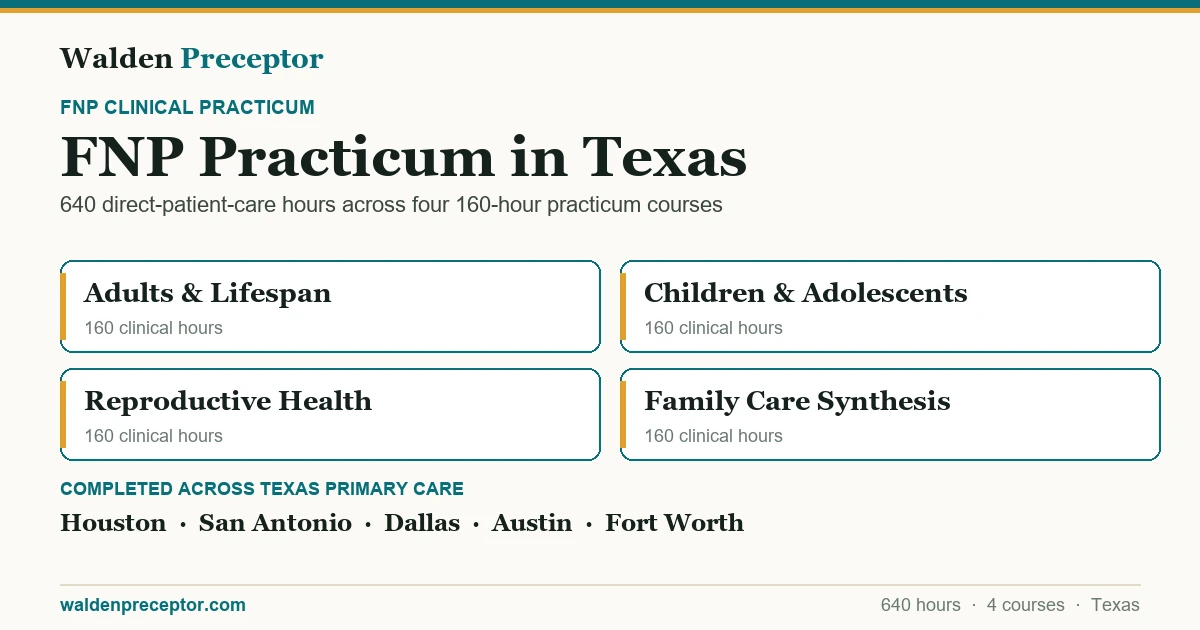
A Walden FNP practicum in Texas requires 640 direct-patient-care hours across four 160-hour practicum courses, completed over no fewer than 8 weeks per course under an FNP-qualified preceptor you secure yourself and nominate in Meditrek. Texas is a restricted-practice state, so the clinics you train in are built around a physician-delegation model, but that shapes the setting, not whether your practicum can happen. We find a Texas preceptor who meets Walden's published requirements and hand you a ready-to-submit match for Walden's review.
Last updated 2026-06-28 · Reviewed by the Walden Preceptor placement team
Get matched with a Texas FNP preceptor
This page is the intersection of two things: the Walden FNP program facts that govern your hours and the Texas rules that govern the clinics where you log them. For the full FNP course breakdown see our Walden FNP preceptor page, and for the broader Texas board picture see our Walden preceptor in Texas page. Here we put the two together.
Start your placement, free
Tell us your program. We map the whole practicum. No payment until you are matched.
How many FNP hours do I need, and does Texas change the count?
The Walden FNP specialization is built around 640 total practicum hours, split evenly into four 160-hour practicum courses. All 640 must be direct patient care. Each course runs over no fewer than 8 weeks, must be completed by the end of Week 10, and caps you at a maximum of 12 practicum hours in a single day. Texas does not change any of those numbers; they come from Walden and apply wherever you train.
Texas does add a separate floor of its own. Under Texas Administrative Code 221.7(e), an APRN education program must document a minimum of 500 unduplicated clinical clock hours in the role and population you are licensed for. Walden's 640 FNP hours clear that Texas licensure floor with margin, so a standard Walden FNP plan satisfies both at once. The point is to plan to 640, not 500: the higher number is what your program of study and Meditrek log require, and meeting it automatically meets the state minimum.
There is no Kansas-style exception for Texas. The Kansas 750-hour rule for new Kansas-bound APRN students does not touch a Texas placement; Texas FNP students follow the standard 640-hour, four-course structure.
What do the four FNP courses look like in a Texas clinic?
Because the FNP role covers the whole family, your 640 hours have to span the lifespan across four courses, not sit in one population. In Texas that maps cleanly onto the family-medicine and community-clinic settings the state's primary-care system runs on. Each practicum course pairs a didactic NRNP/DRNP course with a PRAC/PRCM practicum under the same number; numbering is catalog-year sensitive, so confirm yours in your program map.
| Course | Population | Typical Texas setting |
|---|---|---|
| 6531 | Primary Care of Adults Across the Lifespan | Family medicine, internal medicine, FQHC adult clinics |
| 6541 | Primary Care of Adolescents and Children | Pediatrics, school-based and community child health clinics |
| 6552 | Advanced Nurse Practice in Reproductive Health | Women's health, OB-GYN, family planning clinics |
| 6568 | Synthesis in Advanced Nursing Practice, family care | A full-scope family practice that lets you integrate across ages |
Some Texas students cover several courses at one full-scope family practice; others split across two or three sites. Both work as long as each course's population requirement is met and every site has a Walden affiliation agreement in place.
What do Texas board rules mean for an FNP precepting relationship?
The American Association of Nurse Practitioners classifies Texas as a restricted-practice state, the most limited of its three categories. A licensed Texas NP cannot practice independently of physician involvement: to prescribe and deliver the medical aspects of care, the NP holds a prescriptive authority agreement (PAA) with a delegating physician. Three specifics of that arrangement shape the clinic you will train in:
- A delegation cap of seven. Under Texas Medical Board rules, one physician may delegate prescriptive authority to no more than seven full-time-equivalent APRNs and physician assistants combined (1:7). That cap is lifted in facility-based hospital practice and in practices serving medically underserved populations, which is why rural and underserved Texas clinics often run heavier NP staffing.
- Monthly meetings. For PAAs executed on or after September 1, 2019, the physician and the NP must meet at least once a month to review patient care, regardless of whether they work in the same building.
- Negotiated chart review. Texas does not fix a chart-review percentage in statute; the PAA itself sets how many charts the physician reviews, based on the NP's experience and the practice setting.
None of this gates your practicum. Your hours are supervised learning under a preceptor, so you are not practicing independently during your 640 hours regardless of the state category. What the restricted model does is describe the working world you are training to enter, and it explains the structure of the clinics where an FNP preceptor is most likely to have room for a student. Confirm the current classification yourself on the AANP State Practice Environment map.
Who can serve as my FNP preceptor in Texas?
Your preceptor has to clear two bars at once: Walden's course-specific preceptor criteria and Texas's credentialing for the patients you will see. For the Walden side, a 1:1 preceptor-to-student ratio applies for on-site direct supervision, and the preceptor's license and scope must match the course population, an FNP or other NP in the matching specialty, a physician, or another qualified provider Walden accepts for that course.
For the Texas side, a Texas APRN preceptor holds:
- A valid, unencumbered Texas RN license or a multistate RN privilege
- Texas Board of Nursing authorization for advanced practice in a role and specialty appropriate to the site's patients
- A valid Texas prescriptive authority number, where prescriptive authority is part of the role
We match you with a Texas preceptor who meets Walden's published requirements and submit the proposed preceptor and site for Walden's review. Walden, not us, reviews and approves the placement; we never describe a preceptor or site as endorsed by Walden, Walden endorsed, or affiliated, because no outside service can confer that. There is no guarantee of placement, but the match we hand you is built to pass that review the first time.
How do Meditrek, affiliation agreements, and pacing fit together in Texas?
The academic steps come from Walden and the on-the-ground steps come from your Texas site, and both have to line up before your hours count. Walden advises starting the search at least three terms before your practicum course, because Walden negotiates an affiliation agreement with each Texas site and reviews preceptor qualifications, and neither happens overnight.
| Step | What it means for a Texas FNP practicum |
|---|---|
| Nominate in Meditrek | Walden's practicum portal. You submit your Texas preceptor and site for approval; you cannot register for a practicum course without an approved Meditrek application, and your preceptor signs your hours and evaluations there. |
| Affiliation agreement | A signed agreement between Walden and your Texas clinical site must be in place before hours begin. New sites take longer, which is the most common reason a Texas start date slips. |
| CastleBranch (myCB) | Where you clear background checks, immunizations, and health documents before hours start. Because these items are state and site specific, a Texas clinic can layer its own onboarding on top of Walden's. |
| Pacing | 160 hours per course, at most 12 per day, over at least 8 weeks and done by Week 10. At roughly two clinical days a week you are inside the window; a Texas preceptor who can only host you once a week can leave you short near the deadline. |
Verify compliance items in CastleBranch (myCB) and hours and course numbers in the Walden MSN practicum requirements.
What is finding an FNP preceptor in Texas actually like?
Texas is one of the highest-demand placement markets in the country: large NP cohorts, a physician shortage that pushes NPs into primary care, and the same crowded family-medicine clinics that every nearby program is also emailing. Walden expects you to do the securing, the Office of Field Experience supports the process but does not generally place you, and in a restricted-practice state a clinic has to weigh its own delegation structure before it takes on a student. The result is that a self-run search can stretch across weeks of cold outreach right when you should be studying.
That is the gap we fill. We maintain working relationships with family practices, pediatric and women's health clinics, and community health centers across Texas, so we can match you with a preceptor who fits your FNP course and is willing to host you. We cover the metros and the towns around them: Houston, San Antonio, Dallas, Austin, Fort Worth, El Paso, Arlington, Corpus Christi, Plano, Lubbock, Laredo, McAllen, and the Rio Grande Valley. In a smaller market like Amarillo, Midland, or Tyler we widen the search to nearby towns and tell you the travel up front, so nothing surprises you after you have nominated the site in Meditrek.
1. You tell us the course
Which FNP course is next (6531, 6541, 6552, or 6568), your Texas city, and your start term.
2. We match a preceptor
A credentialed Texas preceptor at a site that fits the course population and meets Walden's requirements, usually within 5 days.
3. You nominate in Meditrek
We hand you the preceptor and site details so you submit the Meditrek application for Walden's review.
No payment until you are matched. If we cannot place you, you owe nothing.
Common questions from Walden FNP students in Texas
How many practicum hours does a Walden FNP need in Texas?
A Walden FNP completes 640 practicum hours across four 160-hour courses (6531, 6541, 6552, 6568), all direct patient care. That count is set by Walden and does not change for Texas. Separately, Texas Administrative Code 221.7(e) requires a minimum of 500 unduplicated clinical clock hours in the role and population for APRN licensure, so the Walden 640 clears the Texas floor with margin.
Does Texas being a restricted-practice state affect my Walden FNP practicum?
No. Texas is a restricted-practice state, which governs how a licensed NP prescribes and practices after graduation through a prescriptive authority agreement with a delegating physician. Your practicum is supervised learning under a qualified preceptor, so the restricted classification does not block it. It does shape the clinic settings you will train in.
Who can be my FNP preceptor in Texas?
Your preceptor must meet Walden's published preceptor requirements for the specific FNP course and hold the right Texas credential for the patients you see, typically a Texas-licensed FNP or other NP in the matching population, a physician, or another qualified provider. A Texas APRN preceptor holds an unencumbered Texas RN license and Board of Nursing authorization for advanced practice in the role and specialty that fits the site. We submit the proposed match for Walden's review; we do not call anyone endorsed by Walden.
How early should I start the Texas preceptor search?
Walden advises beginning at least three terms before your practicum course, because Walden negotiates the affiliation agreement with each Texas site and reviews preceptor qualifications, and both take time. In a high-demand state like Texas the search itself can run for weeks, which is why many students hand the outreach to us.
Sources
- Walden University, MSN Practicum Requirements (640 hours, four 160-hour FNP courses, pacing limits)
- Walden University, Find a Preceptor (student-secured model, Meditrek, affiliation agreements)
- Texas Board of Nursing, APRN Practice FAQ (APRN authorization, prescriptive authority agreement)
- Texas Medical Board, Prescribing and Supervision (1:7 FTE delegation cap, monthly meetings, negotiated chart review)
- AANP, State Practice Environment (Texas restricted-practice classification)
- CastleBranch (myCB) (Walden compliance requirements)
Ready to lock in a Texas FNP preceptor?
Tell us which FNP course is next, your Texas city, and your start term. We will match you with a vetted Texas preceptor and site that meet Walden's requirements, usually within 5 days, and walk you through the Meditrek nomination. No payment until you are matched. See pricing for what a placement runs.
Start my Texas FNP placement