Walden FNP Preceptor in Virginia
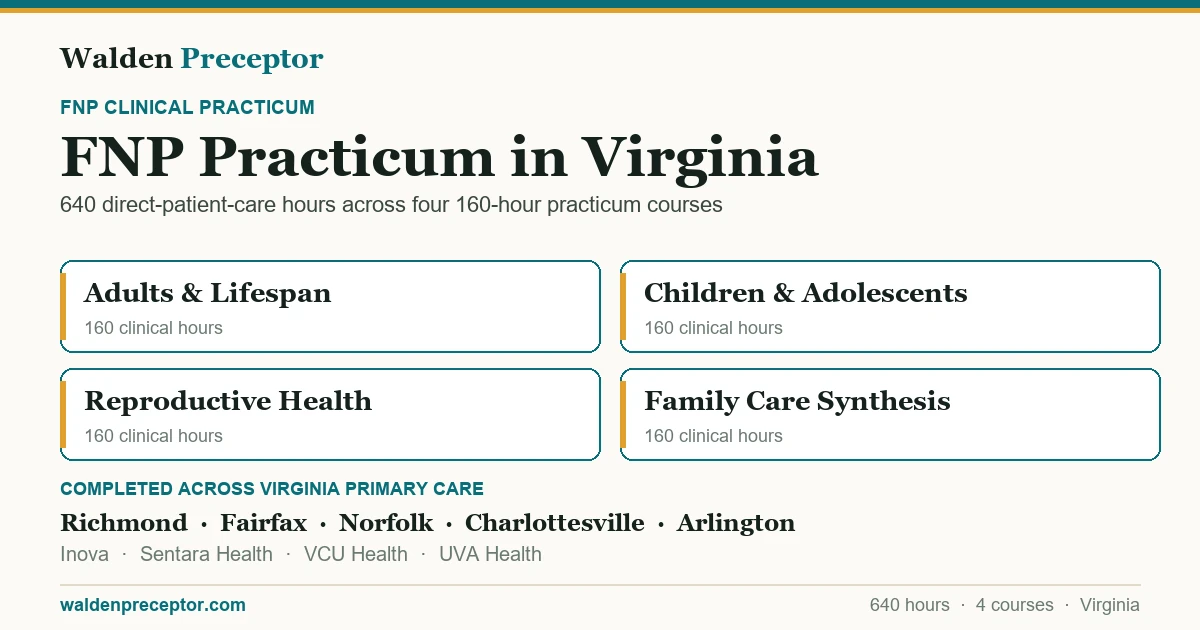
A Walden FNP practicum in Virginia comes down to 640 direct-patient-care hours, four 160-hour courses, an FNP-qualified preceptor, and a Meditrek nomination, all completed in person somewhere in the Commonwealth. Virginia is a restricted-practice state, which means the nurse practitioner teaching you sits on a patient care team with a physician until they reach the autonomous practice designation. That rule colors the practice you train inside; it leaves your Walden hour count untouched. Our part is to find a Virginia preceptor who meets Walden's published requirements and assemble the nomination for Walden to review. You remain the student of record throughout, and we never promise a placement Walden has not approved.
Last updated 2026-06-28 · Reviewed by the Walden Preceptor placement team
Start your placement, free
Tell us your program. We map the whole practicum. No payment until you are matched.
What does a Walden FNP practicum in Virginia require?
Walden owns the hour math; Virginia simply decides the kind of clinic you log those hours in. The FNP specialization is structured as 640 practicum hours in four equal courses of 160 hours, every hour direct patient care. Walden also paces you: a hard ceiling of 12 practicum hours in any single day, a spread of at least 8 weeks, and a finish by the end of Week 10. Read together, those rules quietly dictate your Virginia clinic schedule. Two days a week with a steady preceptor and 160 hours arrives on time; a Fairfax or Norfolk provider who can only fit you in one morning a week pushes you up against the Week 10 wall, and you repeat that math four courses running.
Because the four courses sweep newborns through older adults, one Virginia practice rarely supplies the full range. We line each course up with a site that genuinely sees that age band.
| Course | Patient population | Hours |
|---|---|---|
| 6531 | Primary care of adults across the lifespan | 160 |
| 6541 | Primary care of adolescents and children | 160 |
| 6552 | Advanced nurse practice in reproductive health | 160 |
| 6568 | Synthesis in advanced nursing practice, family care settings | 160 |
Course numbering is catalog-year sensitive; confirm yours in your Walden program of study. Source: Walden University, MSN Practicum Requirements. For the full FNP breakdown, see our Walden FNP requirements page.
How does Virginia's restricted-practice status affect an FNP preceptor?
The American Association of Nurse Practitioners classifies Virginia as a restricted-practice state. In Virginia the mechanism is a patient care team. A nurse practitioner with fewer than the equivalent of three years of clinical experience must maintain a practice agreement with a patient care team physician, who provides input through periodic chart review and is available for consultation in complex cases. One physician may anchor a team with up to six nurse practitioners at a time, or up to ten for psychiatric-mental health NPs. Virginia is also jointly regulated: nurse practitioners answer to both the Board of Nursing and the Board of Medicine, which is why both the nursing license and the team rules apply.
House Bill 971 changed the timeline. Since July 1, 2024, an NP qualifies for the autonomous practice designation after three years of full-time clinical experience, defined as about 5,400 hours, down from the previous five-year bar. Once the Board approves that designation, the practice agreement is no longer required. None of this touches your Walden 640-hour requirement or your Meditrek steps. What it changes is the texture of your training: an FNP precepting you in Richmond is often working inside a patient care team already, conferring with a physician on harder cases as a matter of routine, so the supervision you observe is real practice rather than something staged for a student.
Sources: AANP, Virginia state practice environment (restricted classification); 18VAC90-40-90 (practice agreement and team ratios); Virginia HB971 (2024) (three-year, 5,400-hour autonomous-practice threshold).
Can a nurse practitioner precept me in Virginia?
Yes. The provider who teaches you only has to be someone Walden recognizes for that course, an experienced FNP, a physician, a physician assistant on certain courses, or another approved provider whose scope lines up with the patients you will see. Virginia's patient-care-team rules are about how a newer NP runs their own panel, not about whether they may hand a student a chart and walk them through a visit. So the real test is narrower than students fear: does this preceptor's everyday caseload match the course you are in, and does their Virginia license hold up under a board check.
We screen every candidate on three fronts before a single name reaches your Meditrek nomination.
Virginia license standing
We pull the preceptor's record from the Department of Health Professions lookup, including an NP's autonomous or patient-care-team status, so no credentialing surprise lands halfway through your hours.
Walden course match
We map the candidate's patient mix to the exact course: adults and lifespan for 6531, children and adolescents for 6541, reproductive health for 6552, and a family-care synthesis setting for 6568.
Meditrek readiness
We build the nomination packet so the application is right the first time, and then you are the one who submits it for Walden's own review and approval.
Verify any Virginia license at the Virginia DHP license lookup, run by the Board of Nursing and Board of Medicine.
Does Virginia's preceptor incentive program help me?
Students hear about the Virginia Nurse Preceptor Incentive Program (NPIP) and ask whether it lowers their placement cost. It is worth understanding, even though it usually does not apply directly to a Walden student. The NPIP, administered through the Virginia Department of Health, offers a Virginia-licensed physician, PA, RN, LPN, or APRN a tax-free award of up to $5,000 for serving as an otherwise uncompensated preceptor for a clinical rotation of up to 250 hours, scaled by the hours actually completed.
The catch is eligibility. The award is tied to a rotation arranged in conjunction with a licensed and accredited Virginia public or private not-for-profit school of nursing. Walden is an out-of-state, online university, so a standard Walden FNP rotation does not slot into the NPIP through Walden itself. The program still matters as context: it tells you Virginia is actively trying to recruit preceptors because demand outstrips supply, and a preceptor who knows the program exists is sometimes more willing to take a student. We treat it as a useful talking point in outreach, never as a discount we can promise you. Note too that VDH stopped taking new NPIP applications after April 30, 2026, with the program moving to the Virginia Nursing Workforce Center, so always confirm its current status before relying on it.
Sources: Virginia Department of Health, Nursing Preceptor Incentive Program; VDH, Nurse Preceptor Guidelines (2024) (up to $5,000, 250-hour rotation, Virginia-school requirement).
Where can you complete FNP primary care hours in Virginia?
There is no virtual shortcut here: FNP hours are physical, in-clinic patient care at a Virginia site. With the lifespan spread across four courses, the practices that fit are family medicine, internal medicine, pediatrics, women's health, and the community and federally qualified health centers that anchor care in much of the Commonwealth. A practice broad enough to cover every age can carry all four of your courses; more often students stitch together two or three sites. Either route is fine, provided each course meets its population requirement and each site already holds a Walden affiliation agreement.
Virginia has real depth of primary care to place into. The largest systems include Inova across Northern Virginia, Sentara Health in Hampton Roads and beyond, VCU Health in Richmond, UVA Health around Charlottesville, Carilion Clinic in the Roanoke Valley, and Bon Secours across several regions, alongside hundreds of independent family-practice and community clinics. We place students across Arlington, Alexandria, Fairfax, Richmond, Virginia Beach, Norfolk, Chesapeake, Charlottesville, Roanoke, Lynchburg, Harrisonburg, and Winchester, and into rural Southwest and Southside counties where primary care demand is high and a willing preceptor is often easier to secure than in a saturated Northern Virginia metro.
For Virginia board rules, supervision details, and our regional coverage, see our Virginia placement overview.
What makes finding an FNP preceptor in Virginia hard?
This is the surprise that catches most Walden students mid-program: nobody hands you a preceptor. Walden's model puts the search on you. You find the provider and the site, then nominate them in Meditrek for the university to review before the course can start. The Office of Field Experience will coach you, share prescreen checklists, and run the affiliation-agreement database, yet the actual cold outreach is yours to do, and you do it four separate times.
Virginia adds its own drag to that search. A practice willing to host you is usually already juggling a patient care team and a physician relationship, so a student is a real commitment rather than a quick yes. The Washington-area corridor compounds it, with cohorts from countless programs all chasing the same Arlington and Fairfax preceptors, which is precisely why we work the whole state instead of brawling over the saturated north. Add the ordinary friction, busy clinics, slow affiliation agreements, the preceptor who says yes in March and vanishes by August, and the timeline gets fragile fast. Closing that gap is our job: we pair you with Virginia primary care preceptors suited to your FNP course, city, and availability, confirm their board standing, and carry the affiliation-agreement and nomination paperwork. You still log encounters in Meditrek and your preceptor still signs off, exactly as Walden requires. What disappears is the months of fruitless emailing.
An FNP placement in Virginia, without the cold outreach
With 3,200+ nurses supported, we find a Virginia preceptor and site scaled to your FNP course, your city, and the days you can actually be in clinic, confirm their Virginia board standing, and hand you a clean Meditrek nomination for Walden's review. Nothing is due until you are matched, and our target is five days.
- All four FNP courses covered, from one Virginia site or several
- Preceptors who meet Walden's published requirements, submitted for Walden's approval, never a guarantee of placement
- No payment until matched, five-day match goal
Common questions from Virginia FNP students
How many hours does a Walden FNP practicum in Virginia require?
The Walden FNP track requires 640 practicum hours, split into four practicum courses of 160 hours each (6531, 6541, 6552, and 6568). All are direct patient care, completed over no fewer than 8 weeks and by the end of Week 10, with a daily cap of 12 practicum hours. Virginia does not change those Walden numbers; it shapes the kind of preceptor and site you complete them in.
Does my Virginia FNP preceptor have to be a physician?
No. Walden accepts a qualified preceptor whose license and scope match your course population, which can be an experienced FNP, a physician, or another approved provider. Virginia's patient-care-team-physician rule governs how a newer nurse practitioner runs their own practice; it does not decide who may teach a student. We confirm a candidate meets Walden's published requirements before you nominate them in Meditrek for Walden's review.
How does Virginia's restricted-practice status affect my FNP placement?
Virginia is a restricted-practice state, so a nurse practitioner with fewer than three years of clinical experience works under a practice agreement with a patient care team physician. Since House Bill 971 took effect on July 1, 2024, an NP qualifies for the autonomous practice designation after three years, about 5,400 hours. This affects the preceptor's own career, not your student clinical hours, and it does not change your Walden 640-hour total.
Does Walden assign me an FNP preceptor in Virginia?
No. Walden expects you to secure your own preceptor and clinical site, then nominate them in Meditrek for the university's review and approval. The Office of Field Experience supports the process but does not place most students. We do that sourcing for you across Virginia and prepare the nomination, while you stay the student of record. We never guarantee a placement Walden has not approved.
Where in Virginia can I complete FNP primary care hours?
Direct patient care happens in person at a Virginia primary care site: family medicine, internal medicine, pediatrics, women's health, or a community clinic. We place students across Northern Virginia, Richmond, Hampton Roads, Charlottesville, the Roanoke Valley, and the Shenandoah, including practices tied to systems such as Inova, Sentara, VCU Health, UVA Health, Carilion Clinic, and Bon Secours.
Sources
- Walden University, MSN Practicum Requirements (640 FNP hours, four 160-hour courses, course numbers)
- Walden University, Find a Preceptor (student-secured preceptor, Meditrek nomination, Office of Field Experience)
- AANP, Virginia State Practice Environment (Virginia restricted-practice classification)
- 18VAC90-40-90, Practice agreement (patient care team physician, six-NP and ten-PMHNP ratios)
- Virginia House Bill 971 (2024) (three-year, 5,400-hour autonomous-practice threshold, effective July 1, 2024)
- Virginia Department of Health, Nursing Preceptor Incentive Program (up to $5,000 award, 250-hour rotation, Virginia-school requirement)
Ready to lock in a Virginia FNP preceptor?
Tell us your next FNP course and your city. We will source a verified Virginia preceptor who meets Walden's published requirements, prepare your Meditrek nomination for Walden's review, and stay with you until it is approved. You are matched in five days, with no payment until you are matched. See pricing for what placement costs.