Walden FNP Preceptor in Washington
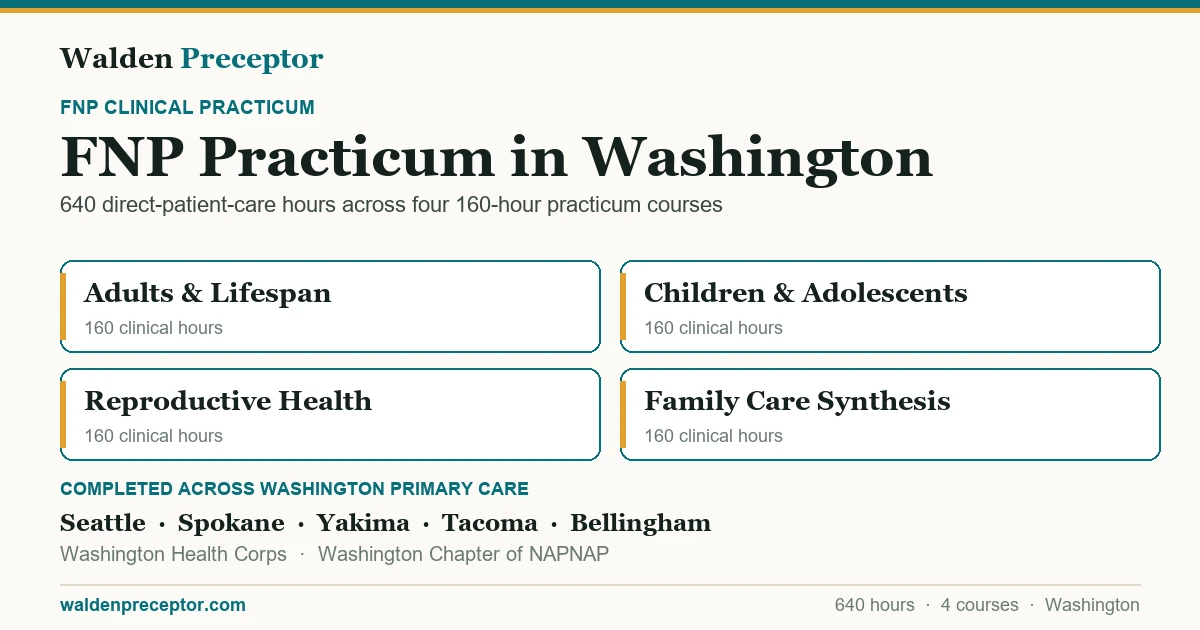
A Walden FNP practicum in Washington requires 640 direct-patient-care hours across four 160-hour practicum courses under an FNP-qualified ARNP. Washington is a full practice authority state, so that ARNP can precept you on their own license with no physician collaborative agreement on file. The catch is the one every Walden student hits: you have to secure that preceptor yourself before you can nominate them in Meditrek. That securing, across Washington, is what we do.
Last updated 2026-06-28 · Reviewed by the Walden Preceptor placement team
Match me with a Washington FNP preceptor
No payment until you are matched with a confirmed Washington preceptor and site.
Start your placement, free
Tell us your program. We map the whole practicum. No payment until you are matched.
What does a Walden FNP practicum in Washington actually require?
Start with the number, because everything else hangs off it. The Walden Master of Science in Nursing FNP specialization is built around 640 total practicum hours, divided evenly into four practicum courses of 160 hours each, every one of which must be direct patient care. Walden also paces them: hours run over no fewer than 8 weeks and must be complete by the end of Week 10, with a hard daily cap of 12 practicum hours (Walden Practicum Manual, MSN requirements).
None of those numbers change because you are in Washington. The hour count, the pacing, and the daily cap come from Walden, not the Washington State Board of Nursing. What Washington changes is the regulatory backdrop your preceptor practices under, the kind of provider who can legally precept you, and how hard one is to land. The rest of this page works through each, against Washington's actual rules.
Which FNP courses does the Washington rotation have to cover?
Because the FNP role spans the whole family, your four courses each target a different patient population, and your Washington site or sites have to cover all of them across the program. Walden's FNP practicum sequence is built like this:
| Course | Population to find in Washington | Hours |
|---|---|---|
| 6531 | Primary care of adults across the lifespan | 160 |
| 6541 | Primary care of adolescents and children | 160 |
| 6552 | Advanced practice in reproductive and women's health | 160 |
| 6568 | Synthesis, care of patients in family care settings | 160 |
Course 6568 field experience, 160 hours. Numbering is catalog-year sensitive; confirm yours in your Walden program map.
In practice, a Washington family-medicine clinic that sees infants through grandparents can carry several of these courses on its own, while a women's-health practice in Tacoma or a pediatric clinic in Spokane might cover a single course well. We map your four courses to Washington settings up front, so you are not three weeks into 6541 discovering the practice you joined sees almost no pediatrics. For the program-wide FNP breakdown, see our Walden FNP preceptor page.
What does Washington full practice authority mean for your preceptor?
Washington is one of the full practice authority states named by the American Association of Nurse Practitioners, and that is genuinely good news for an FNP search. Under WAC 246-840-300 and RCW 18.79, an Advanced Registered Nurse Practitioner in Washington evaluates, diagnoses, orders and interprets tests, and starts and manages treatment as a licensed independent practitioner, with no required physician collaborative or supervision agreement on file.
For your practicum, that independence widens the pool. An experienced FNP-credentialed ARNP who runs their own panel can precept you on their own authority, so you are not limited to physician-led practices the way a student in a restricted state is. Washington uses the umbrella title ARNP, which also covers certified nurse midwives, clinical nurse specialists, and CRNAs, so confirm your preceptor holds the nurse practitioner role in a family or primary care specialty, not just any ARNP designation. One caveat: full practice authority is a state-law floor, not an employer mandate. Some Washington health systems still build physician oversight into their own clinic models, which is fine for your rotation as long as the supervising preceptor meets Walden's FNP course criteria.
Does a Washington FNP preceptor need prescriptive authority?
If your rotation involves prescribing, yes, and it is worth checking, because in Washington prescriptive authority is elective, not automatic with the ARNP license. An ARNP adds it by completing advanced pharmacology training, and a prescribing ARNP holds a DEA registration reflecting schedules 2 through 5 (Washington State Board of Nursing, ARNP license). The vast majority of family-practice ARNPs precepting FNP students carry it, but it is not a safe assumption, so we confirm it as part of vetting. You can verify any preceptor's credential yourself through the Washington DOH Provider Credential Search and keep the printout for your Meditrek nomination.
Where do Walden FNP students actually rotate in Washington?
Primary care across the lifespan is exactly the work Washington's outpatient and community settings do every day, so the right kind of site is plentiful. The bottleneck is preceptor availability, not the existence of clinics. We place FNP students across the state, including:
- Puget Sound family medicine and community clinics: Seattle, Tacoma, Everett, Bellevue, Olympia
- Eastern Washington primary care: Spokane, Yakima, and the Tri-Cities of Kennewick, Pasco, and Richland
- Southwest and northwest sites: Vancouver and Bellingham, plus rural towns where a single clinic anchors the county
- Federally qualified health centers, which lean heavily on NPs as the medical home for whole panels and are a strong FNP lifespan fit
Washington also runs shortage-area incentive programs such as the Washington Health Corps, which channels providers into underserved communities, so an FNP placement in a rural or shortage county often sits inside a site already structured to teach. If your home county is thin on availability, we look at the nearest metro and at telehealth-capable family practices before calling a search stuck.
Why is finding an FNP preceptor in Washington so hard?
It is rarely the rules. FNP is the most saturated NP specialty in the country, so in a market like greater Seattle a single family-medicine preceptor may field requests from a dozen students a term. Walden adds its own friction: you must secure the preceptor and site yourself, then nominate them in Meditrek, and you cannot register for the practicum course until that application is approved. A site new to Walden also needs an affiliation agreement on file, which takes time the calendar may not have. The Washington Chapter of NAPNAP preceptor directory exists precisely because this search is hard enough to need its own statewide tool. Walden's Office of Field Experience runs coaching and, through the Practicum Pledge, will match students whose independent search fails, but that is a backstop, not a head start. We start the outreach the day you reach out.
How placement works once you have a Washington match
The mechanics are the same as any Walden FNP rotation, layered onto Washington verification. Here is the path:
Confirm the course and population
Tell us which FNP course is next (6531, 6541, 6552, or 6568) and your start term, so we match the right Washington population.
We secure a qualified ARNP and site
We work our Washington network, confirm availability for your term, and verify the ARNP license, FNP specialty, and prescriptive authority where relevant.
You nominate in Meditrek
You submit the confirmed preceptor and site in Meditrek. Walden reviews and approves before you can register; we hand you a placement built to clear that review.
Clear CastleBranch compliance
Background check, immunizations, and documents run through CastleBranch (myCB). A Washington hospital may add screenings beyond the Walden baseline, so start early.
Log hours and get signed off
You track direct-care hours in Meditrek and your preceptor signs off there, inside the 8-to-10-week window and 12-hour daily cap.
One framing point worth stating plainly: we do not endorse a preceptor on Walden's behalf, and no service can. Walden reviews and approves the placement you nominate. What we do is find and confirm a Washington FNP preceptor who meets Walden's published requirements, then hand you a match ready to submit for that review. Our broader process lives on the how it works page, and the full Washington picture across every Walden track is on our Washington placement page.
Washington FNP preceptor questions
How many hours is the Walden FNP practicum in Washington?
The Walden FNP track requires 640 direct-patient-care practicum hours, split evenly across four practicum courses of 160 hours each (6531, 6541, 6552, and 6568). The hour count comes from Walden, not from Washington, so it is the same whether you complete it in Seattle, Spokane, or Yakima.
Does an FNP preceptor in Washington need a physician collaborative agreement?
No. Washington is a full practice authority state. Under WAC 246-840-300 and RCW 18.79, an ARNP diagnoses, treats, and prescribes independently with no physician collaborative or supervision agreement on file, so an experienced FNP-credentialed ARNP can precept you on their own license.
Can my Washington FNP preceptor prescribe controlled substances during my rotation?
They can if they hold prescriptive authority. In Washington that is an elective addition to the ARNP license requiring advanced pharmacology training, and a prescribing ARNP holds a DEA registration covering schedules 2 through 5. If your rotation involves prescribing, confirm the preceptor carries it.
Why is it hard to find an FNP preceptor in Washington?
FNP is the most saturated NP specialty, so students compete for the same primary care sites, especially in greater Seattle. Walden also requires you to secure the preceptor yourself and nominate them in Meditrek before you can register, and a new site needs an affiliation agreement. That search is the part we handle.
Does Walden assign my FNP preceptor in Washington?
Generally no. You secure your own preceptor and site and nominate them in Meditrek for Walden's review and approval. The Office of Field Experience supports the process and, through the Practicum Pledge, will match students whose own search is unsuccessful, but the day-to-day outreach is on you.
Sources
- Walden University, MSN practicum requirements (640 hours, four 160-hour courses, pacing)
- Walden University, Find a Preceptor (student-secured model, Meditrek, Practicum Pledge)
- WAC 246-840-300, ARNP scope of practice
- Washington State Board of Nursing, ARNP license and prescriptive authority
- Washington DOH Provider Credential Search
- AANP State Practice Environment (Washington, full practice)
A confirmed Washington FNP preceptor, not another month of cold emails
We have supported 3,200+ nurses and match Walden FNP students to a confirmed Washington ARNP and site, sized to your course, population, and start term. You pay nothing until you are matched, and we aim to do it within five days.
- All four FNP courses mapped to real Washington populations, from one site or several
- ARNP license, FNP specialty, and prescriptive authority verified before you nominate
- We handle the outreach and the affiliation agreement; you stay focused on clinicals
Ready to lock in your Washington FNP preceptor?
Tell us which FNP course is next and your start term. We will map your 640 hours to Washington settings and start matching, with no payment until you have a confirmed placement. See pricing for what a placement costs.
Book your free consult