Walden PNP practicum: 640 hours of pediatric placement, explained
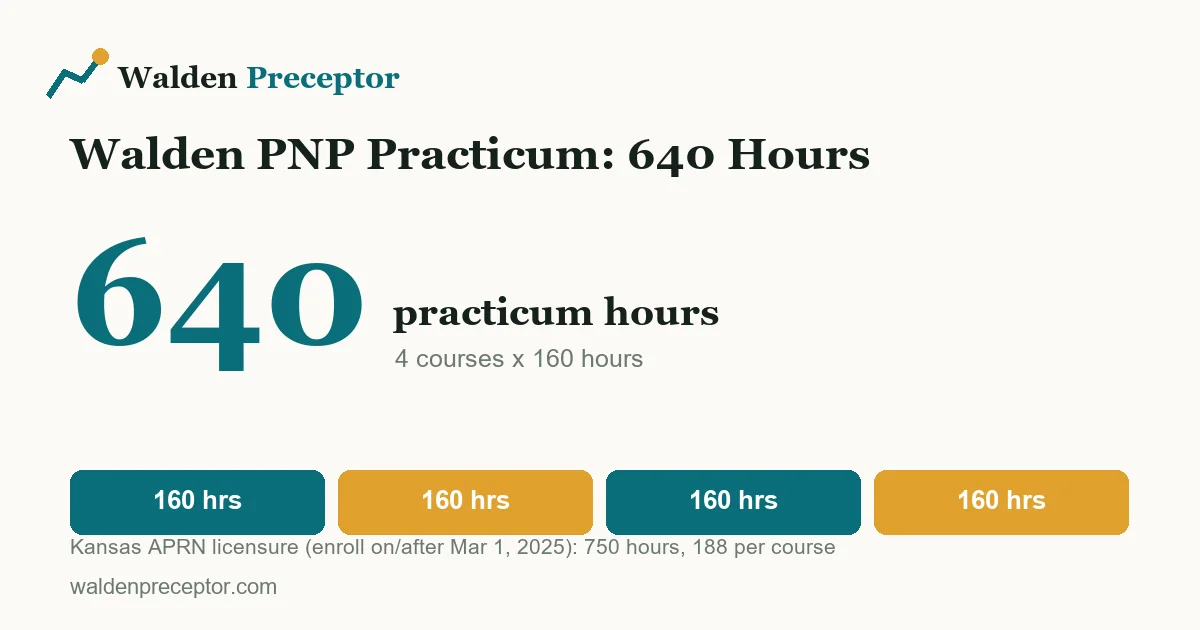
Walden's Pediatric Primary Care Nurse Practitioner (PNP) track requires 640 supervised practicum hours, completed as 160 hours in each of four courses (PRAC/PRCM 6810, 6820, 6830, and 6840). Those hours have to happen with a qualified pediatric preceptor, at an approved site, and logged in Meditrek where your preceptor signs off. This page walks through the hours, the kinds of sites that qualify, and how to get approved before your course starts.
Last updated: June 22, 2026 · Reviewed by the Walden Preceptor placement team
Start your placement, free
Tell us your program. We map the whole practicum. No payment until you are matched.
The numbers at a glance
The PNP specialization spreads its clinical work across four practicum courses, each tied to a didactic course. Here is how the hours break down.
| Practicum course | Focus | Hours |
|---|---|---|
| PRAC/PRCM 6810 | Advanced Pediatric Nursing Practicum I: Primary Care | 160 |
| PRAC/PRCM 6820 | Advanced Pediatric Nursing Practicum II: Complex Care | 160 |
| PRAC/PRCM 6830 | Advanced Pediatric Nursing Practicum III: Specialty Care | 160 |
| PRAC/PRCM 6840 | Advanced Pediatric Nursing Practicum IV: Synthesis Care | 160 |
| Total | Across four courses | 640 |
Course prefixes (PRAC versus PRCM) and exact numbering can shift by catalog year, so confirm the codes on your own program of study before you build your timeline. (Walden MSN practicum requirements)
The Kansas exception
One rule changes the total. Students who plan to seek APRN licensure in Kansas and who enroll on or after March 1, 2025 complete 750 hours instead of 640, which works out to 188 hours per practicum course rather than 160. If Kansas is your licensure state, plan for the higher count from the start so you are not scrambling to add hours in a later term. (Walden MSN practicum requirements)
What counts as a PNP site
Because this is the primary care pediatric track, your hours need to come from settings where you are caring for infants, children, and adolescents under a qualified preceptor. Common settings include:
- Pediatric primary care and family practice clinics that see a strong pediatric caseload
- School-based health centers and community or federally qualified health centers
- Urgent care that regularly treats children
- Pediatric specialty practices for the later complex-care and specialty courses
The progression matters. The earlier courses (6810 and 6820) lean toward well-child visits, routine primary care, and more complex presentations, while the later courses (6830 and 6840) push into specialty and synthesis-level pediatric care. Lining up a site that can offer the right patient mix for each phase is one of the harder parts of the PNP track, especially in areas where pediatric NPs and physicians already take students.
Who finds your preceptor
Walden asks students to secure their own preceptor and clinical site, then nominate that preceptor in Meditrek for approval before the practicum course begins. Walden frames it plainly: "Approach your practicum site and preceptor search with the same diligence you would in looking for a job." The university supports the search rather than assigning placements in most cases. (Walden: find a preceptor)
What Walden gives you to work with:
- Course-specific prescreen checklists to confirm a preceptor and site qualify
- A professional preparation guide on identifying and approaching sites
- An affiliation agreement database in Meditrek showing site-specific instructions
- Coaching calls with Field Placement Coordinators and program roundtable webinars
There is one exception worth knowing: some sites require Walden to secure the preceptorship directly on the student's behalf, and in that case you schedule a coaching call to start that process. Most students, though, do the outreach themselves. (Walden: find a preceptor)
How approval actually works in Meditrek
Meditrek (edu.meditrek.com/waldenu/student) is the system that ties everything together. You will not be able to register for a practicum course without an approved Meditrek application, and your preceptor is the person who signs off on your hours and evaluations. The basic sequence looks like this.
Secure your preceptor and site
Use the prescreen checklist to confirm your preceptor's credentials and that the site fits the pediatric scope for that course.
Nominate in Meditrek
Enter your preceptor and site in Meditrek and submit your application for the Office of Field Experience to review and approve before the term.
Clear compliance
Complete background check, drug screen, immunizations, and required trainings through CastleBranch (walden.castlebranch.com). Walden does not accept outside checks.
Log hours and patient encounters
During the course, record your time and patient logs in Meditrek. Your preceptor signs off, and hours do not count until they approve them.
Sources for portal and onboarding steps: course success, onboarding.
Pacing your hours without burning out
Walden sets practical limits so hours are spread out rather than crammed. You can log a maximum of 12 practicum hours in a single day, your hours need to be spread over at least eight weeks, and you should complete them by the end of Week 10 (or Week 11 for Tempo). For a 160-hour course, that is roughly 16 to 20 hours a week of clinical time on top of coursework, so a preceptor and site that can give you consistent weekly hours matters more than one that promises a big block once. (Walden MSN practicum requirements)
One note on format: the PNP track is course-based, not Tempo Learning. Walden's competency-based Tempo option only applies to Nursing Education, Nurse Executive, and Nursing Informatics, so PNP students follow the standard course calendar and term deadlines. (Walden nursing catalog)
Common ways PNP placements stall
Across pediatric tracks, the same handful of issues tend to delay students:
- Starting late. Pediatric preceptors get booked early. Searching the term before a practicum, not the week before, gives you room.
- Scope mismatch. A site that is mostly adult care will not give you the pediatric patient volume the course expects.
- If your site is not already in Meditrek's database, a new agreement has to be put in place, which takes time.
- Compliance gaps. A missing immunization record or an unfinished CastleBranch item can hold up approval even when the preceptor is ready.
FAQ
How many practicum hours does the Walden PNP program require?
The Pediatric Primary Care NP track requires 640 practicum hours, split as 160 hours across each of four practicum courses (PRAC/PRCM 6810, 6820, 6830, and 6840). Students who plan to seek APRN licensure in Kansas and enroll on or after March 1, 2025 complete 750 hours instead, which is 188 hours per course.
What kind of sites count for PNP hours?
PNP hours are earned in pediatric settings such as pediatric and family primary care clinics, school-based and community health centers, urgent care that sees children, and pediatric specialty practices. The earlier courses lean toward well-child and primary care, while later courses move into more complex and specialty pediatric care.
Who finds my PNP preceptor and site?
Walden asks students to secure their own preceptor and site, then nominate the preceptor in Meditrek for approval before the course begins. Walden provides prescreen checklists, a professional preparation guide, an affiliation agreement database, and coaching calls. A small number of sites require Walden to finalize the agreement directly.
What does the PNP preceptor sign off on?
Your preceptor reviews and signs off on the hours and patient logs you record in Meditrek and completes your evaluations. Practicum hours do not count until the preceptor approves them in the portal.
How fast can Walden Preceptor match a PNP placement?
We aim to match qualified PNP students with a vetted pediatric preceptor and site within five days, and you pay nothing until you are matched.
Sources
If the pediatric site search is the bottleneck
We are an independent service, not part of Walden, and we work with Walden PNP students who are stuck on the placement step. We source and vet a pediatric preceptor and an approved site that matches your course phase, then hand it off so your Meditrek nomination goes through clean. Our guarantee is simple: a match within five days, and no payment until you are matched.
Get matched with a PNP preceptor
Tell us your course, term, and location. We will map your pediatric placement on a free consult.