Walden preceptor and clinical placement in Utah
Utah is a full practice authority state, which makes it one of the friendlier places in the country to build a Walden practicum. The hard part is not the law. It is finding a willing preceptor and an approved site, getting the affiliation agreement signed, and clearing CastleBranch before your hours can count in Meditrek. That is the part we take off your plate.
We are an independent team that helps Walden nursing students secure preceptors and clinical sites so practicum starts on time.
Start your placement, free
Tell us your program. We map the whole practicum. No payment until you are matched.
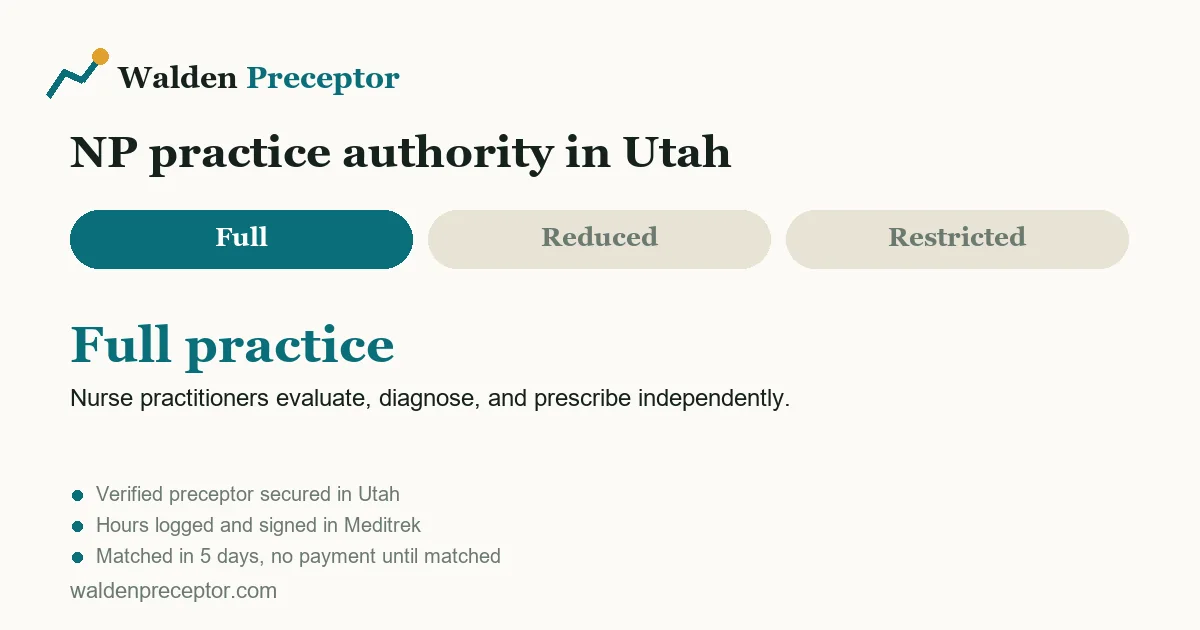
NP practice authority in Utah
The American Association of Nurse Practitioners lists Utah as a full practice authority state. That category means a nurse practitioner can evaluate patients, diagnose, order and interpret tests, and start and manage treatment under the exclusive licensing authority of the state, without a state-mandated physician contract.
This was not always the case. Utah moved from reduced practice to full practice when Senate Bill 36 was signed in March 2023. The change removed the old requirement that an NP hold a consultation and referral contract with a physician as a condition of licensure. For a Walden student, full authority usually means preceptors and sites have more flexibility in how they supervise your learning, because the underlying practice rules are less restrictive than in neighboring states.
Practice authority and student supervision are two separate things. No matter how open the state law is, your Walden practicum still runs on Walden's rules: an approved preceptor with the right credentials, a site that signs an affiliation agreement, and every hour logged and verified in Meditrek. Full authority makes recruiting a preceptor easier. It does not replace the paperwork.
- Full practice authority per the AANP State Practice Environment
- No mandated physician contract since SB 36 (2023)
- NPs diagnose, order tests, and manage treatment independently
- Preceptor credentials still set by Walden, not by the state
The Utah Board of Nursing and DOPL
Nursing in Utah is regulated by the Division of Professional Licensing (DOPL), which sits inside the Utah Department of Commerce. DOPL handles the administrative side of licensure, while the Utah Board of Nursing acts as the advisory body that sets professional standards. The board includes registered nurses, licensed practical nurses, APRNs, and public members.
To practice as an APRN in Utah, a nurse first holds an active RN license, completes a graduate nursing program such as an MSN or DNP, and earns national certification in a specialty like FNP or PMHNP. Your preceptor will hold one of these credentials, and you can confirm any Utah license yourself through the state lookup tool before your practicum begins.
Who regulates
Division of Professional Licensing (DOPL), Department of Commerce, advised by the Utah Board of Nursing.
NP recognition
APRNs are licensed with full practice authority; national specialty certification is required.
Verify a license
Use the DOPL license lookup at secure.utah.gov to confirm a preceptor's standing.
It is worth verifying every preceptor before you submit their nomination. A quick lookup now prevents a Meditrek rejection later, which is one of the most common reasons a start date slips.
Finding a preceptor and site in Utah
Walden asks every student to secure their own preceptor and clinical site, then nominate them in Meditrek for the Office of Field Experience to review. The university supports you, but it does not generally assign placements. That single rule is where most Walden students lose time, because cold outreach to busy clinics in your specialty is slow and discouraging.
This is the part we handle. We recruit preceptors who match your track, confirm they hold the right Utah credentials, and prepare a clean nomination so your Meditrek application goes through the first time. We work across Utah, including:
- Salt Lake City and the Wasatch Front
- Provo and Orem
- Ogden and Layton
- West Valley City and Sandy
- St. George and southern Utah
- Logan and Cache Valley
Whether you need primary care for an FNP rotation, behavioral health for PMHNP, or adult-gero settings for AGPCNP and AGACNP, the goal is the same: a preceptor who will sign off your hours and a site that will sign the affiliation agreement. We start with no payment until you are matched.
What your Utah practicum needs
Once you have a preceptor lined up, the Utah practicum follows the same Walden structure as the rest of the country, with a few state-specific compliance steps layered on top.
| Item | What to expect in Utah |
|---|---|
| Practicum hours | NP tracks (FNP, PMHNP, AGPCNP, AGACNP, PNP) total 640 hours across four 160-hour courses. DNP is a minimum of 1,000 post-bachelor's hours. RN-to-BSN is a 100-hour capstone in NURS 4300. |
| Meditrek | Your preceptor and site are nominated and approved in Meditrek before you start. No hours count until the application is approved. |
| Affiliation agreement | The clinical site signs an agreement with Walden. We confirm a site is willing and able to sign before you commit to it. |
| CastleBranch (myCB) | Background checks, immunizations, and onboarding run through CastleBranch, with Utah and site-specific requirements that vary by clinic. |
| Preceptor credentials | An actively licensed Utah APRN or other Walden-approved provider, verifiable through DOPL. |
Tempo Learning, Walden's competency-based format, is not used for the NP tracks, so plan on the standard term-based practicum sequence.
Virtual versus in-person hours
NP practicum hours in Utah are hands-on. Direct patient care is the point of the experience, so the bulk of your 640 hours will be in person at your clinical site with your preceptor present. Telehealth can be part of a rotation when the site uses it and your preceptor supervises it, which is increasingly common across Utah primary care and behavioral health.
Some coursework and project deliverables, especially in DNP work tied to NURS 8600 and 8601, can be done remotely. The clinical contact hours that Meditrek tracks, though, are real patient encounters. When we place you, we focus on sites that offer the volume and patient mix your specific course objectives call for.
Common questions from Walden students in Utah
Does Utah give nurse practitioners full practice authority?
Yes. The AANP classifies Utah as a full practice authority state. Senate Bill 36, signed in March 2023, removed the prior requirement for a mandatory physician contract, so Utah NPs can evaluate, diagnose, order tests, and manage treatment under the licensing authority of the state.
Who licenses nurse practitioners in Utah?
The Utah Division of Professional Licensing (DOPL), within the Department of Commerce, licenses APRNs with the advice of the Utah Board of Nursing. You can confirm any license through the state verification tool at secure.utah.gov.
Do I have to find my own preceptor for a Utah practicum?
Yes. Walden expects you to secure your own preceptor and clinical site, then nominate them in Meditrek for review. Walden supports the process but does not generally assign placements. We handle the sourcing and outreach for you in Utah cities such as Salt Lake City, Provo, and Ogden.
How many practicum hours does a Walden NP track require?
Walden NP tracks such as FNP, PMHNP, and AGPCNP require 640 hours across four 160-hour practicum courses. The DNP requires a minimum of 1,000 post-bachelor's hours, and RN-to-BSN includes a 100-hour capstone in NURS 4300.
Sources
- AANP State Practice Environment
- AANP Utah
- Utah DOPL Nursing
- Utah License Verification
- Walden Academic Guides, academicguides.waldenu.edu
- Walden CastleBranch, walden.castlebranch.com
Ready to lock in a Utah preceptor?
Tell us your Walden track and where you are in Utah. We will source a preceptor, confirm a site that will sign the affiliation agreement, and prepare your Meditrek nomination. Matched in 5 days, and you pay nothing until you are matched.
Start my free consult