Walden preceptor matching and practicum support in Wisconsin
Wisconsin is a reduced-practice state for nurse practitioners. If you are a Walden University student doing your practicum in Wisconsin, you still have to find your own preceptor, secure an approved site, and nominate them in Meditrek before a single hour counts. We do that legwork for you, and you pay nothing until you are matched.
Most Wisconsin students we work with are matched within 5 days. Our coordinators handle the preceptor search, the Meditrek nomination, and the CastleBranch and affiliation-agreement steps so you can keep your focus on coursework and patients.
Start your placement, free
Tell us your program. We map the whole practicum. No payment until you are matched.
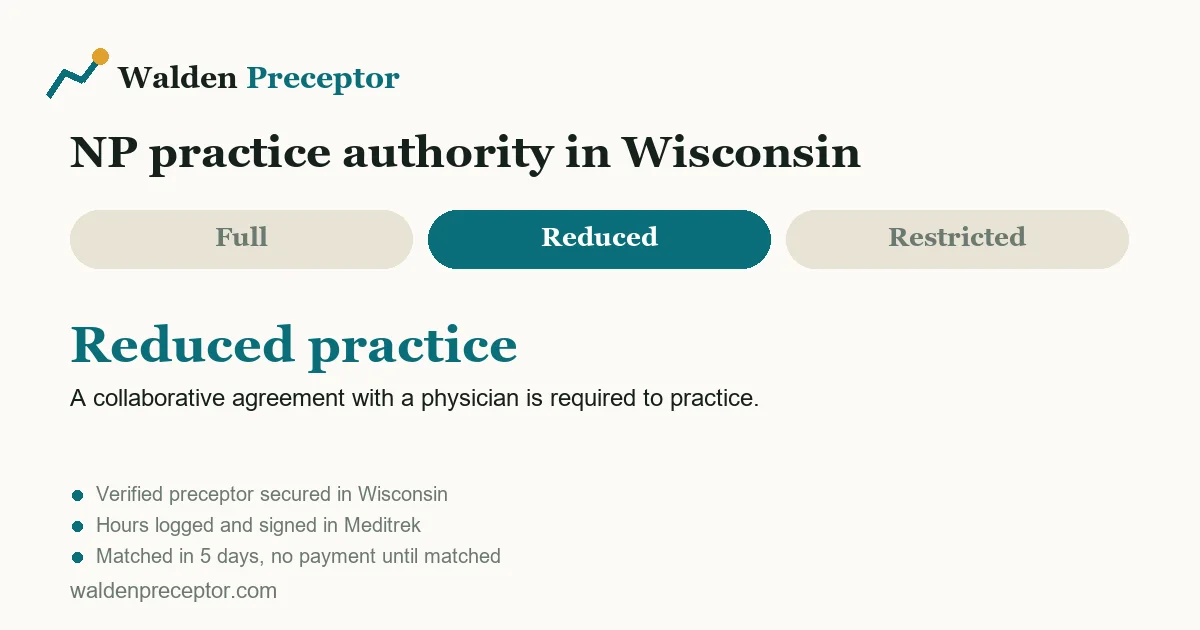
What reduced practice means for you in Wisconsin
The American Association of Nurse Practitioners classifies Wisconsin as a reduced-practice state. In plain terms, state law limits at least one element of NP practice, and the practical effect shows up most in prescribing. Today, nurse practitioners in Wisconsin hold the Advanced Practice Nurse Prescriber (APNP) credential and need a documented collaborative relationship with a physician to exercise prescriptive authority. Schedule II controlled substances may be prescribed only in limited circumstances.
There is a real change on the horizon. Under 2025 Wisconsin Act 17, the state adds an independent-practice pathway and moves to the Advanced Practice Registered Nurse (APRN) title, with an effective date of September 1, 2026. The Board of Nursing began rulemaking in the fall of 2025. For now, plan your Wisconsin practicum around the current collaborative model, and confirm the latest rules with the board before you graduate.
Current credential
Advanced Practice Nurse Prescriber (APNP), regulated by the Wisconsin Board of Nursing under the Department of Safety and Professional Services.
Collaboration
Prescriptive authority requires a documented collaborative relationship with a physician, with limited Schedule II prescribing.
Coming change
2025 WI Act 17 introduces an independent-practice route and the APRN title, effective September 1, 2026.
The Wisconsin Board of Nursing
Advanced practice nurses in Wisconsin are overseen by the Wisconsin Board of Nursing, which sits within the Department of Safety and Professional Services (DSPS). The board sets the standards for the APNP credential, prescribing, continuing education, and the move to APRN status. Knowing what the board expects keeps your practicum on solid ground.
- Who regulates you. The Board of Nursing handles RN and APNP credentialing through DSPS at dsps.wi.gov.
- Credential basics. The APNP credential expects national NP certification, a graduate degree in nursing or a related health field, and recent clinical pharmacology coursework.
- License verification. You and your site can confirm a credential through the state's lookup tools at license.wi.gov.
- Continuing requirements. APNPs complete pharmacology continuing education each renewal period, including responsible-prescribing hours, and carry malpractice coverage as the board requires.
Rules change, and Act 17 is reshaping the framework right now. Always confirm current requirements directly with the Board of Nursing before you rely on them.
Securing a preceptor and clinical site in Wisconsin
Here is the part that trips up most Walden students. Walden requires you to secure your own preceptor and clinical site, then nominate them in Meditrek for review. The Office of Field Experience supports the process, but it does not generally assign placements. You cannot register a practicum or begin logging hours until your Meditrek application is approved. In a reduced-practice state, where a collaborating physician sits behind the prescribing relationship, that search can take real time if you go it alone.
Our Wisconsin coordinators carry the search for you. We tap clinics, hospital systems, and private practices across the state so you are not cold-emailing offices on top of your coursework. We place students in and around:
Major metros
Milwaukee, Madison, Green Bay, Kenosha, and Racine, where larger systems and primary-care networks host NP students.
Smaller cities and rural areas
Appleton, Oshkosh, Eau Claire, La Crosse, Wausau, and Janesville, where community clinics often welcome practicum students.
Once we identify a preceptor who fits your track and schedule, we confirm their license and credentials, walk you through the Meditrek nomination, and stay with you until the placement is approved. You meet your match, you decide, and only then does the work move forward.
Wisconsin practicum requirements at a glance
Your hour count is set by your Walden program, not by Wisconsin. What the state adds is the compliance layer, the site paperwork, and the credential checks. Both have to line up before you start.
| Walden track | Practicum hours | Structure |
|---|---|---|
| FNP, PMHNP, AGPCNP, AGACNP, PNP | 640 hours | Four practicum courses at 160 hours each |
| DNP | 1,000 hours minimum | Post-bachelor's hours tied to your DNP project |
| RN-to-BSN | 100 hours | Capstone practicum (NURS 4300) |
- Meditrek. Every Wisconsin placement runs through Meditrek. Your preceptor signs off your hours there, and no practicum starts without an approved Meditrek application.
- CastleBranch (myCB). Health and background clearances are managed through CastleBranch at walden.castlebranch.com, and Wisconsin sites often add state-specific or system-specific items such as immunization records, drug screening, and background checks.
- Affiliation agreement. Your Wisconsin clinical site needs a current affiliation agreement with Walden before you can begin. We flag this early so it does not stall your start date.
- Tempo Learning note. Walden's Tempo Learning (competency-based) format is not used for the NP tracks, so your Wisconsin practicum follows the standard course-based structure.
Virtual or in-person in Wisconsin?
NP practicum hours in Wisconsin are hands-on. You need direct, in-person clinical contact at an approved site with a preceptor who supervises your care and signs your hours in Meditrek. That is true whether you are in a Milwaukee hospital clinic or a rural practice near Eau Claire.
Telehealth can play a part, but only when your course explicitly permits it and your preceptor directly oversees the visit. When we set up your Wisconsin placement, we make sure the site supports the in-person hours your track demands, so you are not left short at the end of a term.
Wisconsin practicum FAQ
Is Wisconsin a full practice state for nurse practitioners?
No. The AANP classifies Wisconsin as a reduced-practice state. NPs practice under the Advanced Practice Nurse Prescriber (APNP) credential and need a documented collaborative relationship with a physician for prescriptive authority. Under 2025 Wisconsin Act 17, an independent-practice pathway and the APRN title take effect September 1, 2026.
Does Walden assign my preceptor in Wisconsin?
No. Walden requires you to secure your own preceptor and clinical site, then nominate them in Meditrek for review. The Office of Field Experience supports the process but does not generally assign placements. That is the gap our Wisconsin placement team fills.
How many practicum hours do Walden NP students complete in Wisconsin?
Walden NP tracks such as FNP, PMHNP, AGPCNP, AGACNP, and PNP require 640 practicum hours across four 160-hour courses. The DNP requires a minimum of 1,000 post-bachelor's hours, and RN-to-BSN includes a 100-hour capstone (NURS 4300). Hours are logged and signed off in Meditrek.
Can I complete my Wisconsin practicum virtually?
No. NP practicum hours require in-person, hands-on clinical contact at an approved Wisconsin site with an on-site preceptor who signs off in Meditrek. Telehealth experiences may count only when your course allows and your preceptor directly supervises them.
Sources and official references
- AANP State Practice Environment and Wisconsin profile
- Wisconsin Board of Nursing, Advanced Practice Nurse Prescriber (DSPS)
- Wisconsin license verification
- Walden University Field Experience and practicum requirements
- Walden CastleBranch (myCB) compliance
State rules can change, and 2025 WI Act 17 is actively reshaping APRN regulation. Confirm current requirements with the Wisconsin Board of Nursing and Walden before relying on them.
Let us handle your Wisconsin placement
Tell us your track and your part of Wisconsin, and our coordinators will start the preceptor search, prep your Meditrek nomination, and keep your CastleBranch and affiliation steps moving. Most students are matched within 5 days, and you pay nothing until you are matched.