The Walden DNP project and practicum, explained
Your Walden DNP comes down to three moving parts that have to line up: a minimum of 1,000 post-bachelor's practicum hours, an IRB-approved project you build during those hours, and a preceptor who signs everything off in Meditrek. Miss the order and a term slips. This page walks the whole sequence so you can see what to lock down first.
Last updated: June 22, 2026 · Reviewed by the Walden Preceptor placement team
Start your placement, free
Tell us your program. We map the whole practicum. No payment until you are matched.
The 1,000-hour minimum, and the 600 you can carry in
Walden requires a minimum of 1,000 post-baccalaureate supervised practice hours to graduate from the DNP program. You do not always start that count from zero. Students may transfer up to 600 practicum hours earned in their master's program, which is why a post-master's DNP student often has roughly 400 hours left to complete and a BSN-to-DNP student has the full climb ahead.
The rule that trips people up: if you enter with fewer than 600 verified post-bachelor's hours, you make up the gap through field experience in NURS 8600 or NURS 8601. So the first thing to do is get an honest count of what transfers before you map out terms. (Source: Nursing Practicum Manual, DNP requirements.)
The credit-to-hours math you actually plan around
| Field experience course | Hours per credit | Example: 3 credits |
|---|---|---|
| NURS 8600 | 72 hours / credit | 216 hours that term |
| NURS 8601 | 80 hours / credit | 240 hours that term |
You can register for up to 3 credits of NURS 8600/8601 per term (appeals can reach 4, but not beyond). That cap is the single biggest reason DNP timelines stretch, so back-plan from it.
How the project rides on top of your practicum hours
The DNP project is not a separate research bubble bolted on at the end. You build it inside your supervised practice. For catalog years beginning Summer 2024, students complete the DNP Project during practicum activities across the three core practicum courses (NURS 8312, 8512, and 8513), and Walden asks you to use the same practicum site, and preferably the same preceptor, for all three. Your exact course map depends on your catalog year, so confirm yours against your program of study rather than copying a classmate's.
What this means in practice: the site you secure has to be one where your project can actually live. A quality-improvement project needs a setting with the population, data access, and leadership buy-in to implement and measure a change. Picking a convenient site that cannot host your project is the most expensive mistake in the whole degree, because you do not find out until you are weeks in.
IRB approval comes before you touch any data
The full walkthrough of Form A, the study-specific document list and the review calendar lives on our Walden IRB approval page.
This is the gate most students underestimate. Walden's Institutional Review Board must approve your project before you collect or analyze any data, including pilot data. The IRB checks that your work meets Walden's ethical standards and U.S. federal regulations. Approval is typically granted for one year and is renewable.
A few things worth knowing early:
- Almost everything that gathers or analyzes data needs IRB review, whether the data comes from surveys, interviews, observation, work products, or records of any type.
- The narrow exceptions are literature reviews, hypothetical designs, and faculty projects fully independent of Walden resources and participants.
- Site permission and IRB approval are different steps. Your practicum site usually has its own approval or letter-of-cooperation requirement on top of Walden's IRB.
Build the IRB timeline into your project plan from day one. A project that is otherwise ready can sit idle for weeks waiting on approval, and those are weeks you cannot get back near a graduation deadline. (Source: Understanding the Role of an IRB and Research Ethics Review Process.)
Meditrek: the application, the logs, the sign-off
Meditrek (Meditrek) is where the practicum becomes official. Two distinct moments matter:
The pacing caps you cannot work around
Walden will not let you compress a thousand hours into a sprint. On a day you do not work, you may log up to 12 practicum hours. On a day you do work, your combined work plus practicum hours cannot exceed 16. Hours have to be spread across the term, which is exactly why securing a reliable site and preceptor early matters more than any other single decision: a preceptor who can only give you a few hours a week sets a ceiling on how fast you can finish.
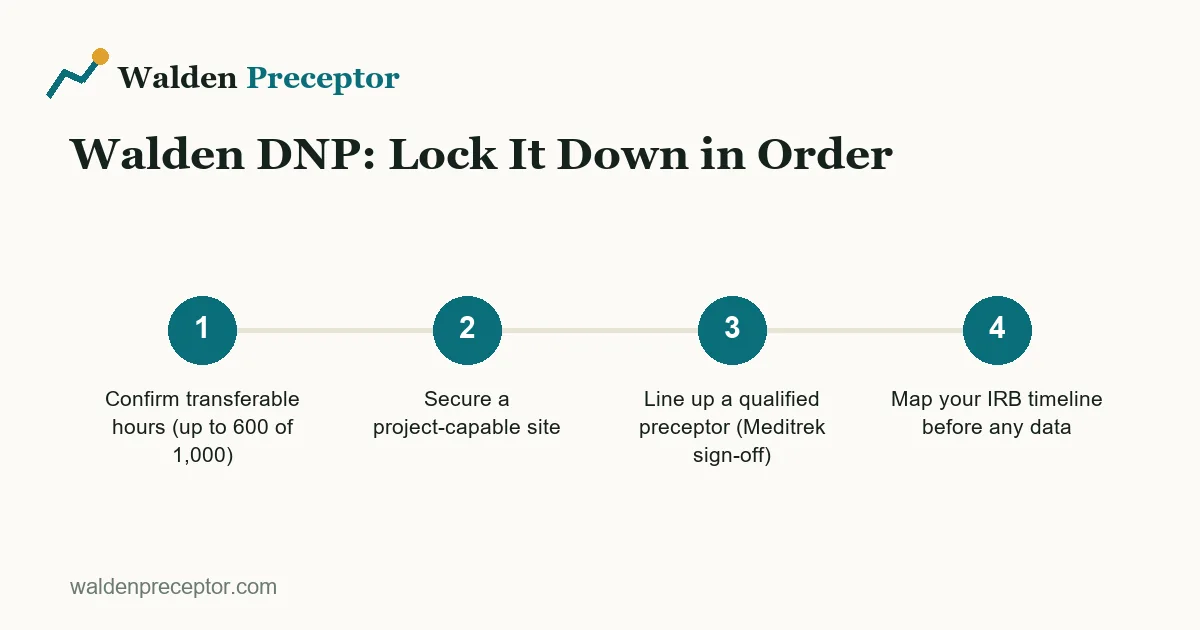
What to lock down first, in order
1. Your transferable hours
Confirm how many of the 1,000 you already have. This sets how many field-experience credits you still need.
2. A project-capable site
A setting that can host your project's population, data, and the change you want to implement and measure.
3. A qualified preceptor
Someone who can give 1:1 supervision, enough weekly hours to hit your pace, and sign off in Meditrek.
4. Your IRB timeline
Map approval before any data collection, and keep it renewed across the project courses.
Frequently asked
How many practicum hours does the Walden DNP require?
A minimum of 1,000 post-baccalaureate supervised practice hours to graduate. You can transfer up to 600 hours earned in your master's program. If you enter with fewer than 600 verified post-bachelor's hours, you make up the difference through NURS 8600 or NURS 8601 field experience.
How do NURS 8600 and NURS 8601 credits convert to hours?
NURS 8600 counts 72 practicum hours per credit and NURS 8601 counts 80 practicum hours per credit. You may register for up to 3 credits per term, so 3 credits of NURS 8601 equals 240 hours in that term.
Do I need IRB approval before I start my DNP project?
Yes. Walden's IRB must approve your project before you collect or analyze any data, including pilot data. Approval is typically granted for one year and is renewable. Literature reviews and hypothetical designs are the main work that does not need IRB review.
What does my preceptor have to do in Meditrek?
Your preceptor provides 1:1 direct supervision, signs your time logs in Meditrek, joins faculty calls, and completes your practicum evaluations in Meditrek. Hours are not counted until the preceptor signs off.
Can I log all my DNP hours in a few weeks?
No. You can log up to 12 hours per day on a day you do not work, and your combined work plus practicum hours cannot exceed 16 in a day. Hours must be spread across the term, not compressed into a short window.
Sources
- Walden Nursing Practicum Manual, Section 2.2: DNP Program and Practicum Requirements (1,000-hour minimum, 600-hour transfer, 72/80 hours per credit, 3-credit cap, daily caps, project across core courses)
- Walden Nursing Field Experience: NURS 8601 DNP Field Experience (field experience, affiliation agreements, preceptor qualifications)
- Walden University: Understanding the Role of an Institutional Review Board (IRB approval before data collection)
- Walden Research Ethics: Research Ethics Review Process by IRB (what needs review, one-year approval)
- Meditrek student portal (Walden) (practicum application, logs, preceptor sign-off)
Course numbers and hour rules are catalog-year sensitive. Always confirm the details against your own program of study and current Walden materials.
Where most DNP students get stuck
It is rarely the writing. It is finding a site that can host the project and a preceptor who can give enough supervised hours to keep your pace, then getting both approved in Meditrek before the deadline. That is the exact piece we handle. We match Walden DNP students with a project-capable site and a qualified preceptor, and we do not take payment until you are matched.
Get matched for your DNP practicum
Tell us your specialty, your remaining hours, and your start term. We will line up a preceptor and a site that fits your project, in about five days. No payment until you are matched.
Start my free consult