Walden’s IRB, from Form A to approval
Walden will not let you touch a single data point until its Institutional Review Board says yes. That one rule reorders your whole capstone: the site has to be real before the paperwork can be written, and the paperwork has to clear before you recruit anybody. This page walks what the IRB reviews, how Form A opens the file, and where your practicum site and preceptor sit inside the review.
Last updated: July 27, 2026 · Reviewed by the Walden Preceptor placement team
Start your placement, free
Tell us your program. We map the whole practicum. No payment until you are matched.
What the Walden IRB actually reviews
Walden’s Institutional Review Board exists to comply with the federal regulations for the protection of human subjects, 45 CFR 46. That framing matters, because it sets the board’s scope far wider than most nursing students expect. Walden’s own handbook language is blunt about it: all research projects involving the access, collection, or analysis of data must be reviewed and approved by the IRB, whether that data comes from surveys, interviews, observation, student or employee work products, or records of any type.
Read that list again, because three items on it catch people out. Records of any type includes the chart review you were planning to call a quick audit. Employee work products includes the staff documentation you were going to pull from your own unit. Observation includes watching a workflow and writing down what you see. None of those feel like research when you are standing on a nursing floor. All three are inside the board’s scope.
The two genuine exceptions are narrow: a literature review, and a hypothetical design that never touches real data. If your project lives entirely in published sources or entirely in theory, you are outside the review. Almost every practice-facing nursing capstone is not.
The sentence that governs your calendar
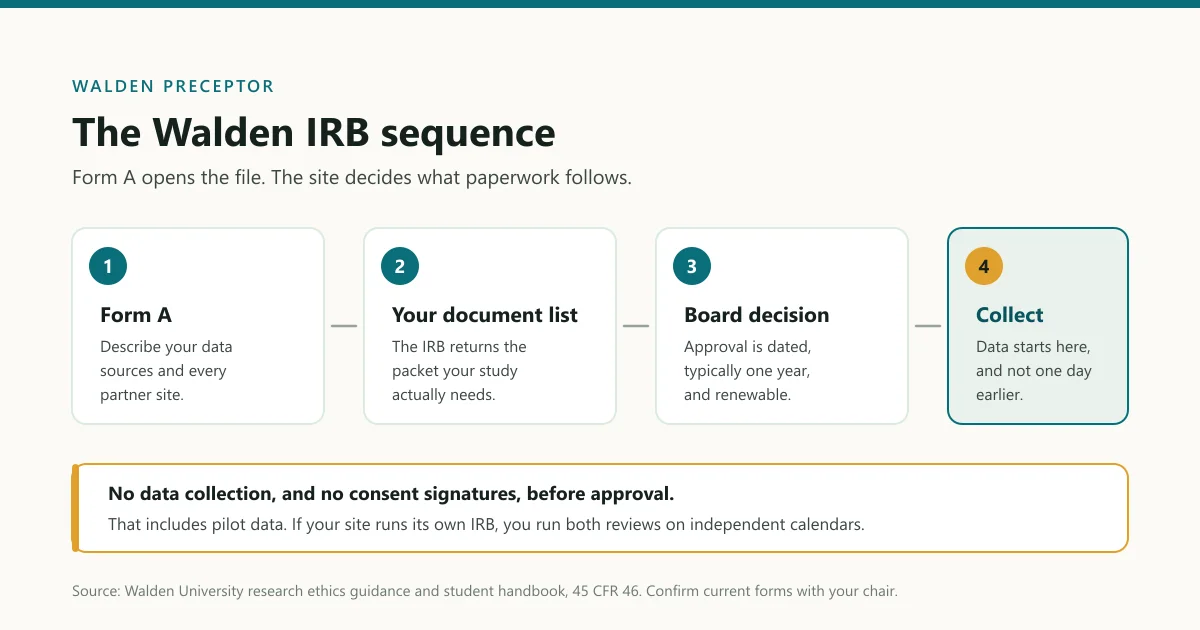
No member of the university community may commence research data collection until it has been approved by the IRB. Not pilot data. Not a few practice interviews to see whether the questions work. Not a signed consent form. Approval comes first, and every hour you spend planning around that is an hour you do not lose to a restart.
Form A opens the file, it is not the whole application
Every student and staff researcher at Walden starts the ethics review the same way, by completing Form A, the Description of Data Sources and Partner Sites. Form A is short relative to what follows, and its job is to tell the IRB two things: where your data will come from, and which outside organizations are involved.
What happens next is the part worth planning for. Once IRB staff read Form A, they send back the list of documents that your particular study needs, based on the data sources and partner organizations you just described. There is no single universal packet to pre-fill. A project drawing on de-identified records at one clinic generates a different document list than a project interviewing staff at a hospital that runs its own review board.
The practical consequence: you cannot meaningfully assemble your IRB paperwork before you know your site. The site determines the documents. This is the single most common sequencing mistake we see, and it is why students who leave the placement to the last minute end up rewriting their timeline rather than their protocol.
Where IRB approval sits in the Walden sequence
Walden’s capstone runs through a fixed set of gates, and the IRB is not the first of them. The order is prospectus, then proposal with its oral defense, then IRB approval, then the final study with its own oral defense and the Form and Style review, and finally approval by the Chief Academic Officer. Your committee and the University Research Reviewer sit inside that chain as independent evaluators.
Note what this ordering does to recruitment. You may not begin recruiting individual participants, which includes obtaining signatures on consent forms, before the board has approved your study. Students who line up willing participants early and treat the IRB as a formality discover that the willingness they collected does not count.
Your site is part of the review, not a detail around it
Because Form A asks about partner sites, the organization where you plan to work is inside the ethics review from the first document. For DNP students, that shows up as a Site Approval Form carrying signatures from the site for both the project itself and the site agreement covering the identified project focus.
Then there is the second review nobody budgets for. If your site runs its own IRB, that board has its own application, its own meeting calendar, and its own answer, and it is entirely independent of Walden’s. Hospital systems commonly do. Small private practices commonly do not. Which one you land in changes your timeline by weeks, and you find out only after you know the site.
Where we fit, and where we do not
We source and secure the practicum site and the qualified preceptor, and we prepare and track the placement paperwork that sits underneath all of this. That is the piece that unblocks your Form A, because the site determines your document list.
We do not obtain IRB approval, we do not submit your application, and we do not speak for Walden or for your site’s review board. Those decisions belong to the boards, and any service that suggests otherwise is selling you something it cannot deliver.
Approval is dated, and it expires
IRB approval is typically granted for one year, and it is renewable. For a project that runs long, which describes a great many nursing capstones, that means a renewal lands somewhere in the middle of your data collection. Put the expiry date in the same calendar as your practicum deadlines rather than discovering it during analysis.
Practicum hours and research data are two different things
This distinction saves a lot of unnecessary worry. The supervised hours you accumulate on the floor and log for your preceptor’s sign-off are practicum hours, governed by your program’s clinical requirements. They are not, by themselves, research data collection. What triggers the IRB is gathering or analyzing data for your project, whether or not you happen to be standing in the same building where you earn hours.
Where the two genuinely intersect is the site. One organization usually has to be willing to host both, which is why a site that is merely willing to supervise clinical hours is not always a site that will sign a project agreement. Ask about both when the placement is being arranged, not after.
Frequently asked
Does a quality improvement project still need Walden IRB review?
Do not assume it is exempt. Walden’s stated scope covers the access, collection, or analysis of data of any type, and the board decides how a project is classified, not the student and not the site. Submit Form A and let the determination come back in writing.
Can I collect data where I work?
Your own workplace is a partner site like any other, and it belongs on Form A. Expect the document list to address the dual relationship between your role as an employee and your role as a researcher.
How early should I start the IRB process?
Practically, as soon as the proposal clears and the site is real. Because the document list is generated from your data sources and partner organizations, an unconfirmed site is a stalled application.
Can I recruit participants while I wait?
No. Recruiting individual participants, including obtaining consent form signatures, may not begin before approval.
What if my site has its own IRB?
You run both. They are independent reviews on independent calendars, and the site’s board will have its own submission requirements. Confirm early whether the organization operates one.
Does IRB approval last the whole project?
Approval is typically granted for one year and is renewable, so a longer project needs a renewal tracked against its expiry date.
Sources
Walden University, Institutional Review Board: Research Ethics and Research Ethics Review Process; Walden University Student Handbook, Doctoral Learning and Resources; Walden University, Nursing Practicum Manual, DNP practicum requirements; 45 CFR 46, Federal Policy for the Protection of Human Subjects. Walden’s requirements change; confirm current forms and sequence with your chair and the IRB before you rely on any timeline.
Working the DNP path specifically? The project-side sequence, the 1,000-hour minimum and the Meditrek sign-off live on our Walden DNP project and practicum page. If the blocker is the site itself, start at finding a Walden preceptor.
Get the site your IRB file needs
Tell us your specialty, your remaining hours, and your start term. We will line up a preceptor and a site that fits your project, in about five days. No payment until you are matched.
Start my free consult