Walden FNP Preceptor in Alabama
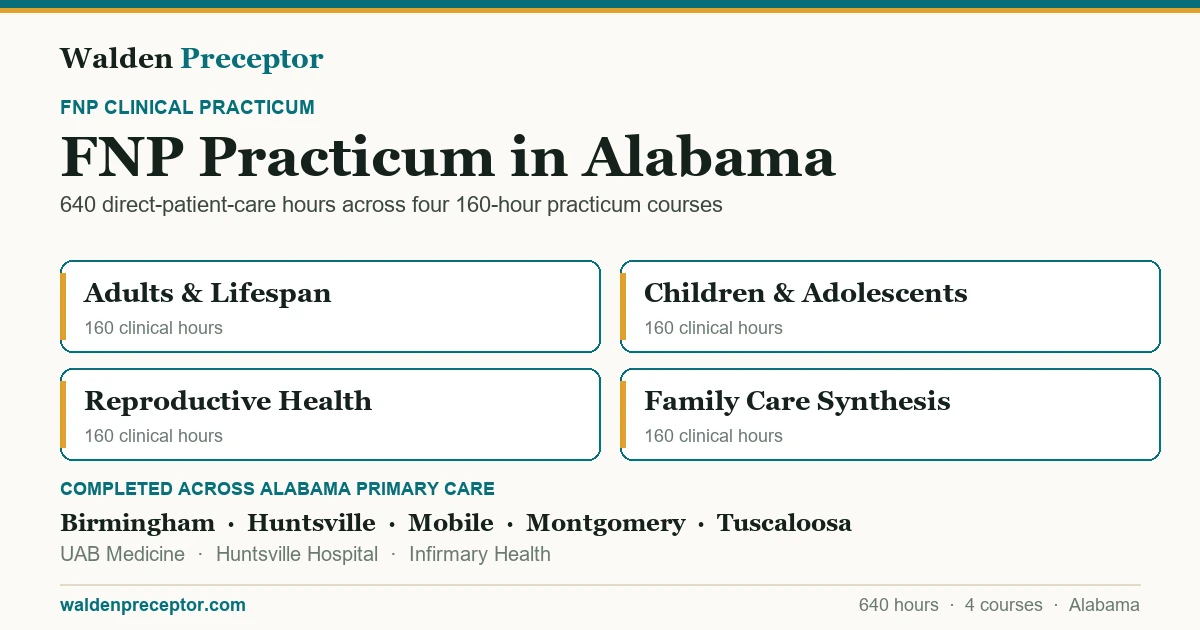
A Walden FNP practicum in Alabama requires 640 direct-patient-care hours across four 160-hour practicum courses, completed in person under an FNP-qualified preceptor. Alabama is a reduced-practice state, so your preceptor works inside a physician collaborative agreement, and you secure the placement yourself and nominate it in Meditrek for Walden's review. We find you an Alabama preceptor who meets Walden's published requirements and prepare that nomination, with no payment until you are matched.
Last updated 2026-06-28 · Reviewed by the Walden Preceptor placement team
Start your placement, free
Tell us your program. We map the whole practicum. No payment until you are matched.
How many FNP practicum hours does Walden require in Alabama?
The Walden Master of Science in Nursing Family Nurse Practitioner specialization requires 640 practicum hours, split into four practicum courses of 160 hours each. That total is Walden's and is identical whether you complete it in Birmingham, Mobile, or a rural county clinic. The Alabama variable is not the hour count; it is the supervision model your preceptor and site have to satisfy, which we cover further down. Walden lists a single state exception, 750 hours for students licensing as an APRN in Kansas, that does not apply to Alabama residents (Walden Practicum Manual, MSN requirements).
Three pacing rules from Walden shape your Alabama schedule. Every hour must be direct patient care, the hours for a course must spread across no fewer than 8 weeks and finish by the end of Week 10, and you may log a maximum of 12 practicum hours in any single day. At 160 hours per course inside a roughly eight-to-ten-week window, you need a preceptor who can host you about two clinical days a week. A site that can only take you one day a week pushes you against the Week 10 deadline, which is why preceptor availability, not just willingness, decides whether your term holds.
For the full FNP requirement breakdown across all four courses, see our Walden FNP preceptor page. This page focuses on what changes when that practicum happens in Alabama.
Which FNP courses need a preceptor, and what each one sees
The FNP specialization pairs a didactic course with a matching practicum (NRNP or DRNP for the lecture, PRAC or PRCM for the clinical) under the same number. Across the four, your Alabama placements have to cover the whole family lifespan, not one age group. In a reduced-practice state, that often means a family-medicine or community clinic that already sees a broad panel, which keeps you from chasing four separate single-population sites.
| Course | Patient population | Hours |
|---|---|---|
| 6531 | Primary Care of Adults Across the Lifespan | 160 |
| 6541 | Primary Care of Adolescents and Children | 160 |
| 6552 | Advanced Nurse Practice in Reproductive Health | 160 |
| 6568 | Synthesis in Advanced Nursing Practice, family care settings | 160 |
Course numbering is catalog-year sensitive; confirm yours in your Walden program of study. Source: Walden 6568 FNP field experience.
An Alabama family practice that sees newborns through older adults can often carry the 6531, 6541, and 6568 hours, with the 6552 reproductive-health block sometimes split to a women's-health or OB-GYN site. We map which of your four courses one Alabama site can cover and where a second is cleaner, so each course's population requirement is genuinely met rather than forced onto a clinic that does not see those patients.
How does Alabama's reduced-practice rule change your FNP preceptor?
The American Association of Nurse Practitioners classifies Alabama as a reduced-practice state. In Alabama an NP is titled a certified registered nurse practitioner (CRNP) and cannot practice independently; the CRNP works under a career-long collaborative practice agreement with an Alabama-licensed physician, jointly recognized by the Alabama Board of Nursing and the Alabama Board of Medical Examiners. That agreement carries a signed standard protocol and a quality-assurance plan with defined outcome measures (Ala. Admin. Code r. 610-X-5-.09).
For your FNP practicum, the practical effect is who can precept you and where. Your preceptor can be a CRNP or a qualified physician who meets Walden's course-specific criteria for the population you are seeing. When that preceptor is a newer CRNP, with under two years (4,000 hours) of collaborative experience, Alabama requires the collaborating physician to be present for not less than ten percent of the CRNP's scheduled hours on site. A more experienced CRNP meets with the physician at least quarterly. Either way, the cleanest placements are practices already running the collaborating-physician-and-CRNP model, because your day-to-day supervision and your hour sign-off line up with how the state actually works.
One reason Alabama FNP preceptors are scarce: a single collaborating physician may oversee only a capped volume of advanced-practice hours, roughly 360 full-time-equivalent hours per week of CRNPs, so a busy clinic that already runs at that ceiling has no room to add a student. We screen for sites with headroom under that cap so the supervision math works before you commit. For the statewide picture across every NP track, see our Alabama practicum page.
What the Alabama board expects of an FNP student
While you are still a Walden student, you are not applying for a CRNP license. You log supervised practicum hours under an approved preceptor, not as an independent provider. The Alabama Board of Nursing's relevant provision is provisional approval: a graduate awaiting certification may practice only with the on-site supervision of an advanced practice nurse of the same specialty or a qualified physician (Alabama Board of Nursing, advanced practice FAQs). The principle that matters for your practicum is the same one Walden enforces: hands-on supervision by a credential that matches your FNP scope.
Two checks follow from that. Confirm your preceptor is in good standing through the Board's public license verification before clinicals begin, and confirm their credential fits the course population you are seeing. We verify both as part of matching, so the nomination you submit to Walden does not stall on a credential mismatch.
Verify a license
Confirm your preceptor's RN or CRNP standing before your FNP hours start.
Alabama Board of NursingCollaboration rules
The joint CRNP collaborative-practice process and the standard protocol.
Board of Medical ExaminersHow hard is it to find an FNP preceptor in Alabama?
Harder than most students expect, for reasons specific to this state. Alabama runs many NP programs against a limited preceptor pool, 56 of its 67 counties are rural, and the state has dozens of designated primary-care shortage areas. Most practicing APRNs cluster in four urban counties, Jefferson (Birmingham), Madison (Huntsville), Mobile, and Montgomery, so outside those metros the FNP-qualified supervision you need thins out fast. Students who self-search commonly spend three to four months per rotation, which is why the standing advice is to start four to six months before your practicum start (NPHub, Alabama NP clinical rotations).
Walden does not hand you a preceptor. You secure your own preceptor and site and nominate them in Meditrek; if your own search fails, Walden's Practicum Pledge may match you. We work the same Alabama geography from the other side, with relationships across the metros and into the smaller towns:
- Family-medicine, internal-medicine, pediatric, and women's-health sites that fit the population for your current FNP course
- Placements across Birmingham, Huntsville, Mobile, Montgomery, Tuscaloosa, Auburn, Dothan, and Hoover, plus surrounding counties, near regional systems such as UAB Medicine, Huntsville Hospital, and Infirmary Health
- A preceptor whose credential fits the course, confirmed to supervise inside Alabama's collaborative model with headroom under the physician hours cap
- The Meditrek nomination prepared so Walden's review clears the first time, not on the third resubmission
Naming real systems is about geography, not endorsement. UAB Medicine, Huntsville Hospital, and Infirmary Health are large Alabama employers of the providers who can precept; whether a specific clinic can host you depends on its own capacity and a Walden affiliation agreement.
Getting your Alabama FNP placement approved
We never call a preceptor or site endorsed by Walden. Walden reviews and approves the placement you nominate. Our job is to match an Alabama FNP preceptor who meets Walden's published requirements and submit a clean nomination for Walden's own review. Two things have to be in place before you log a single hour: an approved Meditrek nomination and a complete compliance file.
Meditrek nomination
No practicum registration happens without an approved Meditrek application. Your preceptor later signs your hours and evaluations in Meditrek, so the nomination must clear before your Alabama start date.
CastleBranch compliance
Walden runs onboarding through CastleBranch and does not accept outside checks. Many Alabama sites add their own immunization, background, or drug-screen items, so we map the exact list to your placement.
Affiliation agreement
Your Alabama site and Walden need a signed affiliation agreement on file. If the site is new to Walden, we start that early so it does not stall your term.
Stack the lead time. Between Walden's Meditrek review, the CastleBranch upload, and the collaborative paperwork on the Alabama side, lock your placement weeks ahead of registration. Confirm Walden's requirements at Walden, Find a Preceptor and your compliance items at CastleBranch (myCB).
Common questions from Walden FNP students in Alabama
How many hours is a Walden FNP practicum in Alabama?
640 practicum hours, divided into four practicum courses of 160 hours each (6531, 6541, 6552, and 6568). The total is set by Walden and does not change because you complete it in Alabama. Hours must be direct patient care, logged over no fewer than 8 weeks and finished by the end of Week 10, with a daily cap of 12 practicum hours.
Does Walden assign my FNP preceptor in Alabama?
No. Walden expects you to secure your own preceptor and clinical site, then nominate them in Meditrek for Walden's review. If your own search is unsuccessful, Walden's Practicum Pledge may match you. We source an Alabama FNP-qualified preceptor who meets Walden's published requirements and submit the nomination for Walden's approval; we never describe a preceptor as endorsed by Walden before that review.
Does Alabama's reduced-practice rule affect my FNP preceptor?
It shapes the kind of site you join. The AANP classifies Alabama as a reduced-practice state, so a CRNP works under a career-long collaborative agreement with an Alabama-licensed physician. For a CRNP with under two years (4,000 hours) of experience, the collaborating physician must be present for at least ten percent of the CRNP's scheduled hours. Your FNP preceptor can be a CRNP or a physician who meets Walden's course requirements; the cleanest placements are practices already set up under this model.
How early should I look for an FNP preceptor in Alabama?
Plan four to six months ahead of your practicum start. Alabama has many NP programs competing for a limited pool of preceptors, 56 of 67 counties are rural, and most APRNs cluster in Jefferson, Madison, Mobile, and Montgomery counties. Self-searching students commonly spend three to four months per rotation, so an early start protects your term.
Can I complete a Walden FNP practicum in Alabama online?
No. Walden coursework is online, but the FNP practicum is in-person, direct patient care with your approved preceptor at a real Alabama site. Telehealth can count only when your preceptor supervises it directly and your course and site allow it. You still need a physical Alabama clinical placement.
Where this information comes from
- Walden University, MSN Practicum Requirements, 640 hours across four 160-hour courses and the Kansas exception
- Walden University, 6568 FNP field experience, FNP course structure and per-course hours
- Walden University, Find a Preceptor, student-secured model, Meditrek, and Practicum Pledge
- AANP State Practice Environment, Alabama reduced-practice classification
- Ala. Admin. Code r. 610-X-5-.09, collaborative practice, standard protocol, and the ten-percent physician-presence rule
- Alabama Board of Medical Examiners, collaboration process and physician supervision-hours cap
- Alabama Board of Nursing, provisional approval and on-site supervision
- NPHub, Alabama NP clinical rotations, rural-county and preceptor-search timeline context
Ready to lock in your Alabama FNP preceptor?
Tell us your city and which of the four FNP courses is next. We will source an Alabama preceptor who meets Walden's requirements, prepare your Meditrek nomination, and handle the collaborative paperwork. Matched in about five days, and no payment until you are matched.