Walden FNP Preceptor in Connecticut
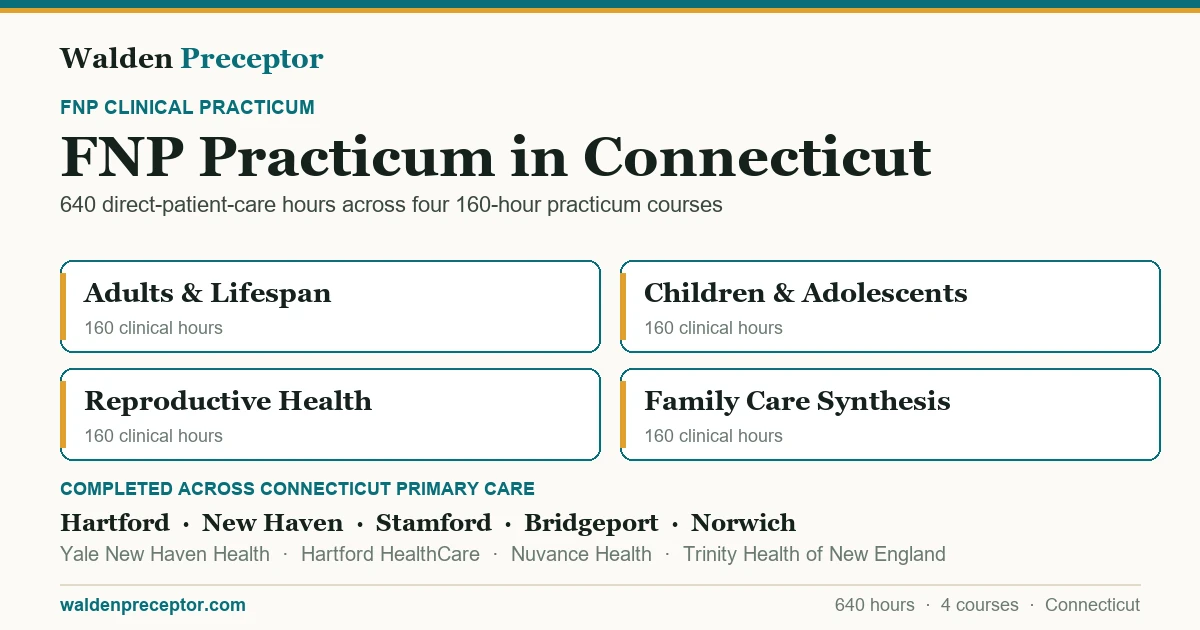
A Walden FNP practicum in Connecticut requires 640 direct-patient-care hours across four 160-hour practicum courses under an FNP-qualified preceptor. Connecticut is a full practice authority state, so the pool of preceptors who can supervise you includes independently practicing nurse practitioners as well as physicians. You secure and nominate your own preceptor in Meditrek; we do that sourcing for you across Connecticut and prepare a clean nomination for Walden to review.
Last updated 2026-06-28 · Reviewed by the Walden Preceptor placement team
Start your placement, free
Tell us your program. We map the whole practicum. No payment until you are matched.
How many practicum hours does a Walden FNP need in Connecticut?
The number is set by Walden, not by Connecticut: 640 direct-patient-care practicum hours, split evenly into four practicum courses of 160 hours each. Being in Connecticut does not raise or lower that figure. The only state-driven exception Walden publishes applies to students who plan to be licensed in Kansas, who complete 750 hours; that exception does not touch a Connecticut resident, so plan on 640.
The four FNP practicum courses each pair a didactic NRNP or DRNP course with a PRAC or PRCM practicum component, and each carries 160 hours of supervised patient care:
| Course | Population focus | Hours |
|---|---|---|
| 6531 | Primary Care of Adults Across the Lifespan | 160 |
| 6541 | Primary Care of Adolescents and Children | 160 |
| 6552 | Advanced Nurse Practice in Reproductive Health | 160 |
| 6568 | Synthesis in Advanced Nursing Practice, family care settings | 160 |
Course numbering is catalog-year sensitive; confirm yours in your Walden program map. Source: Walden MSN practicum requirements. For the full FNP breakdown of courses and patient populations, see our Walden FNP placement page.
What full practice authority means for your FNP preceptor in Connecticut
The American Association of Nurse Practitioners classifies Connecticut as a full practice state. For your FNP practicum, the practical takeaway is the size of the preceptor pool: experienced nurse practitioners in Connecticut evaluate, diagnose, and prescribe on their own, so an independently practicing FNP, AGPCNP, or other primary-care NP can precept you, not only a physician. In a restricted or reduced state the supervising provider is often a physician by default, which thins the pool; Connecticut does not have that constraint.
There is one Connecticut rule worth understanding because it shapes which NPs are practicing independently. Under Connecticut law, a newly licensed APRN must first practice in collaboration with a Connecticut-licensed physician for not less than three years and 2,000 hours. During that collaboration period the written agreement must address the level of Schedule II and III controlled substances the APRN may prescribe and set a method to review patient outcomes. After meeting both thresholds, the APRN submits written notice to the Department of Public Health and may then practice without a collaborative agreement.
This rule governs your preceptor's own license, not your practicum. A newer NP preceptor is simply practicing under a physician collaboration, while a seasoned NP may already practice independently; either one can precept a Walden FNP student as long as they meet Walden's course-specific requirements. You can read the current rules on the Connecticut DPH APRN practice page and the national summary at AANP state practice environment. For the broader, all-program view of practicing in the state, see our Connecticut placement guide.
Who regulates your FNP preceptor, and what we verify
Nursing in Connecticut is overseen by the Board of Examiners for Nursing, which sits within the Department of Public Health rather than as a standalone agency. APRN licensure and the collaboration rules are administered through DPH's practitioner licensing division. For your practicum this matters in two concrete ways:
- Your preceptor must hold an active Connecticut APRN or physician license appropriate to the patient population in your FNP course, which we confirm against the state license verification system before a placement is finalized.
- DPH does not routinely collect copies of collaboration agreements, but a licensed APRN must produce one on request, so a newer NP preceptor still needs that documentation in place. It does not become your paperwork, but it tells us whether the provider is practicing under collaboration or independently.
To be precise about language: a preceptor or site is never "endorsed by Walden" before Walden has reviewed it. We match preceptors who meet Walden's published requirements and submit the proposed preceptor and site for Walden's review in Meditrek. Walden reviews and approves the placement; we do not, and we never present a placement as guaranteed. For the Board itself, see the Board of Examiners for Nursing page.
Where FNP preceptors actually practice in Connecticut
Because the FNP role spans the whole family, your four courses need to cover the lifespan, not one patient population. That points your Connecticut placements toward primary care: family medicine, internal medicine, pediatrics, women's health, urgent care, and the state's federally qualified community health centers, which carry high primary-care volume and are common FNP training sites. Yale New Haven Health and Hartford HealthCare together account for roughly 60 percent of the state's hospital market, with Nuvance Health and Trinity Health of New England rounding out the multi-hospital systems; much of the day-to-day FNP primary care, though, happens in the affiliated clinics and independent practices around those systems. We look across the state:
Greater Hartford
Hartford, West Hartford, New Britain, and Manchester, with family medicine, pediatrics, and community health center sites that suit the 6531 and 6541 courses.
New Haven and the shoreline
New Haven, Milford, and Branford, with primary care, women's health, and pediatric practices useful for the 6552 and 6568 courses.
Fairfield County
Stamford, Norwalk, Bridgeport, and Danbury, with internal medicine, family medicine, and urgent-care sites for lifespan primary care.
Eastern Connecticut
Norwich, New London, and the Storrs and Willimantic area, where independent family practices often have more preceptor capacity than the crowded shoreline.
Some students cover several courses at one practice; others split across two or three sites. Both work, as long as each course's population requirement is met and every site has an affiliation agreement with Walden. If you are open to more than one part of Connecticut, we can usually match you faster.
Is it hard to find an FNP preceptor in Connecticut?
Honestly, yes, and it is worth knowing why before you start cold-emailing. FNP is the most-sought NP specialty in the country, so the competition for primary-care preceptors is among the fiercest of any track. Connecticut compounds that: it is a small, dense state sandwiched between New York and Boston, several nursing programs draw from the same clinics, and hospital-system credentialing for an outside student can take weeks. Precepting is usually unpaid, so many providers who could host a student simply do not have the time. Connecticut nursing programs have testified that limited preceptor capacity keeps them from admitting more FNP students each year, and the state has weighed preceptor tax-credit proposals to ease the shortage. None of that means a placement is out of reach; it means a head start and real relationships matter.
That is the work we take off your plate. Walden does not assign your FNP preceptor: you are expected to secure your own preceptor and clinical site, then nominate that preceptor in Meditrek so the Office of Field Experience can review and approve the match. We maintain relationships with Connecticut primary-care practices, clinics, and community health centers, match you to an FNP-qualified preceptor whose population fits your specific course, confirm the license is active and in good standing, and prepare you to submit a clean Meditrek nomination for Walden to review. You keep your attention on the coursework while we run the outreach and the paperwork. For the step-by-step version of this process, see our guide on how to find a Walden preceptor.
How Walden's pacing rules play out on a Connecticut schedule
Walden sets limits on how fast you can complete hours, and they interact with what a Connecticut preceptor can realistically offer. You can log a maximum of 12 practicum hours per day, your hours must be spread over no fewer than 8 weeks, and you generally need to finish by the end of Week 10 of the course. With 160 hours per course, that math sets your pace.
- At roughly two clinical days a week, 160 hours lands comfortably inside the 8-to-10-week window.
- A Connecticut preceptor who can only host you one day a week leaves you short near the Week 10 deadline, which is the single most common reason students scramble.
- You cannot front-load 160 hours into a few long weeks; the 8-week floor and the 12-hour daily cap both prevent it.
We factor these caps in when we match you, so the preceptor's available days actually add up to 160 hours inside the window. Before practicum begins, you also clear health and background compliance through CastleBranch (myCB), and your Connecticut site and Walden need a signed affiliation agreement in place; if your site does not already have one, that can take time, so we flag it early.
Walden FNP in Connecticut: FAQ
How many practicum hours does a Walden FNP need in Connecticut?
A Walden FNP student in Connecticut completes 640 direct-patient-care practicum hours, divided into four practicum courses of 160 hours each. The hour count comes from Walden and does not change because you are in Connecticut. The Kansas 750-hour exception does not apply to Connecticut residents.
Can a nurse practitioner precept a Walden FNP student in Connecticut?
Yes. Connecticut is a full practice authority state, so experienced APRNs practice independently and can serve as preceptors, alongside physicians and other qualified providers. Your preceptor must meet Walden's course-specific requirements, and we submit the proposed preceptor and site for Walden's review in Meditrek. We do not assert any preceptor is endorsed by Walden before that review.
Does Connecticut require a collaborative agreement that affects my FNP preceptor?
Connecticut requires new APRNs to practice in collaboration with a physician for at least three years and 2,000 hours before practicing independently. That rule governs the preceptor's own license, not your practicum. A newer APRN preceptor is still practicing under collaboration, while a more experienced APRN may already practice independently. Either can precept you if they meet Walden's requirements.
Where are FNP preceptors found in Connecticut?
Walden FNP placements in Connecticut sit in family medicine, internal medicine, pediatrics, women's health, urgent care, and federally qualified community health centers across Greater Hartford, New Haven and the shoreline, Fairfield County, and eastern Connecticut. We match you to a primary-care site and an FNP-qualified preceptor whose population fits the specific 6531, 6541, 6552, or 6568 course you are taking.
Does Walden assign my FNP preceptor in Connecticut?
No. Walden expects you to secure your own preceptor and site, then nominate them in Meditrek for the Office of Field Experience to review. We do that Connecticut sourcing for you, verify the license is active, prepare a clean Meditrek nomination, and flag the affiliation agreement early. You pay nothing until you are matched.
Sources
- Walden University, MSN practicum requirements (640 hours, four 160-hour courses, FNP course numbers, Kansas exception)
- Walden University, Find a Preceptor (student-secured model, Meditrek, Office of Field Experience)
- Connecticut DPH, APRN Practice (three years and 2,000 hours, written collaboration, Schedule II and III, DPH notification)
- AANP State Practice Environment (Connecticut full practice classification)
- Connecticut Board of Examiners for Nursing
Ready to lock in your Connecticut FNP placement?
Tell us which FNP course is next, 6531, 6541, 6552, or 6568, and your part of Connecticut. We source an FNP-qualified preceptor, verify the license, and prepare your Meditrek nomination for Walden to review, with a match in five days and no payment until you are matched.