Walden FNP Preceptor in Kentucky
A Walden FNP practicum in Kentucky requires 640 direct-patient-care hours across four 160-hour practicum courses, supervised by an FNP-qualified preceptor whose license and specialty match the course population. Kentucky is a reduced-practice state, so your preceptor may be an experienced nurse practitioner working under a physician collaborative agreement or a physician directly. Walden does not place you; you secure the preceptor and site and nominate them in Meditrek. We do that sourcing for you and prepare the nomination for Walden's own review.
Last updated 2026-06-28 · Reviewed by the Walden Preceptor placement team
Start your placement, free
Tell us your program. We map the whole practicum. No payment until you are matched.
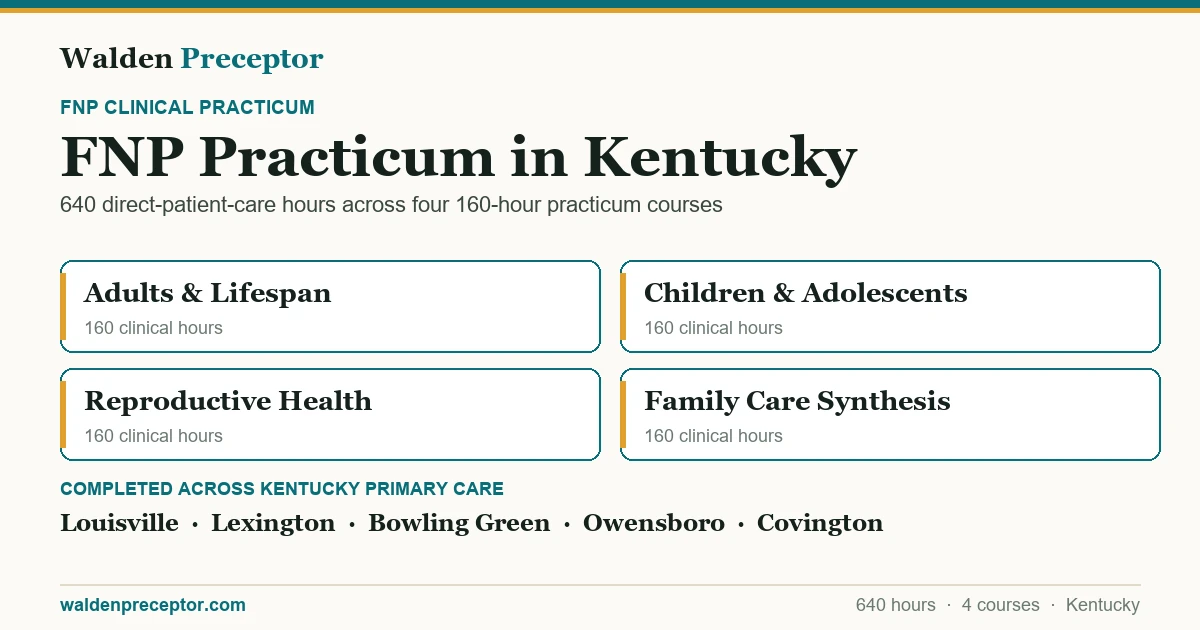
What does a Walden FNP practicum in Kentucky require?
The number is the same in Lexington as it is anywhere: 640 practicum hours, all direct patient care, split evenly into four 160-hour courses. Walden sets that figure; Kentucky does not raise or lower it. The four FNP practicum courses each pair a didactic NRNP or DRNP course with a PRAC or PRCM practicum under the same number, and together they walk you across the whole family lifespan:
| Course | Population focus | Hours |
|---|---|---|
| 6531 | Primary Care of Adults Across the Lifespan | 160 |
| 6541 | Primary Care of Adolescents and Children | 160 |
| 6552 | Advanced Nurse Practice in Reproductive Health | 160 |
| 6568 | Synthesis in Advanced Nursing Practice, family care settings | 160 |
Source: Walden MSN practicum requirements. Course numbering is catalog-year sensitive; confirm yours in your program of study.
The deeper FNP requirement details, the course-by-course preceptor criteria, and the Kansas hour exception live on our Walden FNP preceptor page. This page is about how that practicum actually runs in Kentucky.
How does Kentucky's reduced-practice status affect who can precept me?
The American Association of Nurse Practitioners classifies Kentucky as a reduced-practice state, and the limit centers on prescribing rather than on teaching. A new prescribing nurse practitioner in Kentucky works under one of two written agreements with a physician: the CAPA-NS for non-scheduled legend drugs and the separate CAPA-CS for controlled substances. An APRN cannot even apply for prescriptive authority until holding the license for at least one year, and the CAPA-CS adds a same-or-similar-specialty physician, employment within a healthcare entity, DEA registration, and quarterly KASPER prescription-monitoring reviews.
Here is the part that matters for a practicum: that collaborative agreement governs how your preceptor prescribes, not whether they can supervise you. After four years of prescribing in good standing in each category, an APRN may notify the Kentucky Board of Nursing and continue without the agreement, so many seasoned Kentucky preceptors practice with full prescriptive independence. Your preceptor needs an active license and a specialty that matches the course you are in, whether that is an FNP, another NP, or a physician.
See the AANP Kentucky page and the KBN APRN prescriptive authority rules. Our broader Kentucky placement page covers the board, license verification, and CastleBranch in depth.
Where do Walden FNP students place across Kentucky?
Because the FNP role covers every age, your four courses need to reach across the lifespan, not stay in one clinic type. In Kentucky that means primary care settings: family medicine, internal medicine, pediatrics, women's health, and community and rural health clinics. Kentucky's primary-care shortage cuts both ways. The Commonwealth carries more than 200 designated primary-care shortage areas, so demand for FNP-trained clinicians is real and providers value students who arrive ready, but a single provider in an underserved county may have a packed schedule that makes course pacing a planning problem.
Louisville & Lexington
Family and internal medicine, pediatrics, and women's health across the two largest metros, where multi-site coverage for several courses is most feasible.
Bowling Green & Owensboro
Western and south-central family practice and community clinics serving a largely rural patient panel.
Northern KY & Appalachia
Covington, Florence, and the eastern counties, where shortage designations are densest and a confirmed preceptor is hardest to find alone.
Some students cover all four courses at one family practice; others split across two or three sites to hit the pediatric and reproductive-health populations. Both work, as long as each course's population is met and every site has an affiliation agreement with Walden.
AANP state practice environment. Shortage-area context is drawn from HRSA Health Professional Shortage Area designations for Kentucky.
How fast can I finish 160 hours per course in Kentucky?
Walden caps the pace, and the cap shapes everything about a Kentucky placement. You may log a maximum of 12 practicum hours per day, your hours must spread over no fewer than eight weeks, and you complete each course by the end of Week 10. With 160 hours per course, that is roughly two clinical days a week to stay comfortably inside the window.
That math collides with rural Kentucky reality. A preceptor who can only host you one day a week pushes you toward the deadline; a preceptor whose clinic runs long days can get you there in fewer calendar weeks. When we match a Kentucky FNP student, we confirm the provider's weekly availability against your course start date before anyone commits, so you are not discovering a scheduling gap in Week 7. The hours log and the preceptor sign-off both happen in Meditrek.
Who finds the preceptor, and how does Meditrek approval work?
Walden does not assign you a preceptor. The policy is plain: you secure your own preceptor and clinical site, then nominate them in Meditrek for the Office of Field Experience to review and approve before the practicum course starts. If your own search fails, Walden's Practicum Pledge can match you with a site and preceptor as a fallback. There is no practicum registration without an approved Meditrek application.
For most students the search is the bottleneck, and in a shortage state it is sharper. Cold-calling clinics, chasing a CV, and waiting on credentialing can burn the weeks you needed for the eight-to-ten-week clinical window. Tell us your next course, your city, and your dates, and our team sources a Kentucky preceptor whose specialty fits the course population and whose site will sign an affiliation agreement. We confirm license, scope, and availability first, then hand you a clean package to nominate in Meditrek the first time.
One line we will never cross: we do not call any preceptor "endorsed by Walden." A preceptor either meets Walden's published requirements or does not, and Walden itself reviews and approves the placement after you nominate it. We prepare the nomination so that review goes smoothly; we do not stand in for it.
Common questions from Walden FNP students in Kentucky
How many hours does a Walden FNP practicum in Kentucky require?
640 direct-patient-care hours, divided into four 160-hour practicum courses (6531 adult lifespan, 6541 pediatrics and adolescents, 6552 reproductive health, and 6568 family-care synthesis). The hour count is set by Walden and does not change because you place in Kentucky. You log a maximum of 12 practicum hours per day, spread over at least eight weeks, completing each course by the end of Week 10.
Does a Kentucky FNP preceptor need to be physician-supervised to teach me?
Not for the purpose of precepting. Kentucky is a reduced-practice state, so a nurse practitioner in the first four years of prescribing works under a CAPA-NS or CAPA-CS collaborative agreement with a physician. That agreement governs how they prescribe, not whether they can supervise a student. Your preceptor can be an experienced NP, a physician, or another qualified provider whose license and specialty match the course population.
Does Walden assign my FNP preceptor in Kentucky?
No. Walden requires you to secure your own preceptor and clinical site, then nominate them in Meditrek for the Office of Field Experience to review and approve before the course begins. Walden offers the Practicum Pledge as a fallback if your own search fails. We are an independent service that does that sourcing for you and prepares a clean Meditrek nomination; we never claim a preceptor is endorsed by Walden before Walden reviews it.
Where do Walden FNP students place in Kentucky?
Family medicine, internal medicine, pediatrics, women's health, and community clinics across the Commonwealth, including Louisville, Lexington, Bowling Green, Owensboro, and the Northern Kentucky and Appalachian counties. Kentucky's primary-care shortage (more than 200 designated shortage areas) means demand for FNPs is high, but it can also make a single provider's calendar tight, so course pacing matters.
What does it cost and is placement guaranteed?
You pay nothing until you are matched with a confirmed preceptor and site, and we aim to match FNP students within about five days. We do not guarantee a placement and we never guarantee Walden will approve one; Walden reviews and approves every nomination. Pricing depends on your location and how many of the four FNP courses you need covered. See our pricing page for details.
Sources
- Walden University, MSN practicum requirements (640 hours, four 160-hour FNP courses, daily and weekly caps)
- Walden University, Find a Preceptor (student-secured model, Meditrek nomination, Practicum Pledge)
- AANP, Kentucky state practice environment (reduced practice)
- Kentucky Board of Nursing, APRN prescriptive authority (CAPA-NS, CAPA-CS, one-year and four-year rules, KASPER)
- HRSA, Health Professional Shortage Area designations (Kentucky primary-care shortage context)
Let us find your Kentucky FNP preceptor
You see the patients and log the hours. We source the FNP-qualified preceptor, confirm availability against your course window, and prepare the Meditrek nomination for Walden's review. No payment until you are matched, and we aim to match FNP students within about five days.