Walden FNP Preceptor in New Jersey
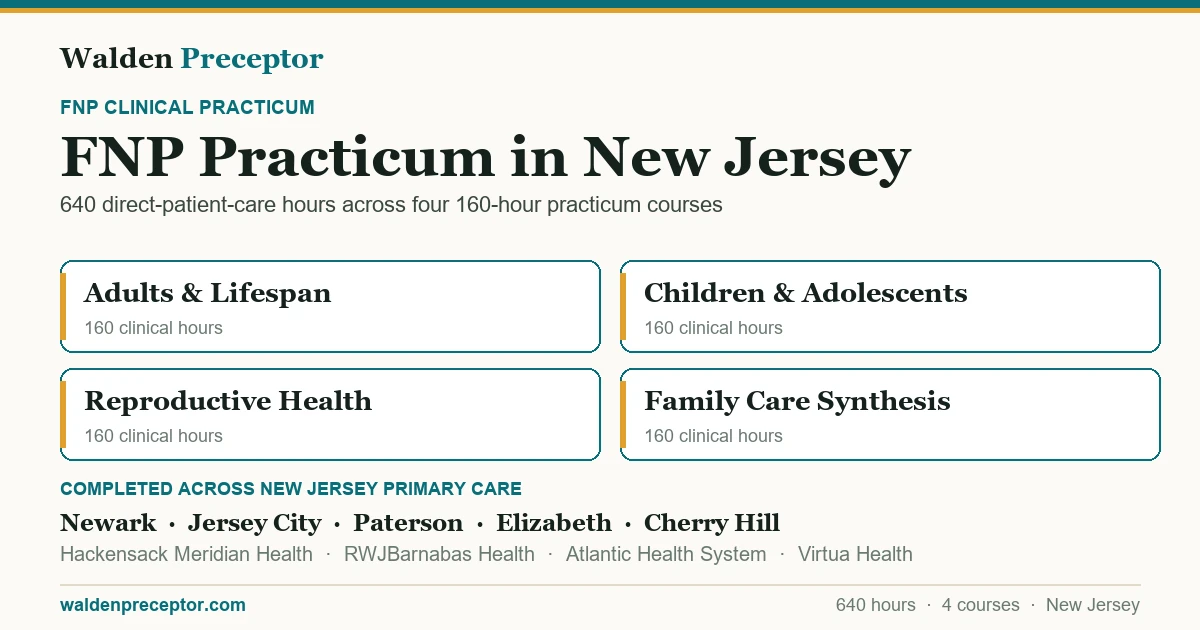
A Walden FNP practicum in New Jersey requires 640 direct-patient-care hours across four 160-hour practicum courses, supervised by an FNP-qualified preceptor whose family-care patient population fits each course. New Jersey is a reduced-practice state, so many of those preceptors prescribe under a written joint protocol with a collaborating physician, while qualifying primary care and behavioral health APNs gained independent authority under a 2026 law. Either way, a certified New Jersey APN can precept you and sign your hours in Meditrek. You secure the preceptor and site; Walden reviews and approves the placement. We find a preceptor who meets Walden's published requirements and prepare the nomination for Walden's review.
Last updated 2026-06-28 · Reviewed by the Walden Preceptor placement team
Start your placement, free
Tell us your program. We map the whole practicum. No payment until you are matched.
How many hours is a Walden FNP practicum in New Jersey?
The number is set by Walden, not by the state. A standard Walden FNP student completes 640 practicum hours in New Jersey, divided evenly into four 160-hour practicum courses. New Jersey adds no hours and subtracts none. What the state shapes is who can supervise those hours and under what prescribing arrangement, which is covered further down.
The four FNP practicum courses move you through the full family-care lifespan, each pairing a didactic course with its PRAC or PRCM practicum component. The course list is the same as on our Walden FNP page; here it matters because each course needs a New Jersey site whose patients fit that population.
| Practicum course | Patient focus | Hours |
|---|---|---|
| 6531 | Primary Care of Adults Across the Lifespan | 160 |
| 6541 | Primary Care of Adolescents and Children | 160 |
| 6552 | Advanced practice in reproductive health | 160 |
| 6568 | Synthesis, care of patients in family care settings | 160 |
Source: Walden Practicum Manual, MSN requirements. Numbering is catalog-year sensitive; confirm yours in your program map.
What pacing does Walden allow, and what does that mean in New Jersey?
Walden caps how fast you burn through hours. You can log a maximum of 12 practicum hours per day, your hours must be spread over no fewer than 8 weeks, and you generally finish by the end of Week 10 of each course. With 160 hours to complete inside that window, the math is tight: a preceptor who can host you only one day a week leaves you scrambling near the deadline, while two clinical days a week sits comfortably inside it.
This is where the New Jersey practicalities bite. Many high-volume New Jersey family practices and health-system clinics run full schedules, so a preceptor's availability, not their willingness, is usually the constraint. When we match you, we confirm a New Jersey preceptor can give you enough days per week to clear 160 hours before Week 10, so the pacing rule does not turn into a missed term.
Can a New Jersey APN under a joint protocol still precept me?
Yes. The American Association of Nurse Practitioners classifies New Jersey as a reduced-practice state, which means at least one element of NP practice is tied to a regulated relationship with a physician. In New Jersey that element is prescribing. Under the joint-protocol rules now codified at N.J.A.C. 13:37-8.1 (recodified from the older 13:37-6.3), an Advanced Practice Nurse who prescribes traditionally works from a written joint protocol with a collaborating physician, signed, kept at the practice office, and reviewed at least annually.
That changed for many providers in 2026. On March 30, 2026, Governor Sherrill signed S2996/A4052, which lets qualifying APNs with more than 5,000 hours of active advanced nursing practice in a covered population focus, including family or individual across the lifespan, adult-gerontology, pediatrics, women's health, and behavioral health, practice independently and prescribe without a joint protocol. APNs who have not met that threshold, or who practice outside those categories, keep a joint protocol.
For your FNP practicum this distinction matters less than it sounds. A preceptor's value is their active New Jersey APN certification, their national FNP or equivalent credential, and the family-care patients they see. Whether they prescribe independently or under a protocol, a certified New Jersey APN can supervise a Walden FNP student and sign off your hours in Meditrek. You may also be precepted by a physician or another qualified provider where your course faculty allow it.
What does the New Jersey Board of Nursing require?
Nursing in New Jersey is regulated by the New Jersey Board of Nursing, within the Division of Consumer Affairs in the Department of Law and Public Safety. The Board issues the Advanced Practice Nurse certification your preceptor must hold, and it sets the education standard behind it: a New Jersey APN completed a master's NP program that included at least 39 pharmacology contact hours plus 6 hours on controlled dangerous substances.
APN certification
A nurse must hold active New Jersey APN certification to practice as an NP here. That certification, plus an active RN license, is what qualifies someone to precept your FNP hours.
Joint protocol rule
N.J.A.C. 13:37-8.1 sets the written joint-protocol standard for APNs who prescribe, except for those now practicing under the 2026 independent authority.
License check
You can verify any preceptor's New Jersey license and APN status through Division of Consumer Affairs license verification before your placement begins.
We confirm a preceptor's certification and license standing before we propose them, so the credential in your Meditrek nomination is the one the Board actually shows. For the broader New Jersey board picture across every Walden track, see our New Jersey placement page.
Where do New Jersey FNP students do the practicum?
Because the FNP role spans the whole family, your four courses need pediatric, adult, and women's health exposure. New Jersey is dense with primary care, which works in your favor. A single full-spectrum family practice can sometimes cover several courses; other students split across two or three sites. Real New Jersey family-care settings we draw on include:
- Family and internal medicine practices within Hackensack Meridian Health and RWJBarnabas Health
- Atlantic Health System and Virtua Health primary care offices
- Federally qualified health centers listed by the New Jersey Department of Health
- Community family-medicine clinics in Newark, Jersey City, Paterson, and Elizabeth
- Suburban primary care in Edison, Woodbridge, Toms River, and Cherry Hill
- Women's health and pediatric offices for the 6552 and 6541 course populations
For the 6531 adult course we target full-spectrum family or internal medicine; for 6541 we add pediatric and adolescent exposure; for 6552 we line up reproductive and women's health; and for 6568 we want a family-care setting where you can synthesize across populations. Tell us your track and where in New Jersey you can travel, from North Jersey down through the shore counties, and we build the shortlist around that.
How do I find an FNP preceptor in New Jersey?
Walden expects you to secure your own preceptor and site, then nominate them in Meditrek for review by the Office of Field Experience. Walden reviews and approves the placement; it does not generally assign you a preceptor, and a proposed preceptor is not approved until Walden says so. That is the gap we close. We do the outreach, vet the provider against Walden's published FNP requirements, confirm the New Jersey site will host a Walden student, and hand you a nomination that is ready for Walden's review. Three things have to line up before your first shift:
- Meditrek nomination. Your preceptor and site go into Meditrek and must be cleared by Walden before you register the practicum. We prepare yours so it does not bounce back.
- CastleBranch compliance. Walden runs onboarding through CastleBranch, and many New Jersey sites add their own items, such as state background checks, drug screens, and facility-specific health records. We tell you what your matched site requires up front.
- Affiliation agreement. Walden and your New Jersey site need an affiliation agreement in place. We flag whether one exists or needs to be started, since this is the step that most often delays a start date.
We match you with a New Jersey FNP preceptor who meets Walden's published requirements and submit the nomination for Walden's review. We do not call any preceptor endorsed by Walden before that review, and we never guarantee a placement. You pay nothing until you are matched, and most students are matched within five days.
New Jersey FNP practicum questions
How many practicum hours does a Walden FNP student complete in New Jersey?
A standard Walden FNP student completes 640 practicum hours in New Jersey, divided into four 160-hour practicum courses (6531, 6541, 6552, and 6568). The hours are direct patient care, spread over no fewer than 8 weeks and finished by the end of Week 10, with a daily cap of 12 practicum hours. New Jersey does not change the Walden hour total.
Can a New Jersey APN who works under a joint protocol precept a Walden FNP student?
Yes. New Jersey is a reduced-practice state, so many APNs prescribe under a written joint protocol with a collaborating physician under N.J.A.C. 13:37-8.1, while qualifying primary care and behavioral health APNs gained independent authority under a 2026 law. Either arrangement is fine for precepting. What Walden reviews is the preceptor's active New Jersey license, national certification, and a family-care patient population that fits the FNP course, not how the preceptor prescribes.
Does Walden approve my New Jersey FNP preceptor, or do you?
Walden reviews and approves the placement. You secure your own preceptor and site and nominate them in Meditrek, and Walden's Office of Field Experience approves them before the practicum course starts. We match you with a New Jersey FNP preceptor who meets Walden's published requirements and prepare the nomination for Walden's review. We never call a preceptor endorsed by Walden before that review, and we never guarantee a placement.
Where in New Jersey can a Walden FNP student do the practicum?
Family-care settings across the state work, including family and internal medicine practices, federally qualified health centers, and primary care offices within systems such as Hackensack Meridian Health, RWJBarnabas Health, Atlantic Health System, and Virtua Health. Because the FNP role spans the lifespan, your four courses need pediatric, adult, and women's health exposure, which may come from one full-spectrum practice or from two or three sites.
Do New Jersey FNP practicum hours have to be in person?
Mostly yes. Walden FNP practicum hours are direct patient care under your preceptor's supervision, so the work is hands-on. Where a New Jersey practice already uses telehealth in normal care and your course faculty agree, a share of hours may be virtual, but the New Jersey FNP practicum is built around in-person clinical work.
Sources
- Walden University, MSN practicum requirements (640 hours, four 160-hour courses)
- Walden University, Find a Preceptor (student-secured, Meditrek, Office of Field Experience)
- AANP State Practice Environment, New Jersey (reduced practice)
- Office of the Governor, APN independent-practice legislation signed March 30, 2026
- N.J.A.C. 13:37-8.1, joint protocols between APNs and collaborating physicians
- New Jersey Board of Nursing, Advanced Practice Nurse certification
Get matched with a New Jersey FNP preceptor
Tell us which FNP course is next and where in New Jersey you can do clinicals. We line up a certified preceptor and site, prepare your Meditrek nomination for Walden's review, and flag your CastleBranch items. No payment until you are matched, and most students are matched within five days. See pricing for how it works.
Start my New Jersey match