Walden FNP Preceptor in Ohio
A Walden FNP practicum in Ohio requires 640 direct-patient-care hours across four 160-hour practicum courses, under an FNP-qualified preceptor whose primary care panel matches the course. Ohio is a reduced-practice state, so a practicing nurse practitioner here keeps a standard care arrangement with a collaborating physician, but that is a licensure rule for after you graduate, not a student practicum document. This page is the precise intersection of the two: what Ohio adds, who can precept you, the settings that work, and how Meditrek approval runs in this state.
Last updated 2026-06-28 · Reviewed by the Walden Preceptor placement team
Start your placement, free
Tell us your program. We map the whole practicum. No payment until you are matched.
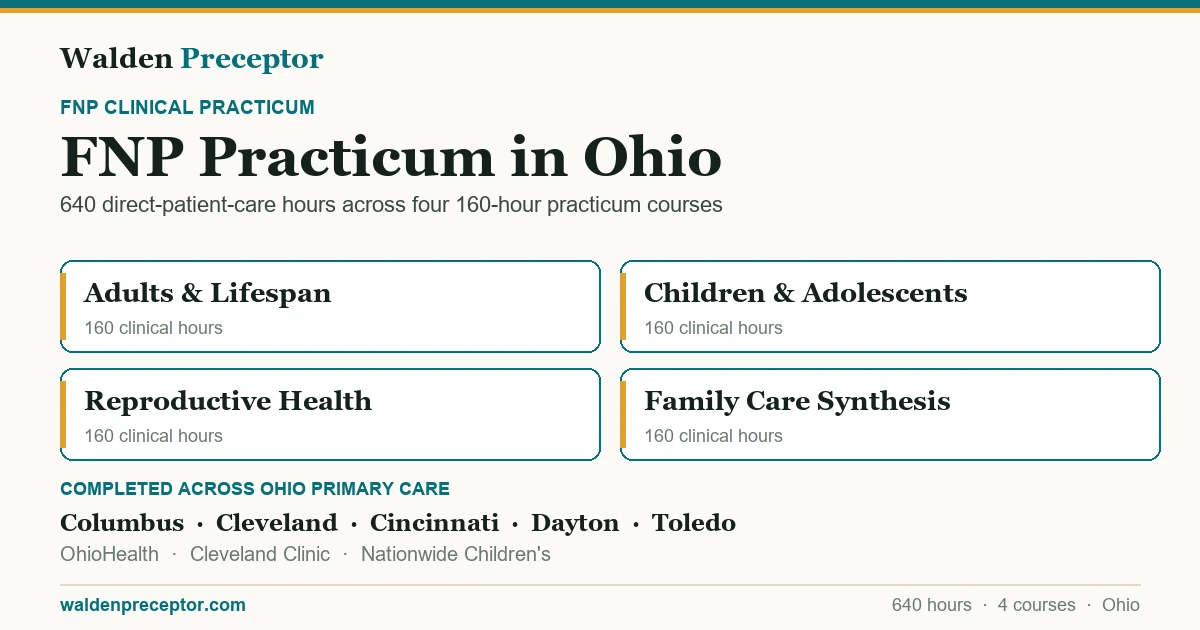
How many hours does a Walden FNP practicum require in Ohio?
Begin with the figure Ohio does not touch. The Walden MSN Family Nurse Practitioner specialization is built on 640 total practicum hours, divided evenly into four practicum courses of 160 hours each, all direct patient care (Walden Practicum Manual, MSN requirements). You complete those hours in your own Ohio community while the coursework stays online. Ohio neither raises nor lowers the count, and the one Walden exception, 750 hours for residents licensing in Kansas, has no bearing here. Each of the four courses also closes on its own clock, so hitting 640 hours in Ohio is rarely the obstacle; sequencing them across an FNP-qualified preceptor and a compliant site, course by course, is. For the full FNP breakdown beyond this state, see the Walden FNP page; for the Ohio picture across every Walden program, see the Ohio practicum page.
What does Ohio's reduced-practice status mean for an FNP preceptor relationship?
The American Association of Nurse Practitioners places Ohio in the reduced-practice category (AANP, State Practice Environment). Reduced practice sits between full practice, where a nurse practitioner evaluates, diagnoses, and prescribes without a physician agreement, and restricted practice, where career-long physician supervision is required. In Ohio a practicing certified nurse practitioner runs most of the clinical role but must maintain at least one formal physician relationship for part of care.
In Ohio that relationship is the standard care arrangement. Under Ohio Revised Code 4723.431, a certified nurse practitioner may practice only in accordance with a written standard care arrangement entered into with each collaborating physician or podiatrist, who must be licensed in Ohio and practicing in the same or a similar specialty. The Board does not pre-approve it; the nurse's employer keeps it on file, the nurse notifies the Board of the collaborating physician within 30 days of starting practice, and the parties reapprove it at least every two years (Ohio Administrative Code 4723-8-04).
Here is the distinction Walden FNP students most often get wrong, so read it plainly: the standard care arrangement is a licensure rule for a practicing nurse practitioner, not a document you sign as a student. During your practicum you work under your preceptor's authority and Walden's site approval, not your own arrangement. Reduced practice becomes your concern after you graduate, certify, and pursue prescriptive authority, which in Ohio begins with a Certificate to Prescribe externship (CTP-E), a supervised first year of prescribing before the full Certificate to Prescribe is issued. Reading Ohio correctly still helps you, because nurse-practitioner-led primary care here already pairs with collaborating physicians, which tends to make those clinics organized, multi-provider teaching sites well suited to a family practicum.
Walden FNP in Ohio, at a glance
Hours: 640 across four 160-hour FNP practicum courses. Pacing: 12 practicum hours per day maximum, at least 8 weeks per course, finished by the end of Week 10. Practice authority: reduced. Regulator: Ohio Board of Nursing. Practicing-CNP collaboration: standard care arrangement with an Ohio physician or podiatrist (a graduate licensure rule, not a student one). License check: Ohio eLicense. Practicum portal: Meditrek. Compliance: CastleBranch (myCB).
Who can precept your Walden FNP hours in Ohio?
A preceptor must hold an active Ohio license, practice in a primary care setting that matches the course's patient population, and meet Walden's published preceptor requirements. A board-certified family nurse practitioner is the most natural fit, since their panel mirrors the FNP scope; family-medicine, internal-medicine, pediatric, and women's-health physicians also precept FNP students, and several courses accept a population-matched clinician for that segment. Walden requires a 1:1 preceptor-to-student ratio for on-site direct supervision, so your preceptor cannot supervise another student on the same site at the same time.
Ohio's reduced-practice rule does not narrow that pool. A nurse practitioner who precepts you is teaching, not delegating their own practice authority, so their standard care arrangement is irrelevant to your student status. What matters is that the license is current and clean, which is why we verify every clinician on Ohio eLicense, the state's public license lookup, before your first shift. The Ohio Board of Nursing recognizes the Certified Nurse Practitioner role and issues the Certificate to Prescribe, so a fully credentialed FNP preceptor here is a known, verifiable quantity (Ohio Board of Nursing, Licensing and Certification).
Which FNP clinical settings work across Ohio?
The FNP is a primary care credential across the lifespan, so your 640 hours have to span adult-gerontology, pediatrics, and reproductive or women's health rather than one age group. The four Walden FNP courses are built around that spread: adults across the lifespan (6531), adolescents and children (6541), reproductive health (6552), and a synthesis course in family care settings (6568). Ohio has the clinic density to cover all of it, with large primary care networks in every metro and community health centers between them.
- Columbus and Dublin: deep central-Ohio primary care, strong adult and pediatric capacity
- Cleveland and Akron: dense family and internal medicine, plus Parma and Canton nearby
- Cincinnati and Dayton: community family-medicine groups and pediatric panels
- Toledo and the northwest: primary care and women's-health practices
- Federally qualified health centers: broad family panels across one site
- Rural and Appalachian Ohio: thinner capacity, so we widen the in-state search
Ohio's largest systems, including OhioHealth, the Cleveland Clinic, and Nationwide Children's in Columbus, host advanced-practice clinical experiences, and the Board has noted the state's heavy reliance on APRNs to cover primary care gaps. A single family-medicine clinic can sometimes cover most of the lifespan, but many FNP students rotate across two or three sites to hit the pediatric and women's-health courses. Inpatient and specialty-only rotations are generally a poor fit; confirm any nonstandard site with your faculty before committing hours.
How do the 12-hour cap and 8-to-10-week window shape an Ohio placement?
Walden's pacing limits matter more for FNP than for shorter tracks, because there are four courses to sequence. You can record a maximum of 12 practicum hours in a single day, each 160-hour course must be spread over no fewer than 8 weeks, and the hours are expected to be finished by the end of Week 10. At roughly two clinical days a week you sit comfortably inside that window, but an Ohio preceptor who can only host you once a week can leave you scrambling near the deadline. A placement you can reach week after week, in Columbus, Cincinnati, or wherever you live, beats a marginally stronger site two hours away you cannot attend consistently, so we confirm a preceptor's weekly capacity against the window before we match you.
What does Ohio practicum approval involve at Walden?
Once an Ohio preceptor and site are identified, the practicum runs through Walden's standard pipeline, and none of it can be skipped. Walden does not assign your preceptor: you secure your own, then nominate them in Meditrek, and the Office of Field Experience reviews the application. No practicum begins, and you cannot register for the course, until that nomination is approved (Walden, Find a Preceptor).
Nominate the Ohio site and preceptor
Submit your preceptor and clinical site in Meditrek for Office of Field Experience review and approval before any hours count toward the course.
Confirm the affiliation agreement
Your Ohio site needs a current affiliation agreement with Walden, housed in the Meditrek database, signed before practicum begins.
Clear CastleBranch compliance
Complete background check, health records, and trainings through CastleBranch (myCB). Requirements are state and site specific, and an Ohio practice may add its own onboarding items.
Verify the Ohio license
Confirm the preceptor's active RN license and CNP authorization on Ohio eLicense before the first shift.
Log and sign off hours
Track time and patient encounters in Meditrek across the 8-to-10-week window; your Ohio preceptor signs your hours and evaluations in the portal.
The most common stall for Ohio FNP students is discovering mid-program that the original site cannot supply pediatric or reproductive-health hours, then scrambling for a second preceptor while a 160-hour clock runs toward the Week-10 deadline. Planning the population coverage and the affiliation agreements at the start is what keeps the term on track.
Why FNP students struggle to find a preceptor in Ohio, and how we help
Ohio has plenty of primary care, but a willing FNP preceptor is still hard to land. The state hosts several large nurse-practitioner programs, so clinics field a steady stream of student requests and many cap how many they take a year. The FNP scope forces a lifespan spread across the four Walden courses, so an adult-only office cannot give you the pediatric or reproductive-health hours, and you are often chasing more than one site. And an Ohio preceptor only counts once Walden approves the Meditrek nomination and the affiliation agreement is signed, so an informal yes is not the finish line.
That is the gap we close. We source FNP-qualified Ohio preceptors whose panels match your four courses, verify each license on Ohio eLicense, confirm the site works for your specific Walden courses and weekly schedule, and prepare a clean Meditrek nomination for you to submit. You stay the named student on the application throughout, and your preceptor signs your hours as usual. We remove the months of cold outreach, not the legitimacy of the placement: we match preceptors who meet Walden's published requirements and prepare the nomination for Walden's own review. We never describe a preceptor or site as endorsed by Walden, and we never guarantee a placement.
Ohio FNP FAQ
How many practicum hours does a Walden FNP practicum require in Ohio?
640 direct-patient-care hours, the same as everywhere else Walden places. They are split across four practicum courses of 160 hours each. Ohio does not change that number; the state's rules govern how a nurse practitioner is licensed and collaborates after graduation, not the student hour count. Kansas residents are the one Walden exception at 750 hours, and that does not apply in Ohio.
Does Ohio's reduced-practice status change who can precept my Walden FNP hours?
No. Ohio's reduced-practice classification and the standard care arrangement under ORC 4723.431 bind a practicing, licensed certified nurse practitioner, not a student. For your Walden practicum you need an FNP-qualified preceptor whose primary care panel matches your course, a site with an affiliation agreement, and an approved Meditrek application before hours count.
Can an Ohio nurse practitioner precept a Walden FNP student?
Yes. A certified nurse practitioner licensed in Ohio who practices in primary care and meets Walden's published preceptor requirements can precept your FNP hours. Family-medicine and internal-medicine physicians, and in some courses a population-matched clinician, also qualify. We verify every preceptor's license on Ohio eLicense before your first day.
How does the 12-hours-a-day and 8-to-10-week pacing work for an Ohio FNP placement?
Walden caps practicum at 12 hours in a single day, requires each 160-hour course to span at least 8 weeks, and expects the hours finished by the end of Week 10. In practice an Ohio FNP student needs a preceptor who can host roughly two clinical days a week to stay inside that window, which is why we confirm schedule capacity before we match you.
Which Ohio cities can host a Walden FNP practicum?
We place across Columbus and Dublin, Cleveland and Akron, Cincinnati and Dayton, Toledo, Canton, and Youngstown, plus smaller and Appalachian communities. Ohio's large primary care networks supply family-medicine, pediatric, and women's-health capacity across the four FNP courses; where local capacity is thin, we widen the search within the state.
Sources
- Walden University, MSN Practicum Requirements (640 hours, four 160-hour courses, Kansas exception)
- Walden University, Find a Preceptor (student responsibility, Meditrek nomination)
- AANP, State Practice Environment (Ohio: reduced)
- Ohio Revised Code 4723.431, standard care arrangement
- Ohio Administrative Code 4723-8-04 (standard care arrangement rule, two-year reapproval)
- Ohio Board of Nursing, Licensing and Certification
- Ohio eLicense, License Look-Up
Get a Walden FNP preceptor in Ohio
You now have the Ohio FNP picture: 640 hours across four 160-hour courses, a primary care preceptor who meets Walden's published requirements, a reduced-practice state where the standard care arrangement is a graduate rule rather than a student one, and a placement Walden leaves to you. We close that gap, sourcing a verified Ohio FNP preceptor, mapping the population coverage to your four courses, and preparing your Meditrek nomination, with no payment until you are matched.
- Verified Ohio FNP preceptor sourced to meet Walden's published requirements
- Primary care panels mapped to all four FNP courses across the lifespan
- Meditrek nomination, affiliation agreement, and eLicense check prepared; no payment until matched
Ready to lock in your Ohio FNP preceptor?
Tell us your next FNP course, your Ohio city, and your weekly schedule. We will map your 640 hours across the four courses and start matching, no payment until you have a confirmed placement.
Book a free consult